Partnerships
The Russian Railway Museum announces the results of the young inventors’ competition
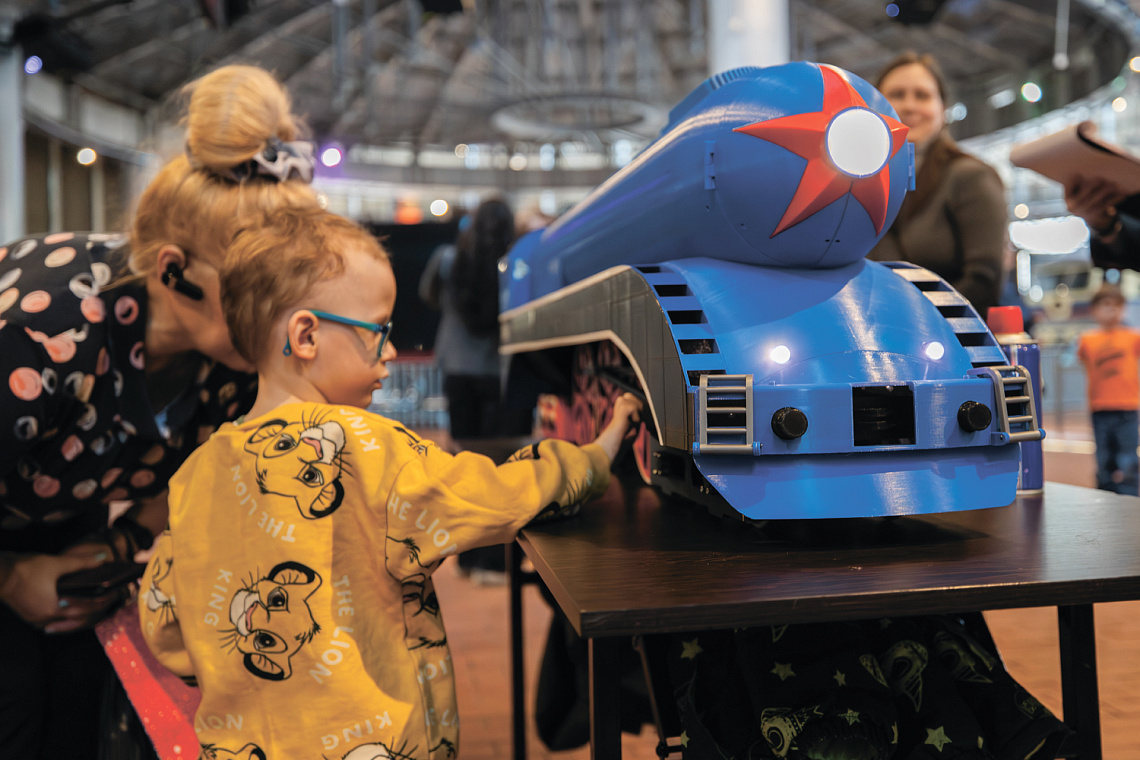
On Wednesday, March 11, 2026, the Russian Railway Museum hosted the final of the Second City Competition “Open Steam-Locomotive Races: Revival Two Centuries Later,” organized by the Academy of Technical Creativity and Digital Technologies.
On Wednesday, March 11, 2026, the Russian Railway Museum hosted the final of the Second City Competition “Open Steam-Locomotive Races: Revival Two Centuries Later,” organized by the Academy of Technical Creativity and Digital Technologies.
Children and young people aged 10 to 20 from St. Petersburg and the Leningrad Region took part. Any type of locomotive was eligible. There were only two requirements: participants could not use ready-made assembly kits, and the parts had to be created using 3D printing. Developing and building the locomotives took four months. Three projects were presented in the final.
Vladimir Odintsov, Director of the Russian Railway Museum, and Valeria Zotova, Director of the Academy of Technical Creativity and Digital Technologies, addressed the participants with welcoming remarks. The projects were then evaluated by an expert jury according to technical, visual, and speed criteria.
The project featuring a Class 2-3-2 steam locomotive by Konstantin Polevoy won the speed and engineering categories. Maxim Rudenko and Andrey Kotik took second place in the speed category with their project of a Cherepanov steam locomotive. Yulia Orlova won a special category with a composite image of a Soviet steam locomotive.
“We were delighted to see young engineers who are just beginning their journey into research and technical creativity. In 2026, we celebrate the 175th anniversary of the St. Petersburg–Moscow main line. To mark the anniversary, the competition’s theme was expanded, and we saw new and interesting locomotives. On the way to the final, the participants visited our museum, became acquainted with outstanding achievements of the past, and studied the designs of legendary machines,” said Vladimir Odintsov, Director of the Russian Railway Museum.
“Each competition project is a unique engineering work by its creators. These are accurate copies of real locomotives and steam locomotives that operated on the Oktyabrskaya Railway in different years. The responsibility with which the participants approached their projects is truly inspiring. They thought through everything—the engineering solution, the mechanics, and the ‘smart’ systems of their trains,” emphasized Valeria Zotova, Director of the Academy.
The competition was organized by the Academy of Digital Technologies, a modern educational platform that enables schoolchildren to gain current skills in IT, robotics, digital manufacturing, media communications, and economics. The final took place at the Russian Railway Museum, Russia’s largest railway museum, whose exhibitions tell the story of the past, present, and future of our country’s railways.
Начало мероприятия:
03/12/2026 12:00:00 am
Окончание мероприятия:
03/12/2026 11:59:59 pm
Галерея фото:
Download / Download
Mnemonic code:
final-konkursa-unyh-izobretatelej-sostoalsa-v-muzee-zeleznyh-dorog-rossii-2026
Code in external DB source:
museum-news-905c82e736fbea95801ff41fe9f3505c15be92ae8d3fee8016bfe231ddab7c2a
Name:
The Russian Railway Museum announces the results of the young inventors’ competition
Preview image:
Download
Detailed image:
Download
Detailed description:
On Wednesday, March 11, 2026, the Russian Railway Museum hosted the final of the Second City Competition “Open Steam-Locomotive Races: Revival Two Centuries Later,” organized by the Academy of Technical Creativity and Digital Technologies.
Children and young people aged 10 to 20 from St. Petersburg and the Leningrad Region took part. Any type of locomotive was eligible. There were only two requirements: participants could not use ready-made assembly kits, and the parts had to be created using 3D printing. Developing and building the locomotives took four months. Three projects were presented in the final.
Vladimir Odintsov, Director of the Russian Railway Museum, and Valeria Zotova, Director of the Academy of Technical Creativity and Digital Technologies, addressed the participants with welcoming remarks. The projects were then evaluated by an expert jury according to technical, visual, and speed criteria.
The project featuring a Class 2-3-2 steam locomotive by Konstantin Polevoy won the speed and engineering categories. Maxim Rudenko and Andrey Kotik took second place in the speed category with their project of a Cherepanov steam locomotive. Yulia Orlova won a special category with a composite image of a Soviet steam locomotive.
“We were delighted to see young engineers who are just beginning their journey into research and technical creativity. In 2026, we celebrate the 175th anniversary of the St. Petersburg–Moscow main line. To mark the anniversary, the competition’s theme was expanded, and we saw new and interesting locomotives. On the way to the final, the participants visited our museum, became acquainted with outstanding achievements of the past, and studied the designs of legendary machines,” said Vladimir Odintsov, Director of the Russian Railway Museum.
“Each competition project is a unique engineering work by its creators. These are accurate copies of real locomotives and steam locomotives that operated on the Oktyabrskaya Railway in different years. The responsibility with which the participants approached their projects is truly inspiring. They thought through everything—the engineering solution, the mechanics, and the ‘smart’ systems of their trains,” emphasized Valeria Zotova, Director of the Academy.
The competition was organized by the Academy of Digital Technologies, a modern educational platform that enables schoolchildren to gain current skills in IT, robotics, digital manufacturing, media communications, and economics. The final took place at the Russian Railway Museum, Russia’s largest railway museum, whose exhibitions tell the story of the past, present, and future of our country’s railways.