Today the museum is closed

Map

Exhibit description

DC Freight Electric Locomotive SSM 14

Work on the electrification of domestic railways in the USSR began in the late 1920s and early 1930s. One of the first sections to be converted to electric traction was the Khashuri–Zestaponi section of the South Caucasus Railway in 1932. This line passed through mountainous terrain via the Surami Pass, featuring very steep gradients of up to 29‰ and curves with a radius of up to 150 m. The use of electric traction was particularly effective in these challenging conditions.

A section of the South Caucasus Railway was one of the first to be converted to electric traction in 1932.

Following that, the Kizel–Chusovskaya mountain section of the Perm Railway, which had gradients of up to 15‰, was electrified in the Urals. In both cases, direct current with a nominal voltage in the contact network of 3000 V was adopted as the current system.

In order to quickly adopt electric traction, a decision was made to adopt foreign experience. As a result, orders were placed with foreign companies for the production of two batches of DC electric locomotives, to eventually master the production of similar locomotives domestically. Between 1932 and 1934, the USSR received electric locomotives of the class S series (eight units built by the American company General Electric) and the class SI (six units built by the Italian company Brown Boveri). These locomotives were tested and operated at the Surami Pass.


Due to the fact that the American-made class S electric locomotives were deemed more suitable for domestic conditions, they were used as prototypes for the production of similar locomotives in the USSR.

Based on technical documentation received from General Electric, the USSR began producing DC electric locomotives, which received the SS designation. Initially, they were designated as SS 11, where the number indicated the axial load in tonnes. The letter “S” in the names of all the above-mentioned electric locomotives stood for “Surami”, and the designation SS specified them as “Surami Soviet”.

These locomotives that feature specific design characteristics such as regenerative braking and unique undercarriage features, belong to the family of electric locomotives known as the Surami type.

The SS locomotives had specific design characteristics, including regenerative braking and unique undercarriage features.

In 1932–1934, through the joint efforts of two Soviet plants—Kolomna Locomotive Works, manufacturing the undercarriage, and Dynamo, manufacturing and installing electrical equipment—a total of 21 DC electric locomotives of the class SS<11 series, No.01–21, were built. These locomotives were no longer produced afterwards, as by that time, mass production of what were considered more advanced electric locomotives of the class VL19 had been established.

Modernisation of the SS

The SS was a single-section, six-axle freight electric locomotive designed for freight traffic. Two three-axle trucks with bar-type frames were connected to one another via a special articulated connector. The body of the electric locomotive had a frame structure with platforms on each side, allowing entry into the control cab.


The traction electric motors, DPE-340, with a continuous rating of 300 kW featured a support-axle suspension. The traction gearbox had a gear ratio of 89 ÷ 20 = 4.45. The power electrical circuit provided three types of traction motor connections: series, series-parallel, and parallel. In the future, this design would become a staple of Soviet freight DC electric locomotives

Most of the SS< series electric locomotives were delivered directly to the Chusovskaya Depot of the Perm Railway, where they were initially used on the Chusovskaya–Kizel line. Later, they were deployed on other electrified sections of the railway, which eventually became part of the Sverdlovsk Railway.


In the 1950s, some of these locomotives underwent modernisation of their electrical equipment, incorporating machines and devices used on the VL22М electric locomotives. After this upgrade, they were re-designated as SSМ. The operation of these locomotives ended in 1968–1974.

In the 1950s, some of these electric locomotives underwent electrical equipment modernisation, after which they were designated as SSМ.

The SS11 14 electric locomotive (SSМ 14 after modernisation) was built in 1933 both at the Kolomna Locomotive Works and Dynamo Plant. By the end of its service life, it had one truck from the S electric locomotive built by General Electric and the other from the VL19 electric locomotive. In the 1980s, it was transferred from the Perm-2 Depot of the Sverdlovsk Railway to the collection of the Central Museum of Railway Transport.

Parameters

Technical
specifications

Factories
Kolomensky, Dynamo
The serial numbe
Unknown
Years of manufacture
1932–1934
Number of built, units
21
Nominal contact line voltage, V
3 000
Axial characteristic
3О+3О
Continuous power, kW
1,800
Continuous traction force, kgf
20,500
Design speed, km/h
70
Service mass, t
132
Type of current
Constant
Electric brake
Recuperative
Traction motor type
DPE-340
Axial gear ratio
4,45
Battery type
ETP-63
Type of pantograph
DJ-4
Wheel diameter, mm
1 200
Service mass, t
132
Axle load on rails, ts
22
Clock mode parameters
Power, kW
2,040
Speed, km/h
30.5
Traction force, kgs
24 000
Continuous speed, km/h
32
Length by buffers, mm
16 480
Body width, mm
3 070
Body height, mm
4 825
Wheelbase of the trolley, mm
4 200
Smallest radius of traversable curves, m
75

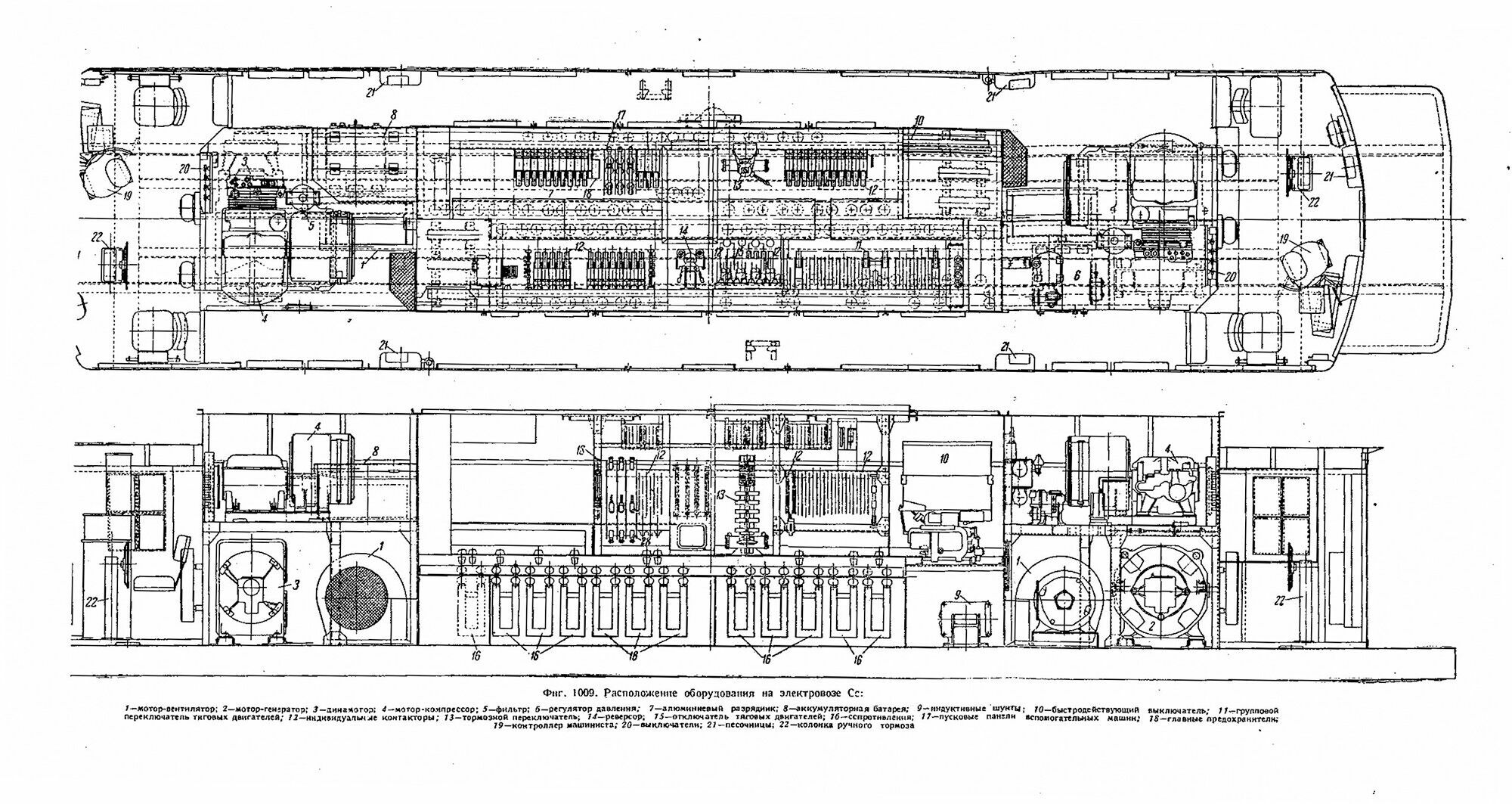
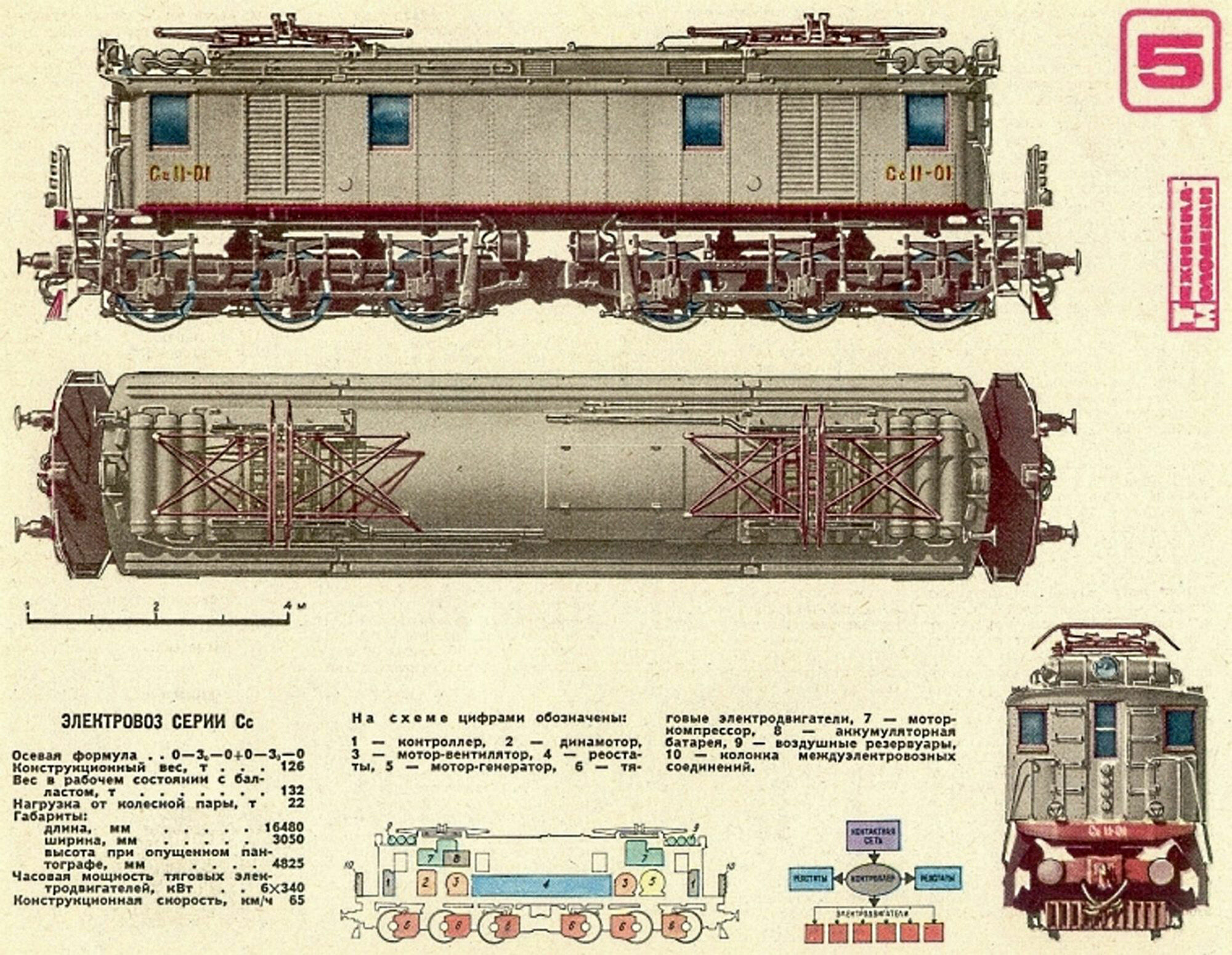
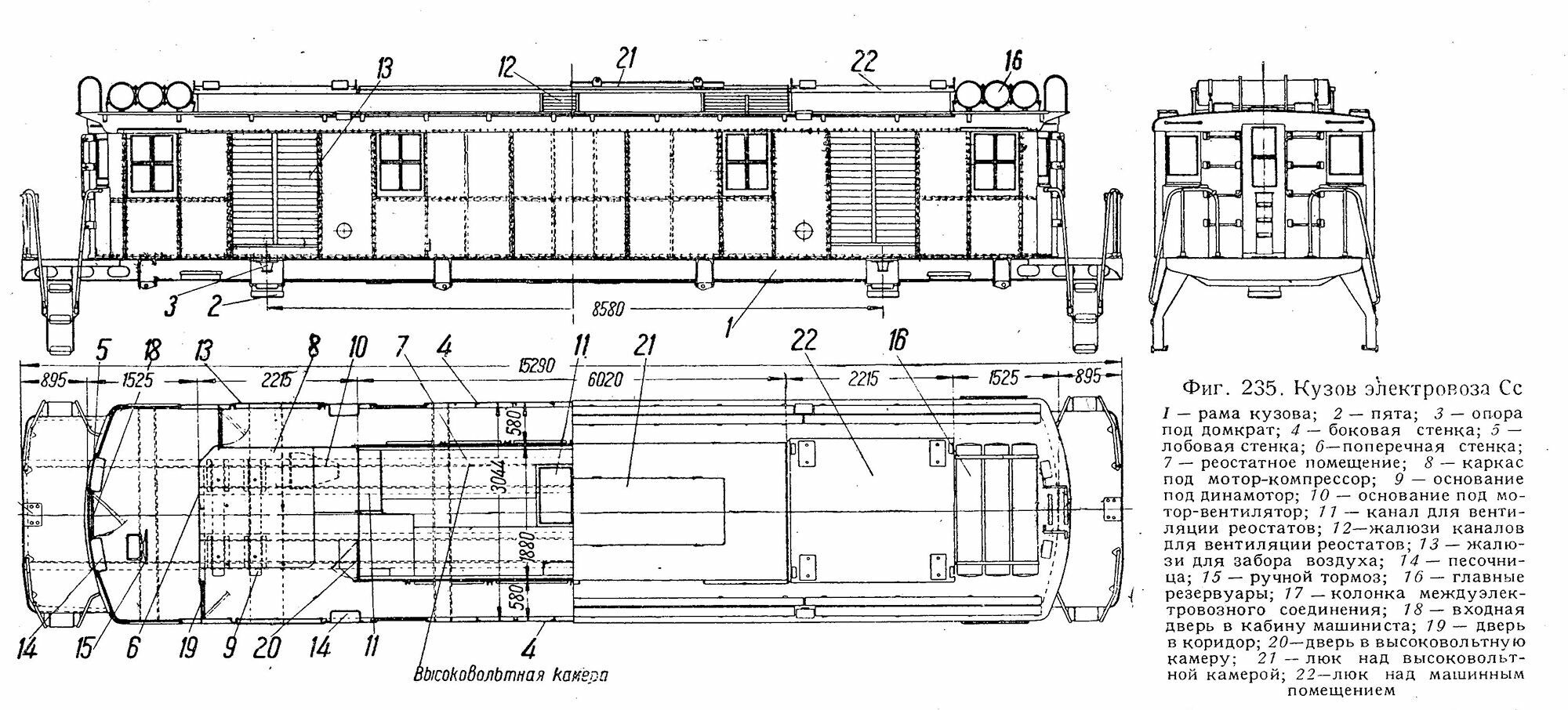
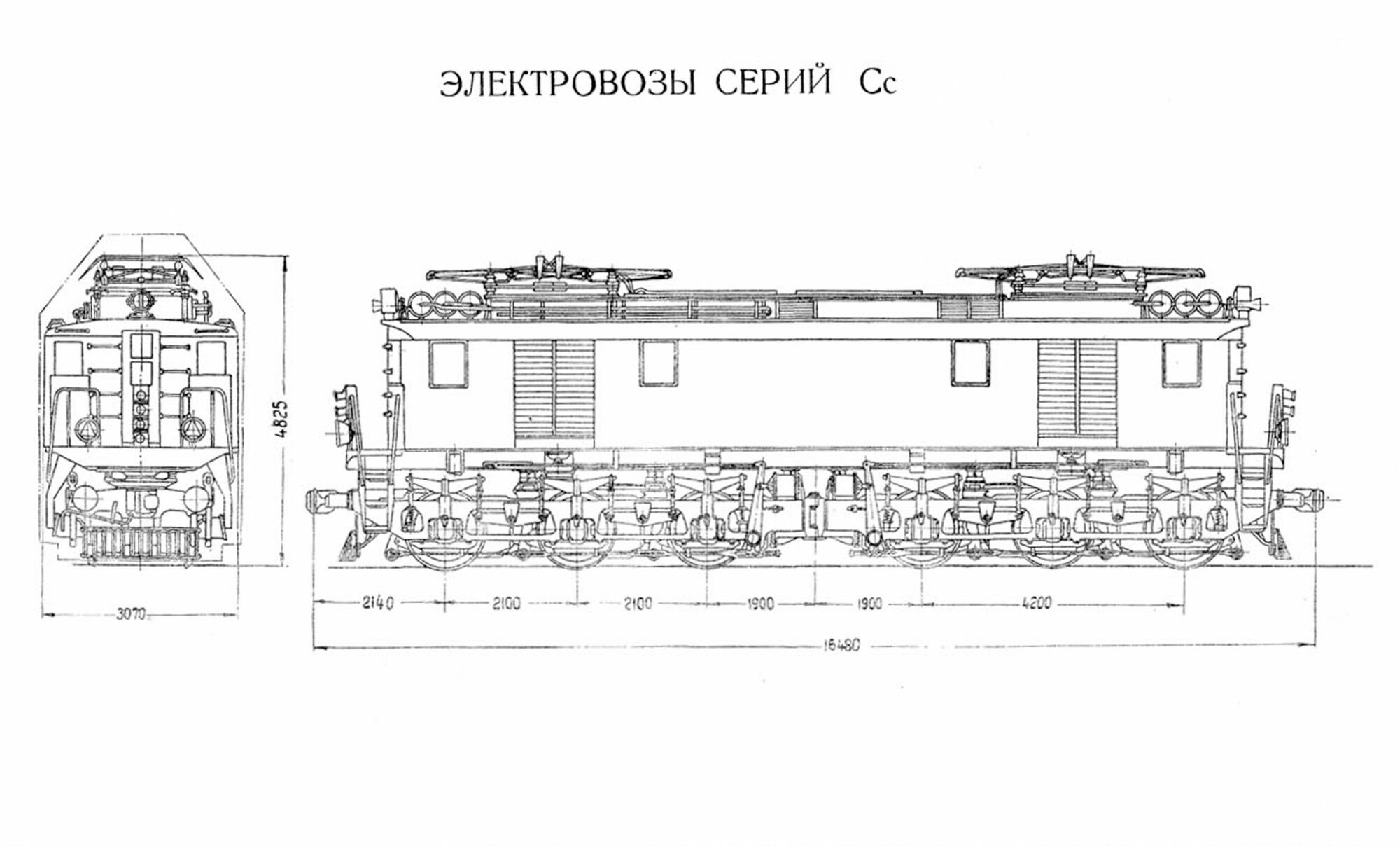
Drawings
and diagrams

History

Chronology

  1. 1932 A section of the South Caucasus Railway was one of the first to be converted to electric traction.
  2. 1932–1934 Class S electric locomotives (eight units built by the American company General Electric) arrived in the USSR.
  3. 1932–1934 Through the joint efforts of two Soviet plants—Kolomna and Dynamo—21 DC electric locomotives of the class SS11 were built.
  4. 1933 The SS 11 14 electric locomotive was built (after modernisation it was designated as SSМ 14).
  5. 1950s On some of SS electric locomotives, the electrical equipment was modernised (hardware and devices used on the VL22М electric locomotives were installed), after which they received the designation SSМ.
  6. 1968–1974 The SSМ locomotives were withdrawn from service.
  7. 1980s The SSМ 14 electric locomotive was transferred from the Perm-2 Depot of the Sverdlovsk Railway to the collection of the Central Museum of Railway Transport.