Today the museum is closed

Map

Exhibit description

Passenger diesel locomotive TEP70-0007

Pilot lot

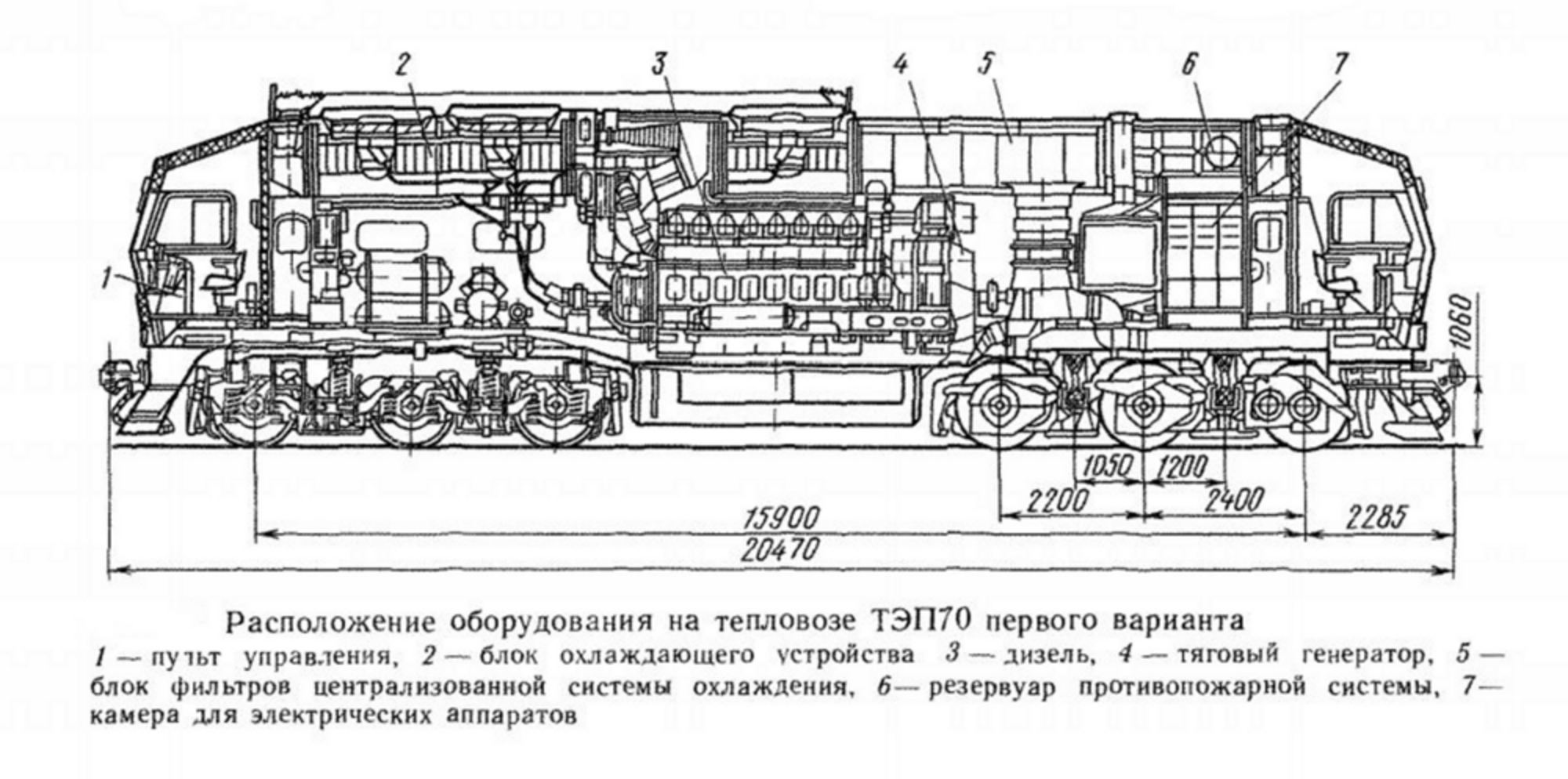
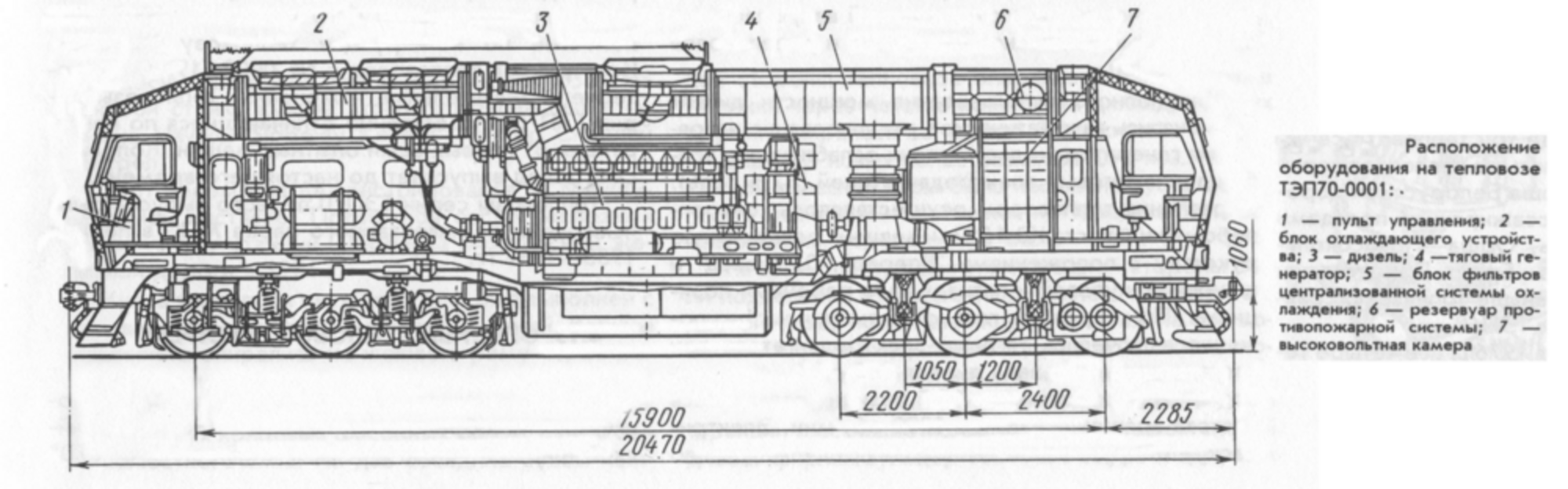
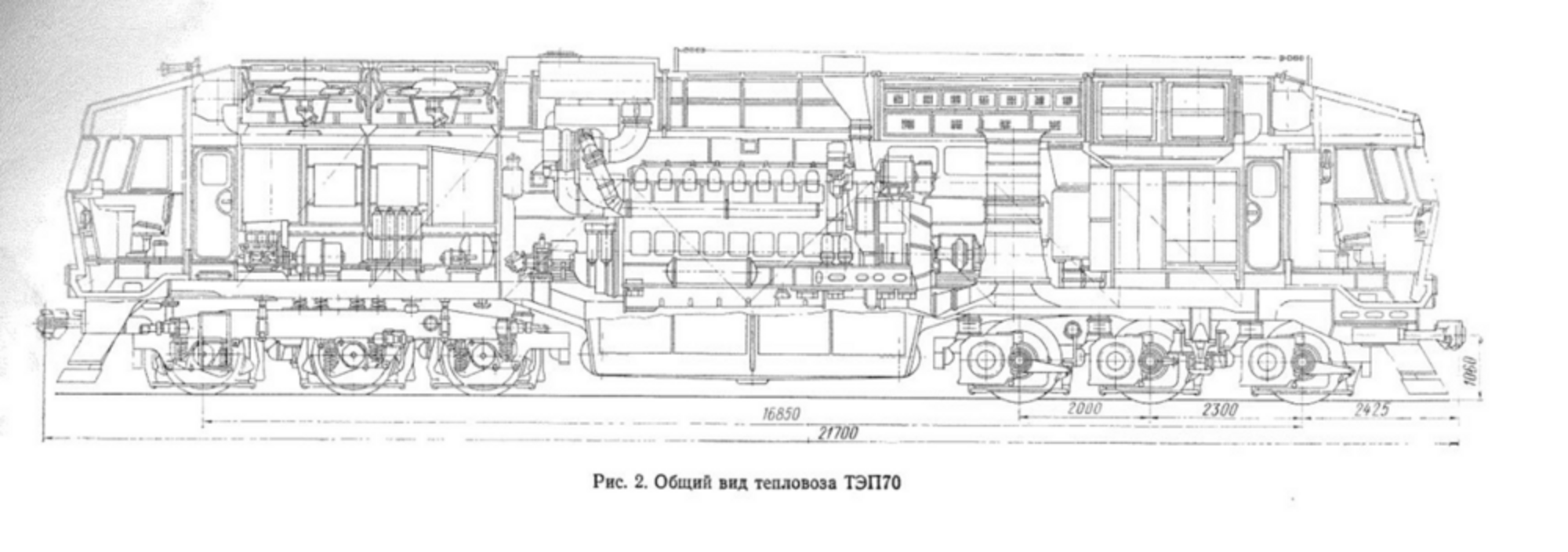
In 1973–1978 the Kolomna plant produced a pilot lot of seven TEP70 series diesel locomotives, No. 0001–0007. They used a dense arrangement of equipment with roof-mounted cooling device blocks, one of which was located directly above the diesel engine.

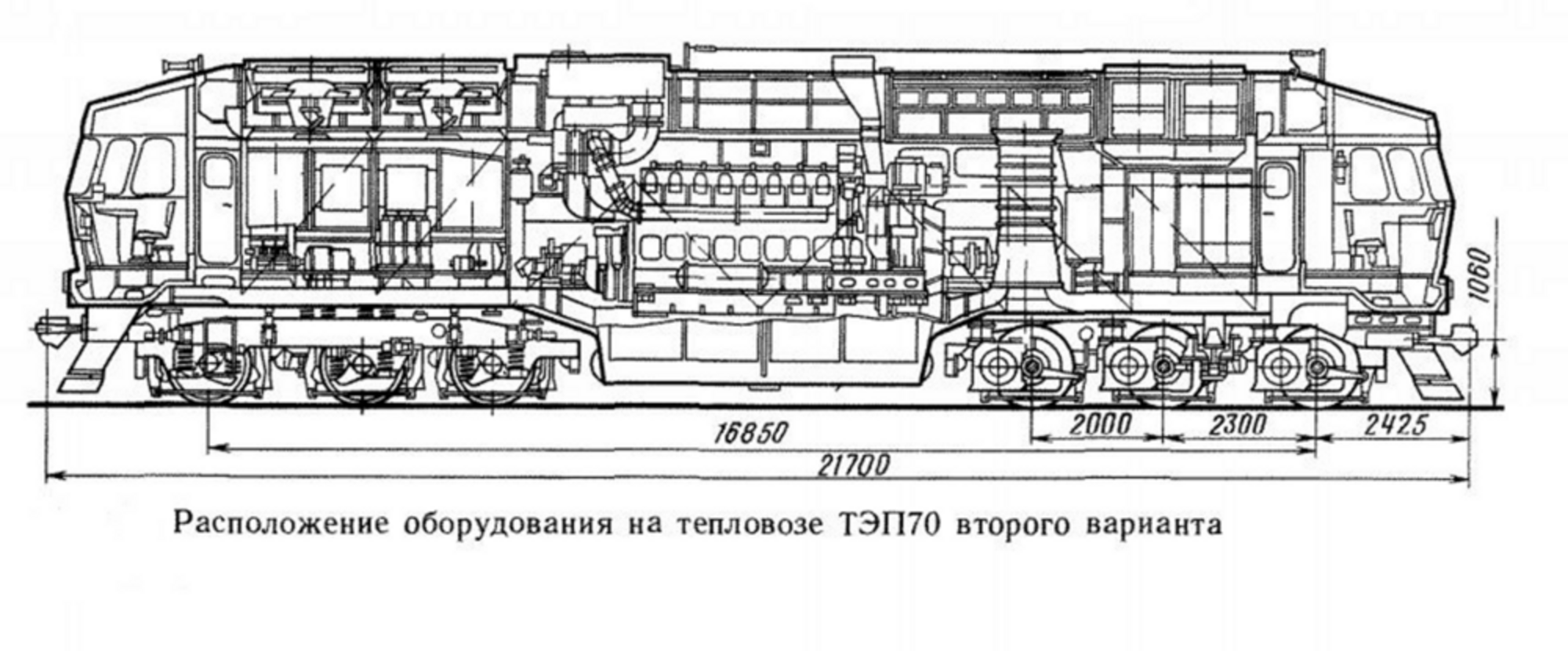
After testing, the plant significantly redesigned the locomotive design. Due to the low reliability of the D49 diesel engines of the first years of production, it was necessary to remove cylinder sets quite often, which turned out to be labor-intensive. Because of this, on subsequent TEP70 series diesel locomotives, instead of a refrigerator with roof-mounted blocks, a more traditional cooling device design was used. The entire locomotive body was redesigned, the length of which increased by almost one and a half meters.

The undercarriage of the locomotive was significantly changed: if the experimental TEP70s were equipped with bogies that were generally similar to those used on the TEP60, then later on new locomotives were equipped with a design with one-way torque transmission using a cardan shaft connected to the gear wheel by elastic couplings. As a result, the TEP70 diesel locomotives from No. 0008 onwards differed significantly from the first seven experimental machines of this series.

In the 1980s TEP70 diesel locomotives were delivered from the factory to the Alma-Ata, Belarusian, Central Asian, October, Baltic and Southern railways. In the early 2000s they were mainly shipped from construction to the Volga, Sverdlovsk, Northern, Moscow and South-Eastern, as well as to the Kaliningrad, Gorky and Far Eastern railways.

Museum specimen

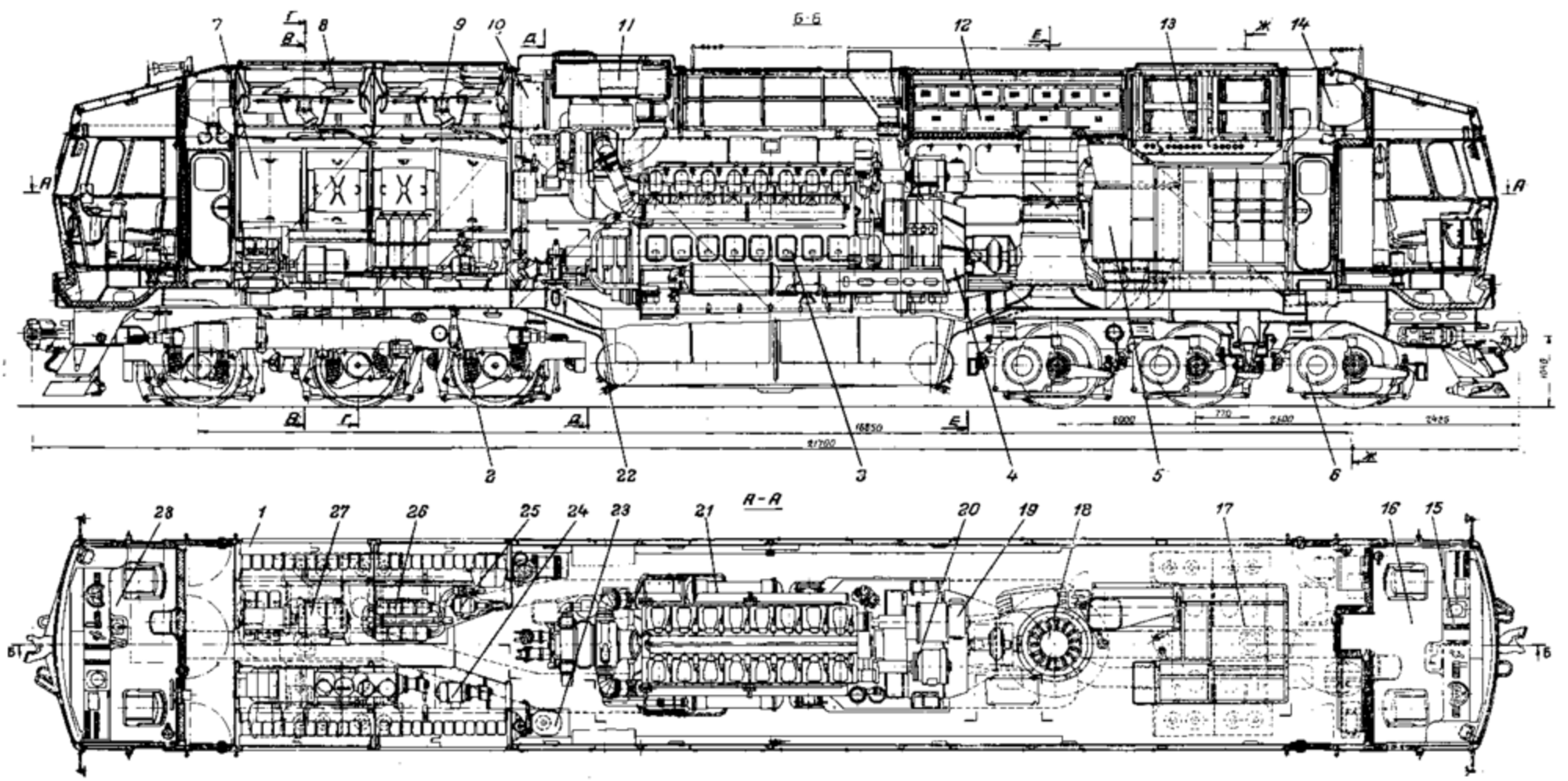
The TEP70-0007 diesel locomotive presented in the museum, factory number 1740, was built in 1977 as part of an experimental batch. After testing in the late 1970s on the Belarusian Railway, this locomotive, being an experimental model, did not work in passenger traffic. In 1982 it was transferred to the track service of the October Railway, where it was used for various economic work for a long time. It entered the museum from the track machine station PMS-28 Gory of the October Railway in 1994

The development of diesel engine manufacturing was moving towards the creation of four-stroke engines, which were more advanced and economical than two-stroke engines. One of the main developers of the new engines was the Kolomna Diesel Locomotive Plant named after V. V. Kuibyshev. They created a line of four-stroke 16- and 20-cylinder turbocharged engines of the ChN26/26 type with a capacity of 3,000 to 6,000 hp.

According to the new assignment from the Ministry of Railways, the plant was to create a passenger diesel locomotive with an axle arrangement of 3₀-3₀, that is, three leading axles in each bogie. It was to be equipped with a diesel engine with a capacity of 4,000 hp and have a design speed of 160 km/h.

The TEP70-0005 diesel locomotive also passed thermal engineering tests on the test ring of the All-Union Scientific Research Institute of Railway Transport (VNIIZhT) and dynamic tests on the Belorechenskaya — Maykop section of the North Caucasian Railway. The locomotives were used to test a new type of electric transmission, control and regulation systems, power and auxiliary equipment.

Parameters

Technical
specifications

Length, mm
21,700
Height, mm
4,975
Width, mm
3,086
Axle arrangement
3о-3о
Continuous speed, km/h
50 (traction force 167 kN/170,000 kgf)
Maximum speed, km/h
160 (traction force 58.8 kN/6,000 kgf)
Minimum radius of curves, m
125
Weight with 2/3 fuel and sand capacity, t
129
Load from wheelset on rail, tf
21.5
Fuel capacity, kg
6,000
Sand capacity, kg
800
Water capacity, kg
1,480
Number of cylinders
4
Diesel generator
2A-9DG (6-cylinder 2A-5D49)
Location cylinders
V-shaped
Traction generator
GS-504A
Cylinder diameter, mm
260
Piston stroke, mm
260
Rated engine power at 1,000 rpm, hp
4,000
Specific fuel consumption at power
153–160 g/(hp h)
Weight of dry diesel with frame, kg
18,500
Weight of diesel generator, kg
26,000
Power of traction generator, kW
2,750
Line voltage in continuous mode, V
360
Maximum line voltage, V
580
Nominal current frequency at 1,000 rpm, Hz
100
Weight of generator, kg
6,500
Exciter
VS-650
Auxiliary starter-generator
STG-7
Traction electric motors
ED-119
Nominal power of electric motors, kW
411
Voltage in continuous mode, kW
512
Maximum voltage, kW
750
Continuous current, A
880
Current at maximum voltage, A
600
Anchor speed, rpm
657 (max. 2,320)
Electric motor weight, kg
3,250

Drawings
and diagrams

History

Chronology

  1. 1972–1973 Such a diesel locomotive was designed during 1972–1973. It was assigned the TEP-70 series — a diesel locomotive with electric transmission, passenger, 1970s.
  2. 1979 Starting with diesel locomotive No. 0008, built in 1979, the design underwent significant changes — even their appearance began to differ greatly.
  3. 1982 The diesel locomotives differed significantly from serial machines, which complicated their repair. Therefore, they worked with passenger trains for a very short time — until 1982.
  4. 1982 After testing, TEP70-0007 did not operate in passenger traffic, and in 1982 it was transferred to the Track Service of the October Railway, where it was used for service work. Entered the museum from the track machine station PMS-28 Gory of the October Railway in 1994.
  5. 1986 Subsequently, diesel locomotive #0001 was sold in 1986 to the Lubny Paint and Varnish Factory (Southern Railway), where it was used as a power plant. Diesel locomotives 0004–0007 were transferred to the October Railway to the Reshetnikovo (OPMS-1) and Gory (PMS-28) track machine stations to haul service trains, where they were not subject to high operational loads. In the 1990s, all diesel locomotives with numbers 0001–0006 were written off and cut up for scrap metal.