Today the museum is closed

Map

Exhibit description

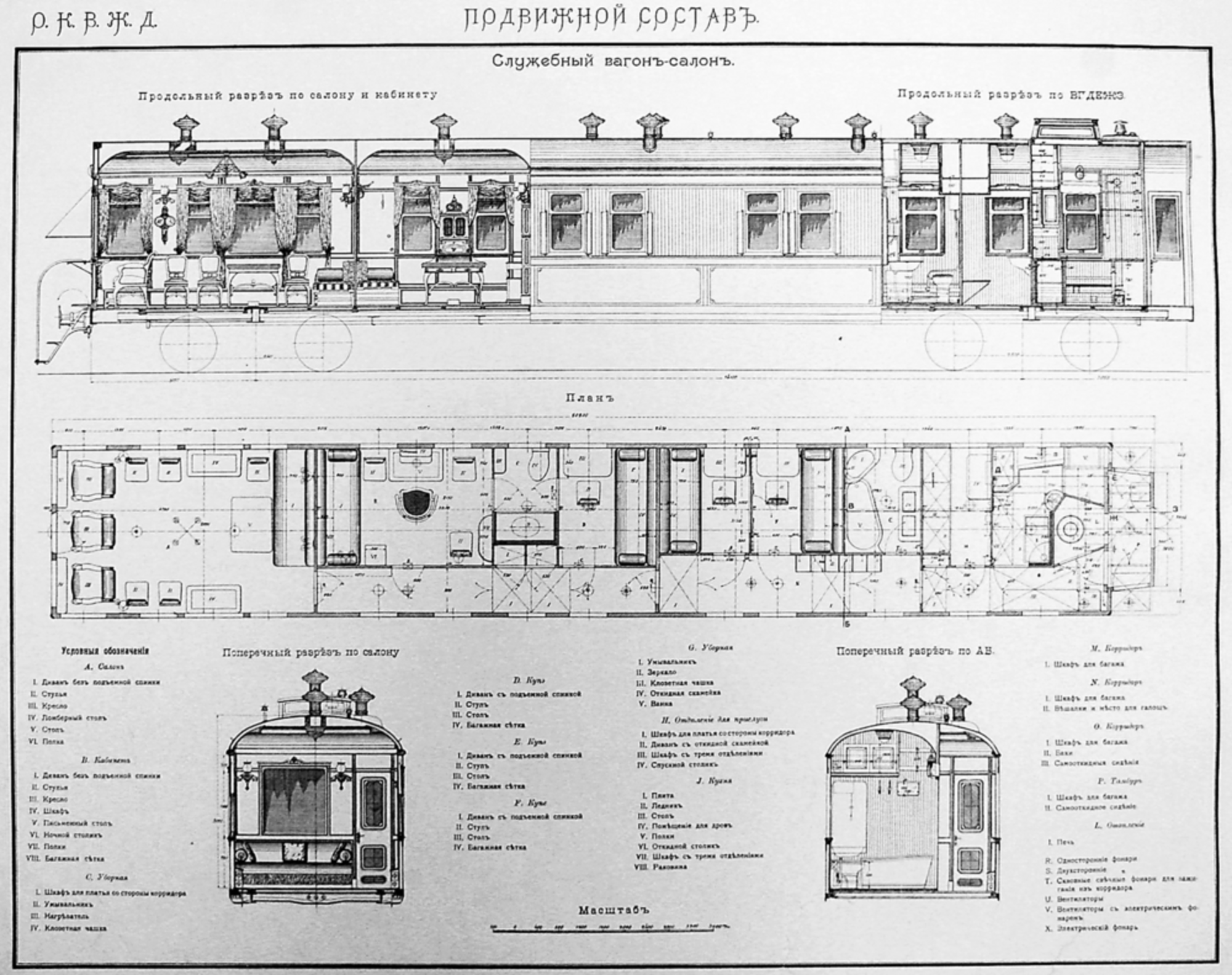
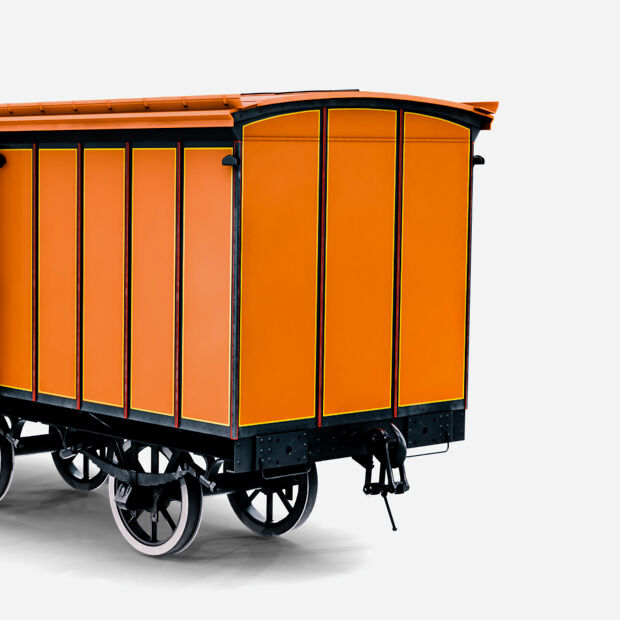
Service Palace Car No. 3 of the Chinese Eastern Railway

The car was built at the Russo-Baltic Wagon Factory in Riga for the private Chinese Eastern Railway (CER) around 1902. It features a Polonceau-type body structure with load-bearing lower half-walls in the form of trusses made from thick iron sheets, which is why carriages of this type were sometimes referred to as  “armored”.

In 1903, the Chinese Eastern Railway was put into operation.

The CER had a remarkable history. It was constructed on Chinese territory at the end of the 19th century, initiated by Russia, and operated as a joint-stock company established by the Russo-Asiatic Bank with both Russian and Chinese capital. The road manager was General D.L.  Horvath. The railway was put into operation in 1903. During the Russo-Japanese War of 1904–1905, it was in the combat zone.

Political Chaos

After the Xinhai Revolution in China, the status of the railway remained unchanged, but the subsequent civil war led to the de facto autonomy of the Three Eastern Provinces (Manchuria), through which the CER passed.

In 1918, a new Board was established in Harbin, replacing the Railway Board in Petrograd, where the Bolsheviks were in power. This new Board was headed by General D.L. Horvath. Engineer V.D. Lachinov became the Road Manager. From 1919, the road was managed by the Inter-Union Railway Committee, which operated until 1922 but was unable to ensure the proper functioning of the CER. In the autumn of 1920, the government of the Republic of China reached an agreement with the Russo-Asiatic Bank to jointly manage the railway. In 1920, Engineer D.P. Kazakevich became the Manager of the CER, followed by B.V. Ostroumov in 1921.

In 1924, after several years of Soviet-Chinese negotiations, the government of the Republic of China officially recognized the USSR’s rights to the CER. Since the central government in Beijing did not control the provinces through which the railway passed at that time, an additional agreement was made in 1924 between the USSR and the government of the Autonomous Three Eastern Provinces of the Republic of China. A Board headed by Bao Guiqing was established with an equal number of members from both the USSR and the Republic of China. A.I. Ivanov was appointed as the Manager, but in 1926, he was replaced by A.I. Emshanov.

In 1924, control over the CER was passed to the Soviet Union.

A series of conflicts and provocations culminated in 1929 with the so-called “Conflict on the CER”, which led to military action between Soviet and Chinese troops, involving aircraft and tanks. In 1931, the Japanese army invaded the Three Eastern Provinces. In 1932, the state of Manchuria was established on this territory, which came under Japanese control.

Negotiations soon began over the purchase by Manchukuo of the rights to the CER, culminating in 1935 with the sale of these rights by the USSR. From 1935 to 1945, the railway was known as the North Manchuria Railway. Although it was officially operated by Manchukuo, in reality, it was under the control of the Japanese occupiers. The Japanese Engineer Sahara was appointed as the Railway Manager.

After Japan's invasion of Manchuria, the Soviet Union sold the rights to the CER.

In 1945, Chinese and Soviet troops forced the Japanese Kwantung Army and Songhua Flotilla to surrender, restoring the rule of the Republic of China in the Three Eastern Provinces. The railway, which was renamed the Chinese Changchun Railway, suffered significant damage during the combat operations.

After the war, the USSR regained control over the CER, but in 1952 transferred the rights to the People's Republic of China.

Despite the Three Eastern Provinces becoming a battlefield in the renewed civil war from 1946 to 1948, the Chinese Changchun Railway was restored with the assistance of the USSR. In 1952, the Soviet leadership transferred the rights to the railway to the People’s Republic of China.

Throughout these turbulent times, the palace car was used for official trips by the management of the CER, including the railway’s directors, as well as by military and civil authorities along the route. It is highly likely that the car was used by notable figures such as General A.N. Kuropatkin, General D.L. Horvath, Chief Inspector of the Security Guard and CER Board Member Admiral A.V. Kolchak, the ruler of the Three Eastern Provinces Marshal Zhang Zuolin and his son Marshal Zhang Xueliang, Marshal Baron Muto Nobuyoshi, Emperor of Manchukuo Puyi, and the last commander of the Japanese Kwantung Army General Otozo Yamada.

During the Chinese Civil War (1945–1949), the car was transferred from the Chinese Changchun Railway to the USSR, where it continued to be used by party and railway leaders. Over the years, it was re-equipped several times to meet the preferences of its successive owners.

The car was restored during repair work carried out in 2007, returning it to its original appearance with a few exceptions. Notably, the later trucks on roller bearings, later coupling and absorption devices, and enlarged windows in the end wall were preserved. The enlargement of the windows occurred before the car was transferred to the USSR.

Parameters

Technical
specifications

Year of construction
1902
Number of axes
4
Body length with vestibule, m
20 200
Tara, t
50
Body, system
Carrier, Polonceau
Distance between centers of pivot beams, m
14 100
Heating type
Water autonomous
Lighting type
Electric, candle

Drawings
and diagrams

History

Chronology

  1. 1902 The palace car was built at the Russo-Baltic Wagon Factory in Riga for the private Chinese Eastern Railway (CER).
  2. 1903 The CER was put into operation.
  3. Autumn 1920 The Government of the Republic of China reached an agreement with the Russo-Asiatic Bank to jointly manage the railway.
  4. 1924 After several years of Soviet-Chinese negotiations, the government of the Republic of China officially recognized the USSR’s rights to the CER.
  5. 1935–1945 The CER was called the North Manchuria Railway and was formally operated by Manchukuo.
  6. 1945 Chinese and Soviet troops forced the Japanese Kwantung Army and Songhua Flotilla to surrender, restoring the rule of the Republic of China in the Three Eastern Provinces.
  7. 1945–1949 The palace car was moved from the Chinese Changchun Railway to the USSR, where it was used by party and railway leaders.
  8. 1995 The palace car was brought to the Russian Railway Museum in Saint Petersburg.
  9. 2007 The palace car was restored during repair work.