Today the museum is closed

Map

Exhibit description

Freight Steam Locomotive LV18 002

In 1948, the Ministry of Railways decided to upgrade the class L steam locomotives: this class had no remaining capacity for additional weight. This meant that upgraded thermal devices (Bryansk-Locomotive-Works-type system feedwater heaters) could not be installed in them and further efficiencies could not be made. It also meant difficulties when seeking to reinforce some assemblies with weak points. Since the planned changes could not change the new steam locomotive’s axial load, the answer was found in rolliing the supporting truck.

It was decided to upgrade the class L due to a lack of capacity for additional weight: it was impossible to install a new feedwater heater or make efficiencies.

In 1949–1950, a design for a new locomotive with a 1-5-1 wheel arrangement was developed at the Voroshilovgrad Locomotive Works, with serial number OR18. A new, more powerful boiler with a reinforced steam superheater was designed for the new vehicle. The area of the boiler grate was 6.46 m2. A pneumatic actuator was installed for grate movement, as well as are on the doors of the firebox. The driving wheelsets of the type 1-5-1 steam locomotive were located at the same distance of 1,625 mm from one another, while for the class L, this distance was increased to 2,000 mm between the fourth and fifth wheelsets.

The new feedwater heater resulted in savings of 7–8 % on fuel and 12–14 % on water.

The symmetrical wheel arrangement meant the 1-5-1 steam locomotive could reach the same speed of 90 km/h whether travelling forwards or backwards. The new locomotive was fitted with a Bryansk-Locomotive-Works-type combination feedwater heater, which proved itself well in operation. The feedwater heater meant a 7–8 % savings on fuel and 12–14 % on water. To ensure better starting power and better travelling on ascents, the locomotive was designed for greater adhesive weight, which at speeds of up to 25–30 km/h increased to an adhesive force of 91–99 t.

The fact that the Voroshilovgrad Locomotive Works was working on the final design of the 1-5-1 steam locomotive at the same time as completing production of the class SO and mastering production of the type 1-5-0 class L meant that work was delayed. From autumn 1950, the project for the modernisation of the class L steam locomotive was placed under the leadership of the new chief designer at the Voroshilovgrad Locomotive Works, P.M. Sharoyko, who had previously designed the SO and UU 23 001 steam locomotives. Sharoyko decided to enter into an agreement with Kharkiv Polytechnic Institute to carry out research work. Its purpose was the development of theory-based recommendations for the design of assemblies for the driving mechanism and cab section of the planned type 1-5-1 steam locomotive.

Mass Production

The first steam locomotive, designated OR18 01, was built in December 1951. A four-axle type P33 tender was coupled to it. In June 1952, the steam locomotive was sent to the Ministry of Railways’ Central Research Institute test loop at the Shcherbinka Station to be rated. It gave high-performance results during testing. The locomotive demonstrated tangential power of 3,590 hp — the highest value among all Soviet class locomotives. This figure is 12 % greater than that of the class FD and 14 % greater than the class TE3 diesel locomotive.

The first class OR18 01 steam locomotive demonstrated the highest efficiency of all Soviet steam locomotives — 9.27 % — and the strongest tangential power of all locomotives produced.

The class OR18 01 also demonstrated the highest efficiency of all Soviet steam locomotives — 9.27 %. This increase in traction and power was mainly due to reduced losses in the clearer gas and steam circuits. The locomotive had highly developed gas ducts above the arch, in the tubular part of the boiler, in the smokebox, and also steam ducts in the regulator and steam superheater. The presence of a feedwater heater undoubtedly also contributed significantly to the test results.

In 1953–1954, the Voroshilovgrad Locomotive Works produced nine more steam locomotives in the prototype and pilot batches. During production of the pilot batch, they received a new class designation: LV (class L steam locomotive with modifications from the Voroshilovgrad Locomotive Works). The vehicles that had received the “old” class designation OR18 were renamed LV18 001–004, and subsequent locomotives received the new designation.

With the new steam locomotives having shown good results in the operational tests, in 1955, the Voroshilovgrad Locomotive Works switched to series production of the class LV locomotive, which gradually replaced the class L in the plant’s production programme. In 1955, 112 LV vehicles were built (0011–0122), and in 1956, 400 more (0123–0522). LV 0522, which was completed in late 1956, became the last mainline steam locomotive produced in the USSR.

The water and fuel reserves of the four-axle tender were not sufficient for the new class, so from approximately LV 0026 onwards, six-axle tenders were coupled to the series-produced steam locomotives.

The series-produced steam locomotives had some minor design differences to the prototype vehicle. In the prototype and pilot batches, as well as the first series-produced locomotives, the locomotives were coupled to four-axle type P33 tenders. Later, from approximately LV 0026, six-axle type P58 tenders were coupled to the series-produced steam locomotives. This change was due to the clear discrepancy between the water and fuel reserves of the four-axle tenders and the specifications of the new vehicles.

Class LV steam locomotives were put into operation on the mainlines of the Krasnoyarsk, South Ural, East Siberian and other railways. With the introduction of electric and diesel locomotive traction, they were transferred to less heavily worked sections.

The class LV was in operation for the shortest time of any steam locomotive class — approximately 15 years in total.

Created on a foundation of experience gained over long years of Soviet steam locomotive production, class LV locomotives were characterised by greater traction, operational and service capabilities than all other Soviet freight steam locomotives. At the same time, along with the class P36, they turned out to be the steam locomotives put into operation for the shortest period of time. The last class LV locomotives were retired from operation by the mid-1970s. The average service life of these vehicles was only approximately 15 years.

Class LV steam locomotives began to be removed from the USSR Ministry of Railways fleet inventory from 1982. By that time, they were in storage on the following railways: Northern, Tselinnaya, Sverdlovsk, South Ural, and Kemerovo. Most of the vehicles were scrapped, and some were used as stationary boiler plants. As of 1st January 1992, only 89 class LV locomotives remained in the USSR Ministry of Railways fleet inventory.

Today, class LV steam locomotives can be found in most railway museums across Russia, as well as in museums in the countries of the former Soviet Union. A number of class LV steam locomotives have also been mounted on plinths. There are still several operational class LV vehicles in Russia, including the last one produced, LV 0522.

Museum Exhibit

Freight steam locomotive LV18 002 was manufactured at the Voroshilovgrad Locomotive Works in 1953 and was assigned serial number 15098. When it left the plant, it bore the designation OR18 002.

In December 1953, the steam locomotive was delivered to the Lyublino Depot on the Moscow-Kursk-Donbas Railway, where it was put through operational testing. In July 1954, it was transferred to the Moscow-Sortirovochnaya Depot on the Moscow-Ryazan Railway. From January 1960, it was operated on the Northern Railway. From 1963 until its decommissioning in October 1986, the steam locomotive was in the fleet inventory of the Sharya Depot.

The exhibit in the museum was bought at the price of scrap metal from a motor transport company that planned to use it as a boiler plant.

After decommissioning, the steam locomotive ended up in Syktyvkar at a motor transport company, where it was intended to be used as a boiler plant. In 1993, the locomotive was purchased by the Central Museum of the Oktyabrskaya Railway from the owner, state company Syktyvkaravtotrans, at the cost of scrap metal, and in 1996, it was delivered to St. Petersburg.

Parameters

Technical
specifications

Year
1953
Weight of the locomotive in working condition without tender, t
121.5
Weight of the locomotive in working condition with tender, t
190.0
Design speed, km/h
80
Maximum power at the wheel rim, hp
2,600
Empty weight of a steam locomotive, t
109.8
Adhesive weight of a steam locomotive, t
90.1
Tender type
Four-axle
Complete wheelbase of a steam locomotive with tender, mm
21,658
Length of a locomotive with tender along the axles of the automatic coupling, mm
24,585
Diameter of driving wheels, mm
1500
Minimum radius of a passable curve, m
125
Steam pressure, kg/cm2
14
Firebox type
Radial
Grate area, m2
6.46
Total evaporating heating surface of the boiler (water), m2
236.9
Heating of the surface of superheater pipes (gas), m2
149.2
Number of smoke tubes, pcs.
85
Smoke tube diameter (outer), mm
51
Number of fire tubes, pcs.
66
Diameter of fire tubes (outer), mm
133
Superheater tube diameter (outer), mm
35
Superheater type
Double-turn

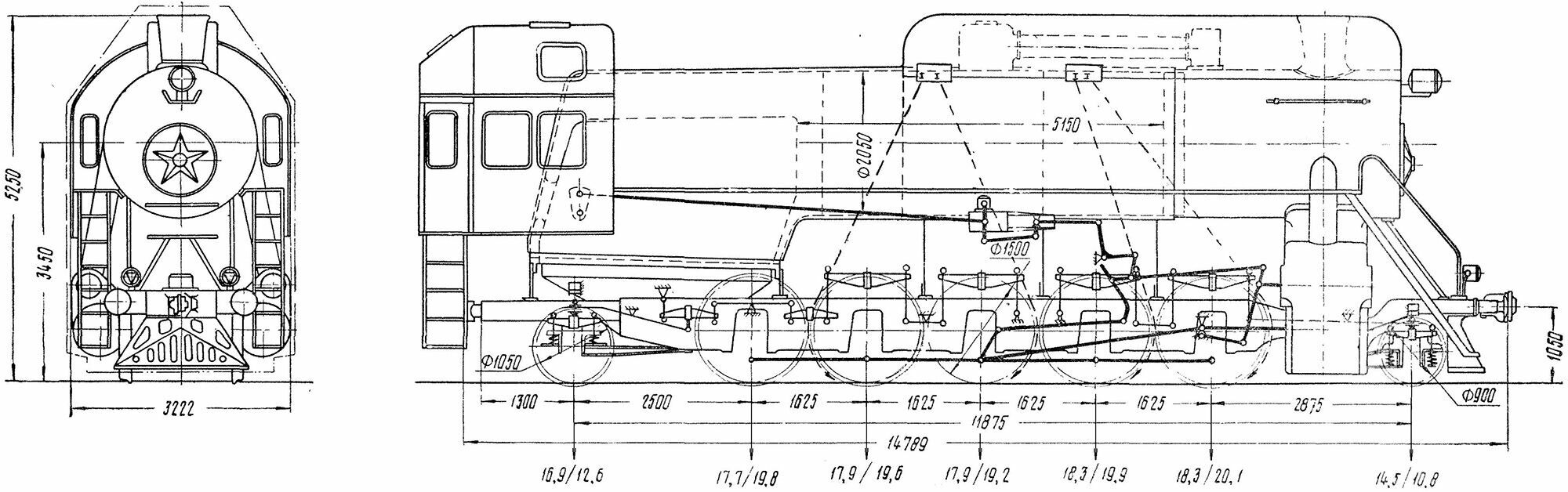
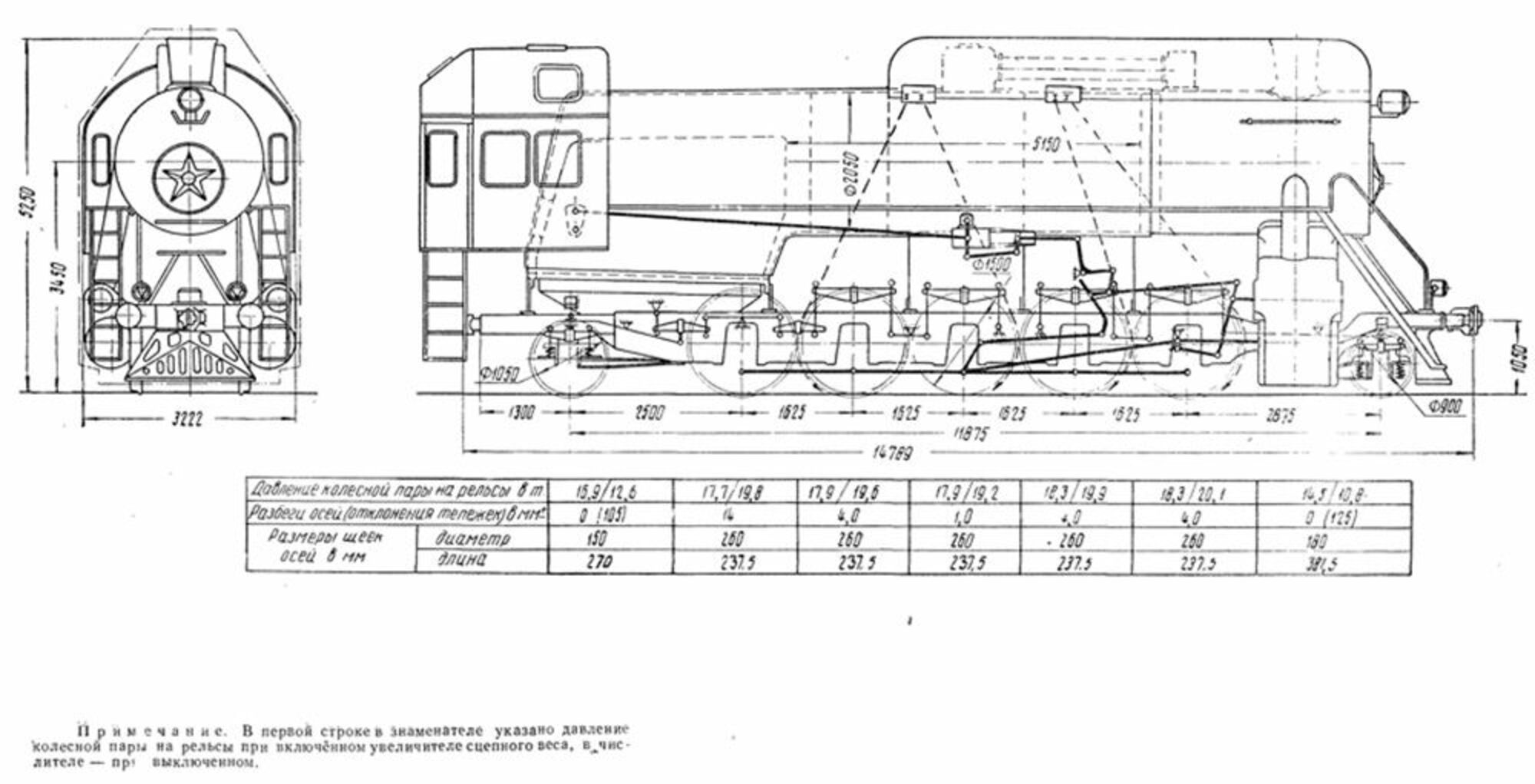
Drawings
and diagrams

History

Chronology

  1. 1948 The Ministry of Railways decides to upgrade the class L steam locomotive.
  2. 1949–1950 The Voroshilovgrad Locomotive Works develops a design for a new locomotive.
  3. December 1951 The first modernised class L steam locomotive is built.
  4. 1953–1954 The Voroshilovgrad Locomotive Works produces nine more steam locomotives in the prototype and pilot batches.
  5. 1955 The Voroshilovgrad Locomotive Works starts series production of class LV steam locomotives.
  6. 1955 112 class LV steam locomotives are built (0011–0122).
  7. 1956 400 class LV steam locomotives are built (0123–0522).
  8. 1982 Class LV steam locomotives begin to be removed from the USSR Ministry of Railways fleet inventory.
  9. October 1986 Freight steam locomotive LV18 002 is in the fleet inventory at the Sharya Depot.
  10. 1993 Freight steam locomotive LV18 002 is purchased by the Central Museum of the Oktyabrskaya Railway from the owner, state company Syktyvkaravtotrans, at the cost of scrap metal.
  11. 2001–2016 Freight steam locomotive LV18 002 is on display at the museum at the former Varshavsky Station in St. Petersburg.