Today the museum is closed

Map

Exhibit description

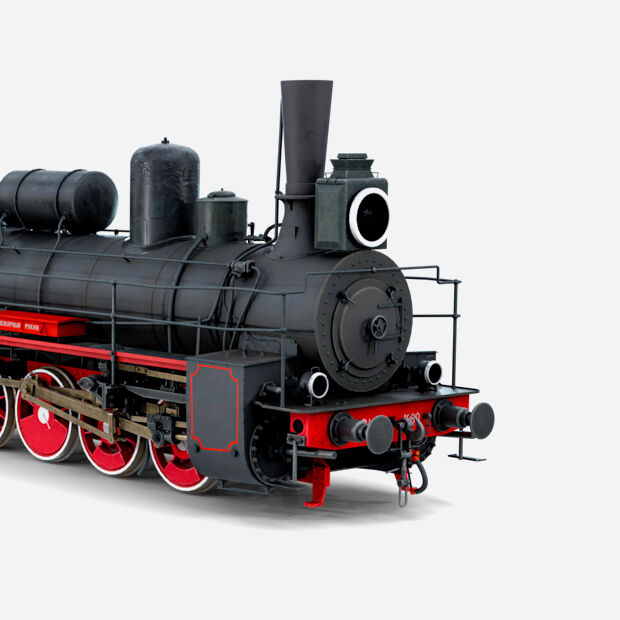
Steam locomotive Freight locomotive type O-3-O

Steam locomotive type 0-3-0

In 1831 the locomotive fleet was divided into passenger and freight. The latter had two, and sometimes three driving wheel pairs. From the second half of the 19th century until the 1880s steam locomotives type 0-3-0, with three driving axles in one rigid frame, were the most common on Russian railways.

The B series steam locomotives of the Oryol-Vitebsk Railway were built by the Schneider & Company plant (Creusot, France) in 1868 in the amount of 30 units.

In 1868–1869 the same plant built batches of B series steam locomotives for the Gryaze-Tsaritsyn (25 units) and Kursk-Kharkov-Azov (40 units) railways, with seven locomotives of the Kursk-Kharkov-Azov Railway being transferred in 1902 to the Central Siberian Railway.

As the weight of trains increased, this type of steam locomotive was displaced by more powerful ones with four driving wheel pairs, and the remaining stock was used for shunting work. From January 1 1913 in Russia, unified series of steam locomotives were introduced, and all obsolete 0-3-0 machines, regardless of the time and place of manufacture, received the designation T (three-pair).

A large number of similar steam locomotives with the axle arrangement 0-3-0 (three-pair) from various manufacturing plants worked on the construction of the Trans-Siberian Railway.

Museum exhibit

The Museum of Russian Railways displays a model of a freight steam locomotive type 0-3-0 (series B) of the Oryol-Vitebsk railway. The weight of the locomotive in working condition without a tender reached 35 tons, its maximum speed — slightly more than 53 km/h.

A large number of similar locomotives with the 0-3-0 axle arrangement (three pairs) from various manufacturing plants worked on the construction of the Trans-Siberian Railway.

History

Chronology

  1. 1868 The B-series locomotives of the Oryol-Vitebsk Railway were built by the Schneider & Company plant (Creusot, France) in 1868 in the amount of 30 units.
  2. 1868–1869 In 1868–1869, the same plant built batches of B-series locomotives for the Gryaze-Tsaritsyn (25 units) and Kursk-Kharkov-Azov (40 units) railways, with 7 locomotives of the Kursk-Kharkov-Azov Railway being transferred to the Central Siberian Railway in 1902.