Today the museum is closed

Map

Exhibit description

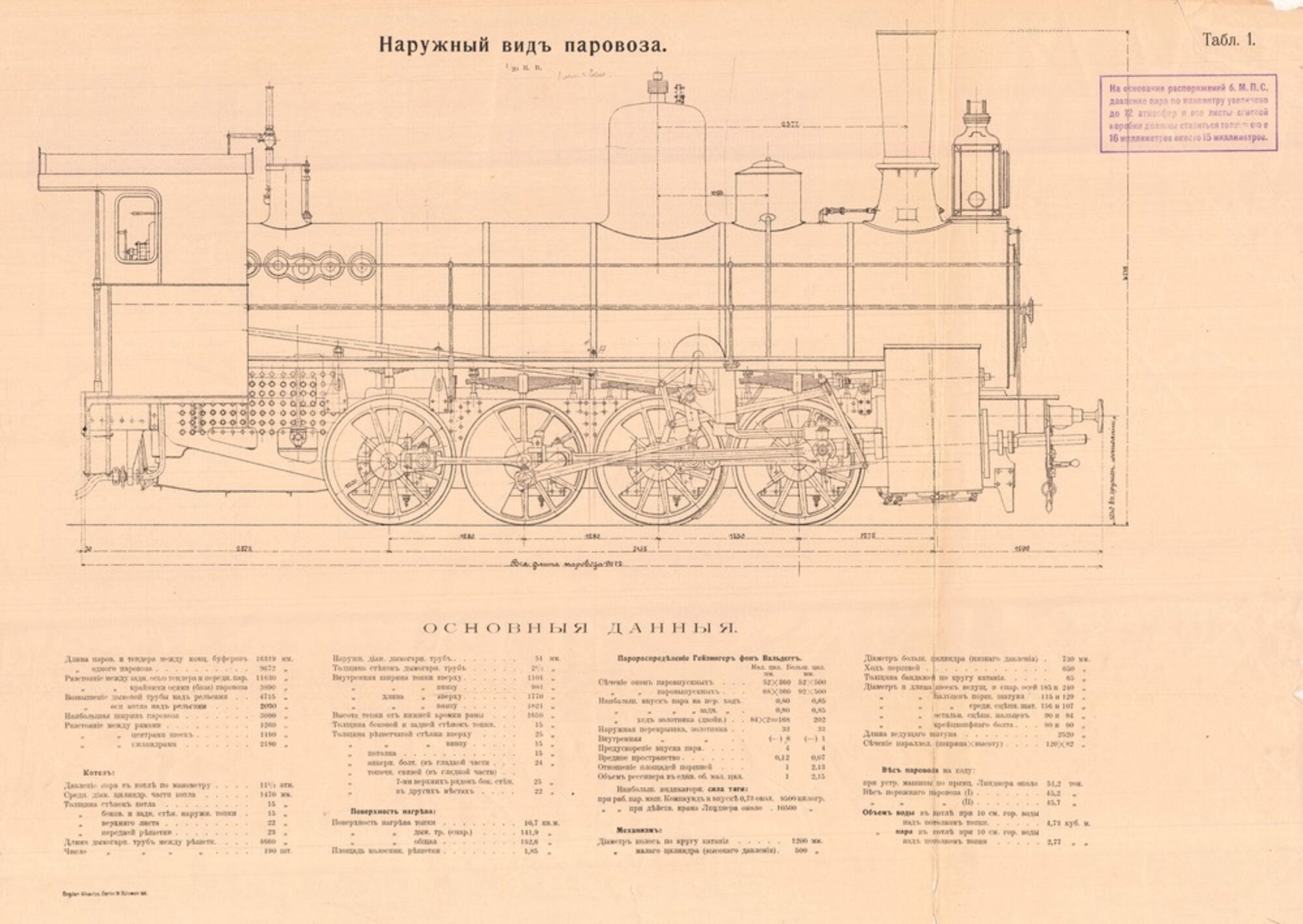
Freight locomotive OV 6640

In 1892, the concept of a “standard-type steam locomotive” or “standard steam locomotive” was introduced on Russian railways, referring to a locomotive designed to meet standardised specifications. The early standard steam locomotives of the 1892, 1893, and 1897 types featured four driving wheelsets (wheel arrangement 0-4-0), a Joy valve gear, and a compound engine. This compound system directed steam first into the smaller-diameter high-pressure cylinder (on the right), and then, after use, into the low-pressure cylinder (on the left) with a larger diameter.

In 1892, the concept of a “standard-type steam locomotive” was introduced in Russia, referring to a locomotive built to standardised specifications.

The compound concept, which reduces the temperature difference in the cylinders during the working stroke and thus minimises heat loss from steam condensation, was specifically designed to save fuel. However, despite its many advantages, standard steam locomotives with Joy valve gear demonstrated lower efficiency, consuming more fuel per unit of work than their predecessors. These earlier locomotives, despite having simpler (with same-size cylinders) engines and a more archaic valve gear with a sliding block mechanism inside the frame, proved to be more economical.

Steam Distribution

Research conducted from 1898 to 1900 on the Kharkiv—Nikolaev Railway revealed that the 1897 standard steam locomotives had unsatisfactory steam distribution. In response, Engineer Yury Lomonosov proposed a project to redesign their valve gear. However, subsequent tests of the modified steam locomotives showed that these changes were insufficient.


In 1899, the Kolomna Machine-Building Plant constructed two steam locomotives for the Southwestern Railway featuring a Walschaerts valve gear modified by the Kolomna Locomotive Works. They also included other modifications, such as a reduction in the surface heating and an increase in cylinders diameter, which led to an imbalance between the boiler and the engine. Although the first 0-4-0 steam locomotives with Walschaerts valve gear thus proved unsuccessful, the failure was not attributed to the valve gear itself.


In 1901, the 23rd Advisory Congress of Traction Service Engineers outlined a series of measures to improve the 1897 standard steam locomotive. These measures included replacing the Joy valve gear with the Walschaerts valve gear, substituting Ramsbottom pressure relief valves with spring-rod valves, and introducing four-axle tenders designed by the Kharkiv Locomotive Works alongside the existing three-axle tenders. In the same year, the Putilov Works began manufacturing steam locomotives that incorporated the decisions made at the congress. These locomotives came to be known as the 1901 standard-type steam locomotives.


The 1904 standard-type steam locomotives featured several improvements over the 1901 model, including an increase in boiler steam pressure from 11.5 to 12 kgf/cm 2 .


However, rising transportation demands and the strengthening of railway tracks allowed for the use of more suitable heavy-duty steam locomotives than the standard 0-4-0 design. So, production of the 1905 standard-type locomotives with a 1-4-0 wheel arrangement began. After this, the orders for 0-4-0 locomotives continued, but they significantly decreased. From 1907 onward, some 0-4-0 locomotives were equipped with superheaters during construction. Additionally, retrofitting previously built standard-type steam locomotives with superheaters became common practice.


Unification

In 1912, Russia implemented a unified system for designating steam locomotive classes. Under this system, all standard-type steam locomotives with the 0-4-0 wheel arrangement were assigned the class designation “O”, derived from the word “main”. Steam locomotives of the 1901 and 1904 standard types, featuring a compound engine and a Walschaerts valve gear with a Gounod loop, were designated as class O V . Steam locomotives equipped with the Walschaerts valve gear, as modified by the Kolomna Locomotive Works, were given the designation OK. These indices reflected the authorship of Walschaerts and the Kolomna Locomotive Works.

In 1912, Russia implemented a unified system for designating locomotive classes.

For the same reasons, the designation was given to steam locomotives that were equipped with a Joy valve gear: 1892 and 1893 standard types—O D , 1897 standard type—O D , and those with steam distribution modified at the suggestion of Yury Lomonosov—O L . 0-4-0 steam locomotives with superheaters were designated as O P .

Steam locomotives of the class O V were produced until 1928. As for the class O locomotives of all variations, approximately 8,000 units were produced. This makes it the most widely-produced class of steam locomotives in the Russian Empire.

The class O with all indexes was the most widespread in the Russian Empire.

From the mid-1910s to the mid-1940s, many class O steam locomotives were fitted with armour plating. They participated in two World Wars and the Civil War as part of armoured trains. The smaller locomotives were better suited for this service than the ones with higher capacity, a longer base and higher boiler position.

The 1901 standard-type steam locomotive was built at the Putilov Works in 1902. The designation O V 6640 was assigned in 1914, when the locomotive was operating on the Southwestern Railway. After the Civil War, the locomotive ended up on the Yekaterininsky Railway.

The museum displays one of the oldest O V steam locomotives. It worked for years on the railways, participated in the Great Patriotic War, and even appeared in movies.

In the 1930s, the locomotive was used for shunting at the Kyiv–Petrivka Station. During the Great Patriotic War, it served as an armoured locomotive, was captured by the enemy, recaptured, and sent for repairs at the Yaroslavl Electric Locomotive Repair Plant. In 1945, the armour was removed, and the locomotive was transferred to the Lithuanian Railways. From 1953 to 1956, the Lithuanian Railways were merged with the Estonian and Latvian Railways into the Baltic Railway, then restored.

Parameters

Technical
specifications

Manufacturing plant
Putilov
The factory number
Unknown
Year
1902
Weight in working condition without tender, t
51.2–53.2
Weight in working condition with tender, t
112
Design speed, km/h
55
Maximum power at the wheel rim, hp
600
General data
Empty weight of a steam locomotive, t
45.2–47.2
Adhesive weight of a steam locomotive, t
51.2–53.2
Complete wheelbase of a steam locomotive with tender, mm
14 297
Length of locomotive with tender by buffers, mm
18,721
Diameter of driving wheels, mm
1 220
Minimum radius of a passable curve, m
78
Tender type
Four-axle
Boiler
Steam pressure, kg/cm2
12
Firebox type
Crampton
Grate area, m2
1.85
Total evaporating heating surface of the boiler (water), m2
152.6
Number of smoke tubes, pcs.
190
Smoke tube diameter (outer), mm
51
Superheater type
No
Type of heating
Coal, manual
Car and crew
Machine type
Compound (double expansion)
Number of cylinders, pcs.
2
Cylinder diameter, mm
500–730
Piston stroke, mm
650
Diameter of valves
Flat
Steam distribution system, t
Walschaer
Tender
Empty weight, t
23.5
Weight with full supply of water and coal, t
63.5
Water supply, m3
23
Coal stock, t
17
Permissible height of the sides of the coal volume, mm
340
Frame thickness, mm
33
Frame type
Sheet
Type of trolleys
Riveted
Suspension
Single spring

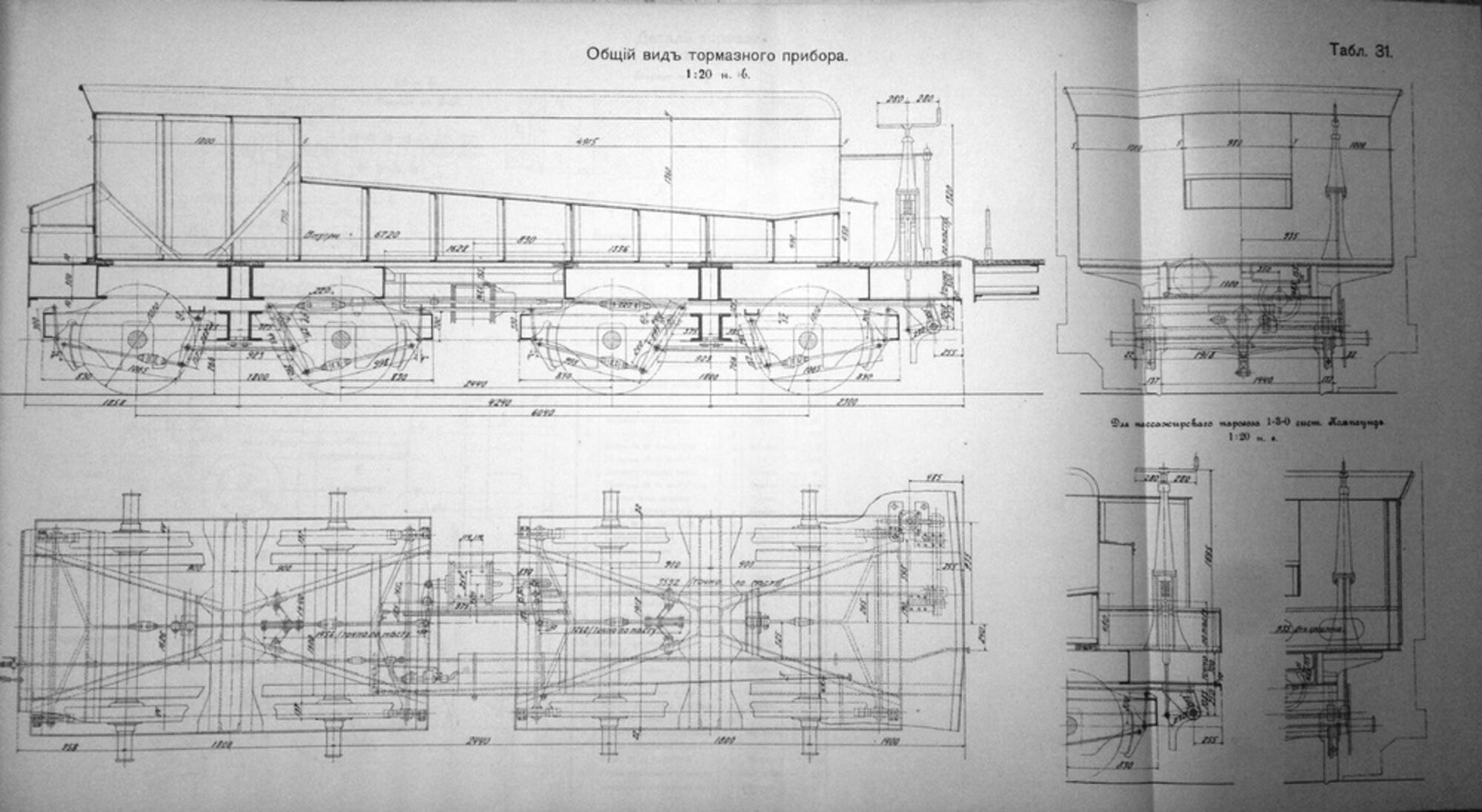
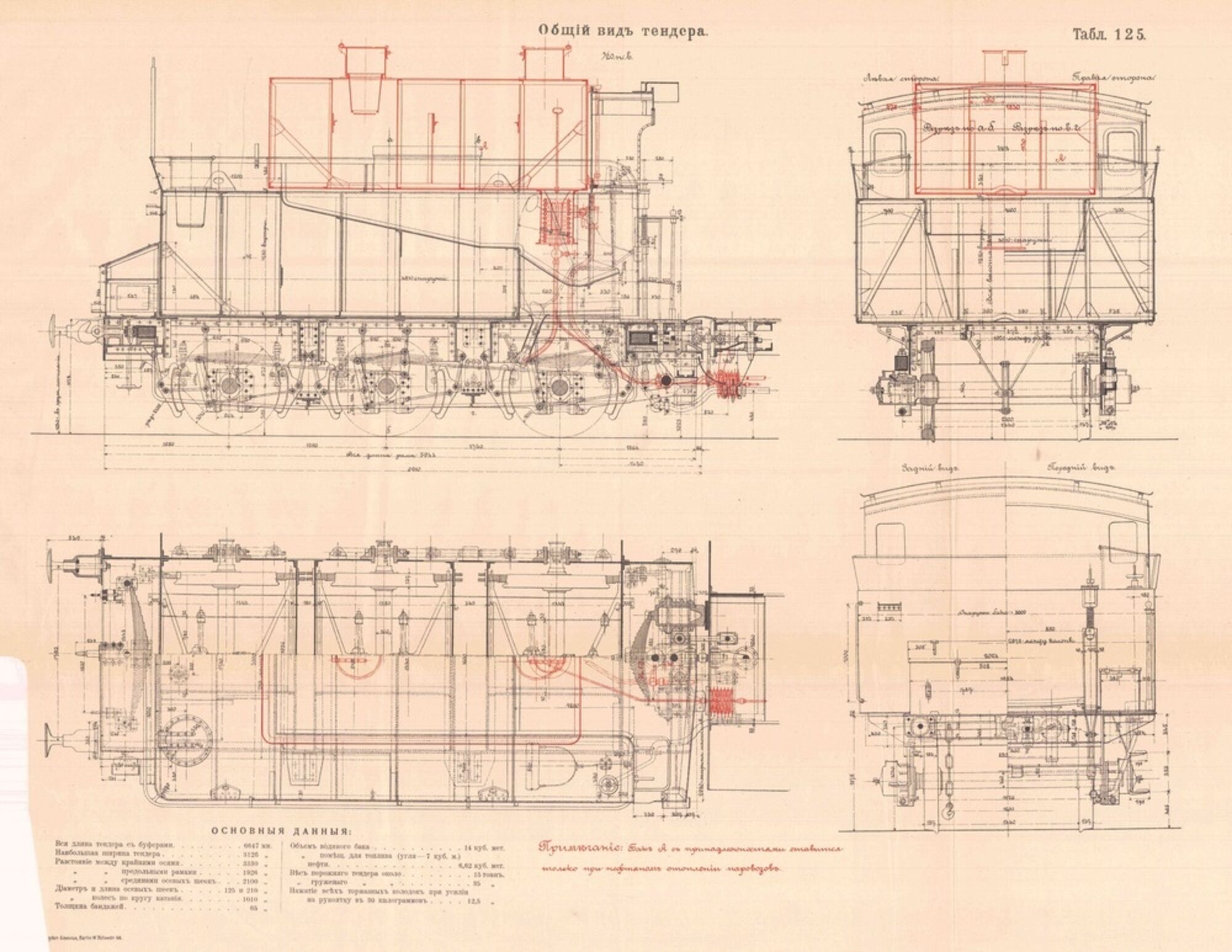
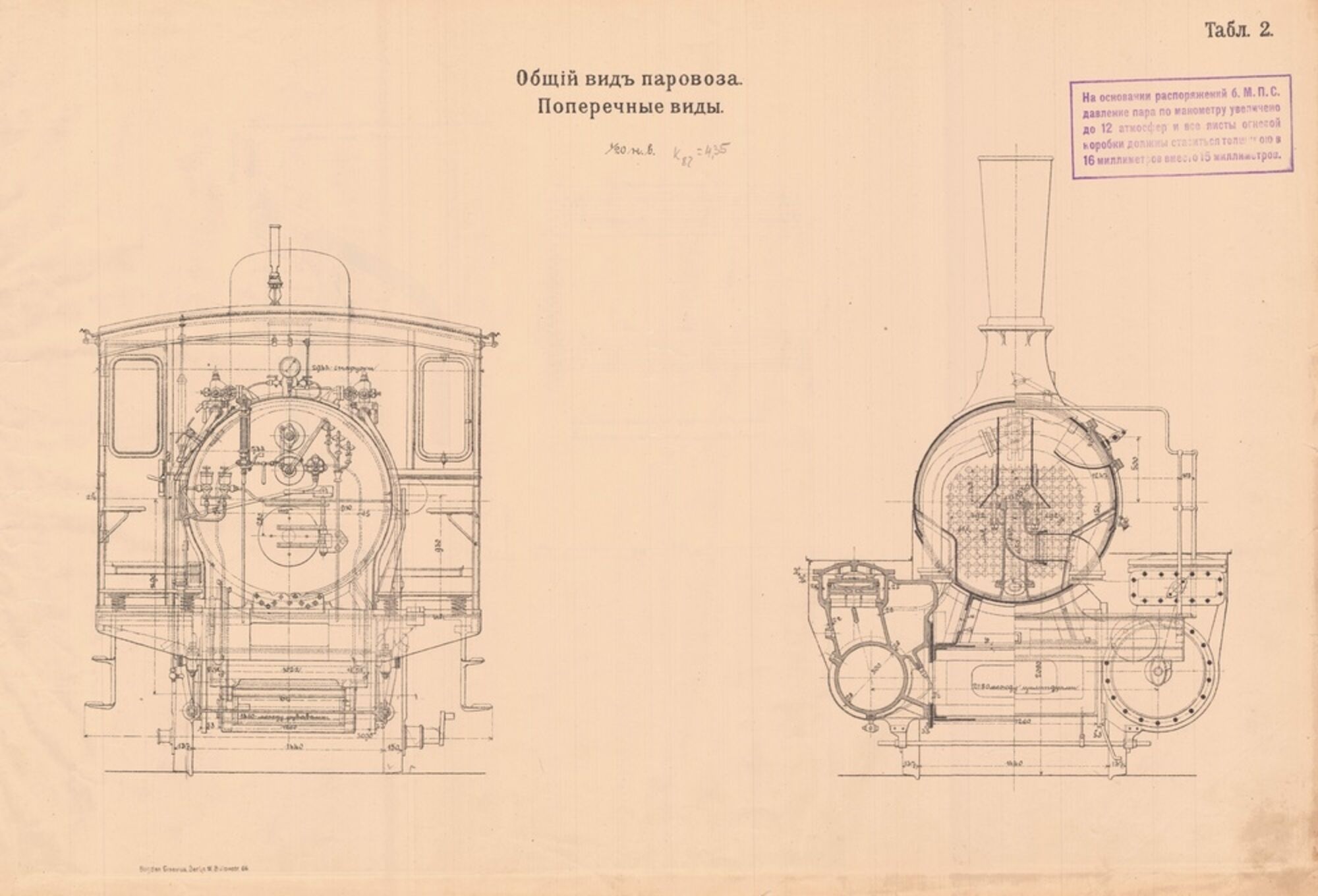
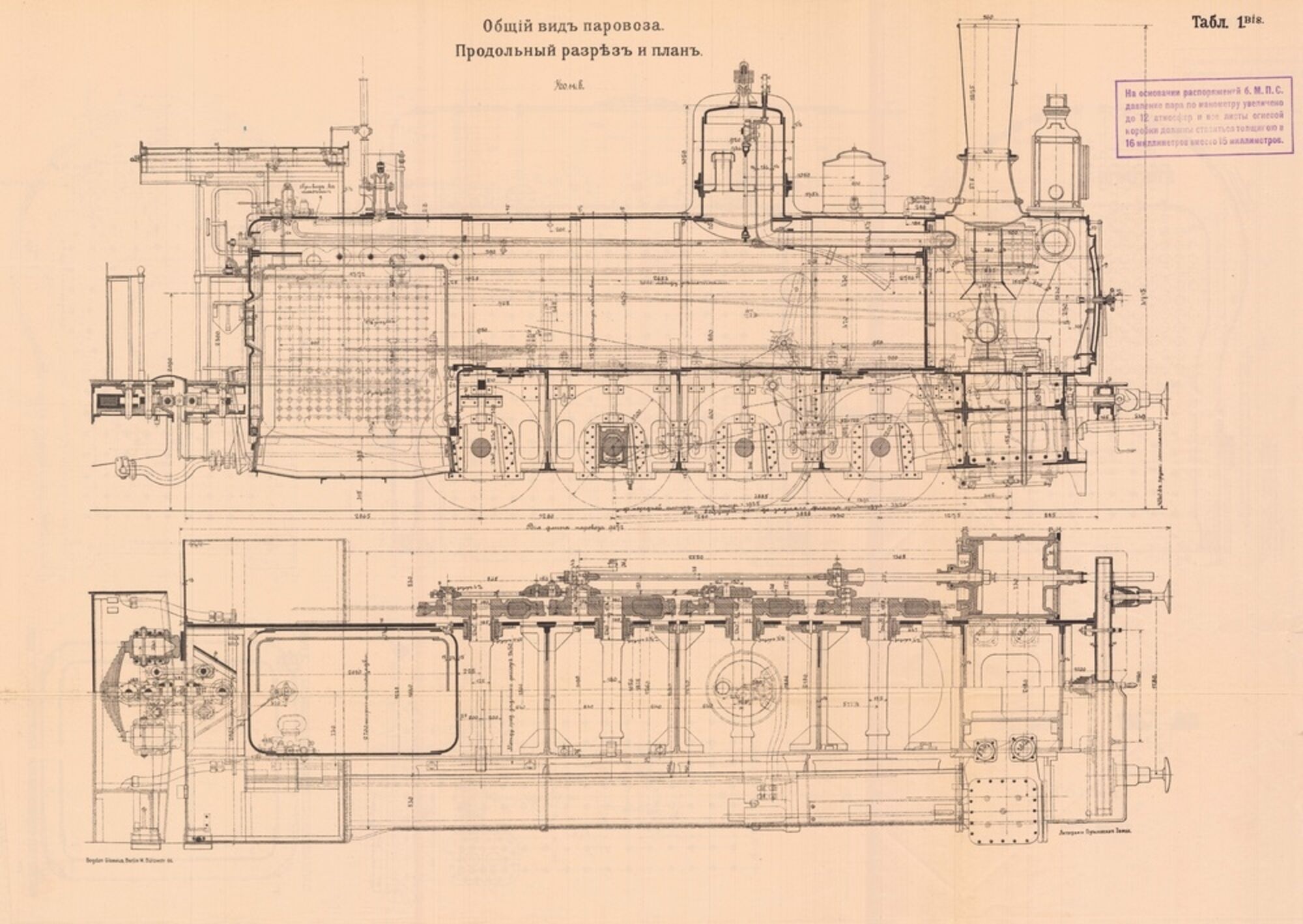
Drawings
and diagrams

History

Chronology

  1. 1892 The concept of a “standard locomotive” was introduced in Russia.
  2. 1901 After modernisation, the standard steam locomotive was reintroduced as the 1901 standard steam locomotive.
  3. 1902 The O V 6640 steam locomotive was built at the Putilov Works.
  4. 1904 The steam locomotive was modernised and designated as the 1904 standard steam locomotive.
  5. 1912 A system of class designation was established in Russia. 1901 and 1904 standard-type steam locomotives were designated as the class O V .
  6. 1928 Production of the O V steam locomotives ceased.
  7. 1961 The O V 6640 steam locomotive was transferred to the Kaliningrad Regional Economic Soviet.
  8. 1998 The OV 6640 steam locomotive became an exhibit at the Russian Railway Museum.