Today the museum is closed

Map

Exhibit description

Freight locomotive FD20 1103

With the beginning of the  first five-year plan (1928–1932), the leadership of the Communist Party of the USSR charted a course for the forced development of the heavy and military industry of the Soviet Union. The process of the industrialisation of the country began:new giant industrial enterprises were built, and old ones underwent major reconstruction. The extractive industry saw rapid growth.

The class E could not cope with the growing demands on railway capacity. Attempts to modernise it were unsuccessful.

In order to meet the rapidly increasing need of industry, completely different, far higher requirements were imposed on the railways, primarily concerning an increase in railway capacity. It was clear that the class EU steam locomotives with an axle load of 16–17 t, being produced by Soviet plants in this period, no longer met the requirements for traction power. Repeated attempts to modernise the class E steam locomotives were not successful. The only way forwards was to create steam locomotives with far higher traction.

Project Development

At the beginning of 1930, the Joint State Political Directorate (OGPU) organised the Technical Bureau for Railway Transport Reconstruction under G.I. Blagonravov’s leadership to “provide support” the People’s Commissariat of Communication Routes. The Technical Bureau for Railway Transport Reconstruction put to work engineers and technicians being held as political prisoners.

The OGPU organised a design bureau using engineers and technicians being held as political prisoners to “provide support”.

At the end of April 1931, the OGPU had developed a preliminary design for a new type 1-5-1 steam locomotive with a 20-t load using coupling wheelsets. This locomotive was later designated the class FD in honour of Felix Dzerzhinsky (1877–1926), a Soviet political leader and founder and head of the Cheka. From 1923 to 1924, Dzerzhinsky was the USSR People’s Commissar for Communication Routes.

The working design of the steam locomotive was developed by two organisations: the OGPU and the Central Locomotive Design Bureau of the People’s Commissariat for Heavy Industry. Development began on 1st May 1931, and 100 working days later, the project was completed.

Design documentation for steam locomotives built in the USA was used during the development of the class FD, but it was a newly designed locomotive, not a variant of the US designs.

Design documentation for the classes TA and TB of prototype steam locomotives built in the USA for the Soviet Union was used in the design of the class FD, along with that of other steam locomotives built by American firms. However, the FD was not a variant of any American steam engine; it was a newly designed locomotive. The Baldwin and ALCO plant standards were used in  the process.

In comparison with American steam locomotive production practice, Soviet designers faced far more severe constraints. Firstly, the steam engine design had to be as light as possible to come to an axle load of 20 t. American railways at the time allowed for far higher axle loads. Secondly, the steam locomotives had to match the narrow gauge of European railways: this requirement was for military purposes.

The new steam locomotive was designed around many solutions and devices that had never before been used in Russian steam locomotive manufacturing: a mechanical stoker, bar frame, firebox with combustion chamber, and more.

In August 1931, the workshop drawings of the new machine were handed to the Luhansk Locomotive Works.

In Production

The refurbishment of the Luhansk Locomotive Works for the construction of powerful locomotives meant delays for the production of the first FD steam locomotive. Many of the assemblies and parts for it were manufactured at other steam locomotive plants around the country. For example, the blanks for the bar frames were produced by the Izhora Plant in Leningrad (now St. Petersburg) and machined at the Krasnoye Sormovo Plant in Gorky (now Nizhny Novgorod). Nevertheless, on 6th November 1931, on the eve of the next anniversary of the October Revolution, steam locomotive FD20 1 brought a train with the Luhansk Locomotive Works workers to Moscow.

At speeds of above 30 km/h, the class FD proved to be twice as powerful as EU steam locomotives.

From March to May 1932, the new steam locomotive underwent testing on the Southern Railways under the Institute for Traction Reconstruction. At speeds of above 30 km/h, the class FD proved to be twice as powerful as EU steam locomotives.

Series production of FD steam locomotives began in Luhansk (renamed to Voroshilovgrad in November 1935) in August 1933. From 1931 to 1941, a total of approximately 3,220 FD20 and FD21 steam locomotives were produced.

Improvements were continuously made to the performance of the steam locomotives during series production. The biggest update was made in 1940, when significant changes were made to the design of the steam locomotive. The extent of this can be seen in the 123 assembly drawings out of the total 450 for the steam locomotive and tender which were replaced with new drawings.

In addition, changes were made to 63 more old drawings. The main innovations included the all-welded boiler and firebox, the addition of a wide-tubed L-40 superheater, the use of disc wheelsets for trailing axles and reinforcement of the frame with new interframe fittings. These steam locomotives were given the designation FD21. Prototype FD locomotives were also built, using pulverized-coal-fired boiler and steam condensing devices. However, work on these steam locomotives did not progress beyond experiments.

In Operation

After construction, FD steam locomotives were sent to the most heavily worked sections and mainlines in the Soviet rail network: Moscow-Kharkiv, Rostov-Michurinsk, Kharkiv-Bryansk, Leningrad-Vitebsk, Moscow-Orsha and others.

Despite the difficulties inherent to the introduction of such a revolutionary machine as the class FD steam locomotive to the USSR’s railways, by the time the Great Patriotic War broke out, steam locomotive engineers and technicians had generally mastered the operation of these vehicles.

In 1936, FD20 508 pulled a record-setting train weighing 11,230 t and 564 axles long.

The high-performance capabilities of steam locomotives meant the drivers working with the class FD could achieve impressive results. As an example, on 11–12th February 1936, on the Shumikha-Kurgan section of the South Ural Railway, steam locomotive FD20 508 pulled a record-setting train weighing 11,230 t and 564 axles long.

A flat section with gradients of up to 6 % was chosen for this record-setting event, and a uniform heavy-duty train of four-axle cars connected by automatic couplers was formed up. It is evident that this record bears little similarity to real operating conditions. Nevertheless, it testified to the considerable capabilities of the class FD steam locomotives.

After the outbreak of the Great Patriotic War, most FD steam locomotives were evacuated from the railways in the  western parts of the country to the east. Many were transferred to storage, as the operation of heavy steam locomotives such as the class FD was only possible on reconstructed sections of track.

After the end of the war, FD steam locomotives were gradually returned to operation on the railways of the western parts of the country. However, their operation proved very difficult due to the poor condition of the track equipment on Soviet railways, especially in the immediate years following the war.

Since FD steam locomotives were operated only on heavily worked mainlines, their replacement with diesel and electric locomotives was carried out relatively quickly, by the early1960s. The last locomotives were in operation until the mid-1960s, for example, on the South-Eastern Railway. Steam locomotives were moved to storage and gradually removed from the inventory or transferred to industry, in most cases for use as stationary boiler plants. The process of decommissioning and transferring FD steam locomotive was quite lengthy all told: from the late 1950s to the mid 1980s.

One of the most interesting chapters in the story of FD steam locomotives is their use of the railways of China. After a significant number of FD steam locomotives had been moved to storage, it was decided to transfer some of these swiftly abandoned but powerful locomotives to the railways of the PRC. From 1958 to 1961, approximately 1,050 FD steam locomotives were transferred to China. Their conversion to 1,435-mm gauge was undertaken in the PRC.

Approximately 1,050 FD-class steam locomotives were transferred to China after the war. There, their designation was changed several times, and sometimes made reference to “friendship”, and sometimes to “anti-revisionist”.

On the Chinese railways, the FD steam locomotives went through several class designations. To begin with, they were called the class YH, meaning “friendship”. During the Cultural Revolution, they were renamed to FX, meaning “anti-revisionist”. Finally, in 1971, they became once more known as the class FD. Operation of FD steam locomotives in China continued until October 1985. Today, the railway museums of Beijing and Shenyang house two FD steam locomotives.

Within the former Soviet Union, approximately 25 examples from this once-massive class of steam locomotives can be found in museums and on plinths.

In the Museum

Freight steam locomotive FD20 1103 was manufactured at the Voroshilovgrad Locomotive Works in 1936. The steam locomotive’s serial number is unknown.

It was put into operation on the South Ural, Kuybyshev and Odesa Railways. During the Great Patriotic War, FD20 1103 became one of the steam locomotives converted to type 1-5-2 to reduce the axle load. Instead of a single-axle support truck, this type of locomotive used one with two axles. The converted locomotives were called the FDR class. This considerably reduced the axle load, meaning class FDR steam locomotives could be operated on lines with a relatively weak upper track structure. After the war, the steam locomotives were converted back to type 1-5-1.

After the end of operation in the early 1960s, steam locomotive FD20 1103 was retired to the Tzvetkovo Storage Base on the Odesa Railway, where it remained until 1987. In June 1987, it was transferred for use as a boiler plant at industrial complex no. 55 of the Ministry of Defence of the USSR. The reinforced concrete plant of this complex, where FD20 1103 ended up, was located not far from Moscow Sheremetyevo Airport. In 1991, the steam locomotive was purchased from the owner by the Central Museum of the Oktyabrskaya Railway at the price of scrap metal and delivered to the museum in Shushary.

Parameters

Technical
specifications

Total number of steam locomotives, pcs.
2 925
Height, mm
4 650
Width, mm
3 150
Design speed, km/h
85
Minimum curve radius, m
105,5
Power, l.s.
3 000
Axial formula
1–5–1
Locomotive weight when empty, t
131,8
Weight of the locomotive in working condition, t
102,1
Steam pressure in the boiler
15 кг/см2
Number of flame tubes
130
Total evaporating heating surface of the boiler, m2
295,16
Superheat heating surface (gas), m2
148,4
Grate area, m2
7,04
Number of smoke pipes
43
Diameter of smoke pipes, mm
57
Diameter of steam superheating pipes, mm
30
Firebox type
Radial
Number of cylinders
2
Cylinder diameter, mm
670
Piston stroke, mm
770
Spool diameter, mm
330
Frame type
Block
Frame thickness, mm
125
Diameter of driving wheels, mm
1500
Tender type
6P and Type 17
Number of tender axles
6
Tender length, mm
12 543 / 13 090
Weight of loaded tender, tonnes
120
Water reserve, m3
44
Coal reserve
20/22 tonnes
Length with tender 6P according to buffers, mm
28 967
Superheater type before 1940
Double-turn, Schmidt
Superheater type since 1940
Single-turn, “Lokomotivproekt”
Length with tender Type 17 according to buffers, mm
28 422
Diameter of flame tubes since 1940, mm
152
Diameter of flame tubes before 1940, mm
89

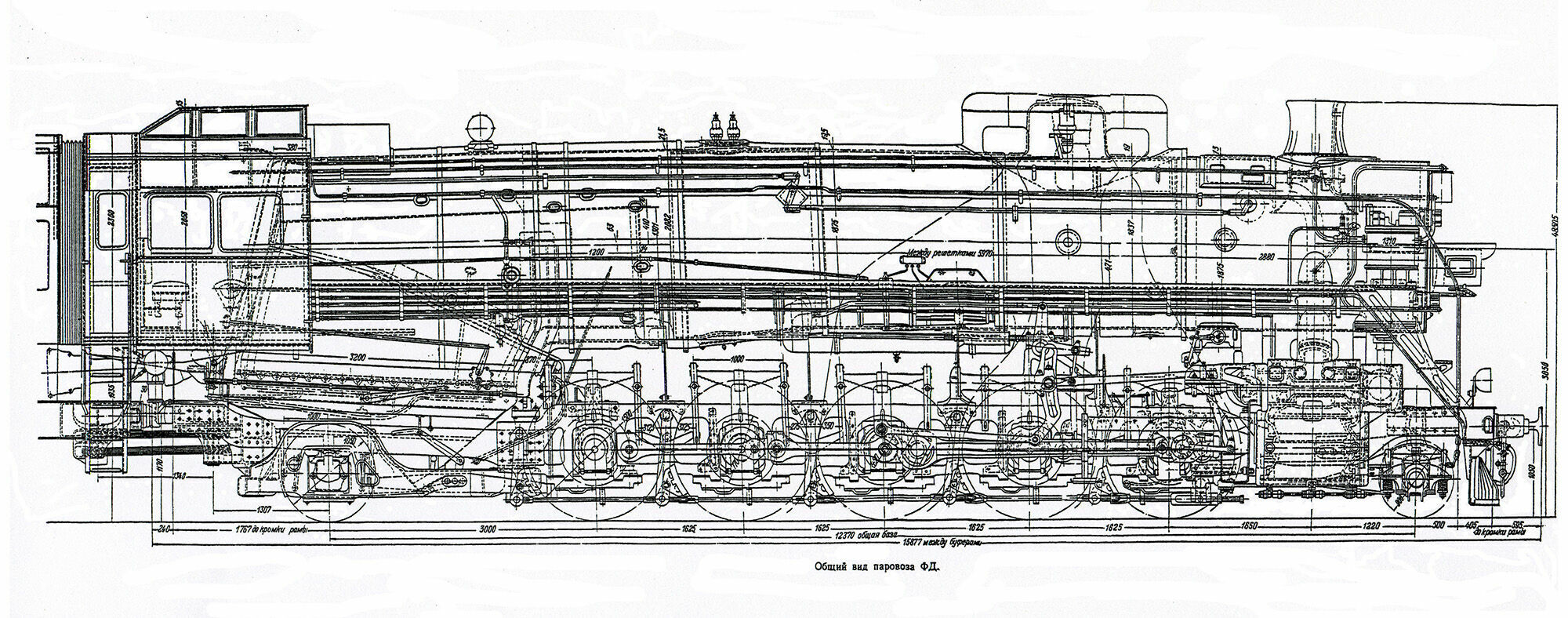
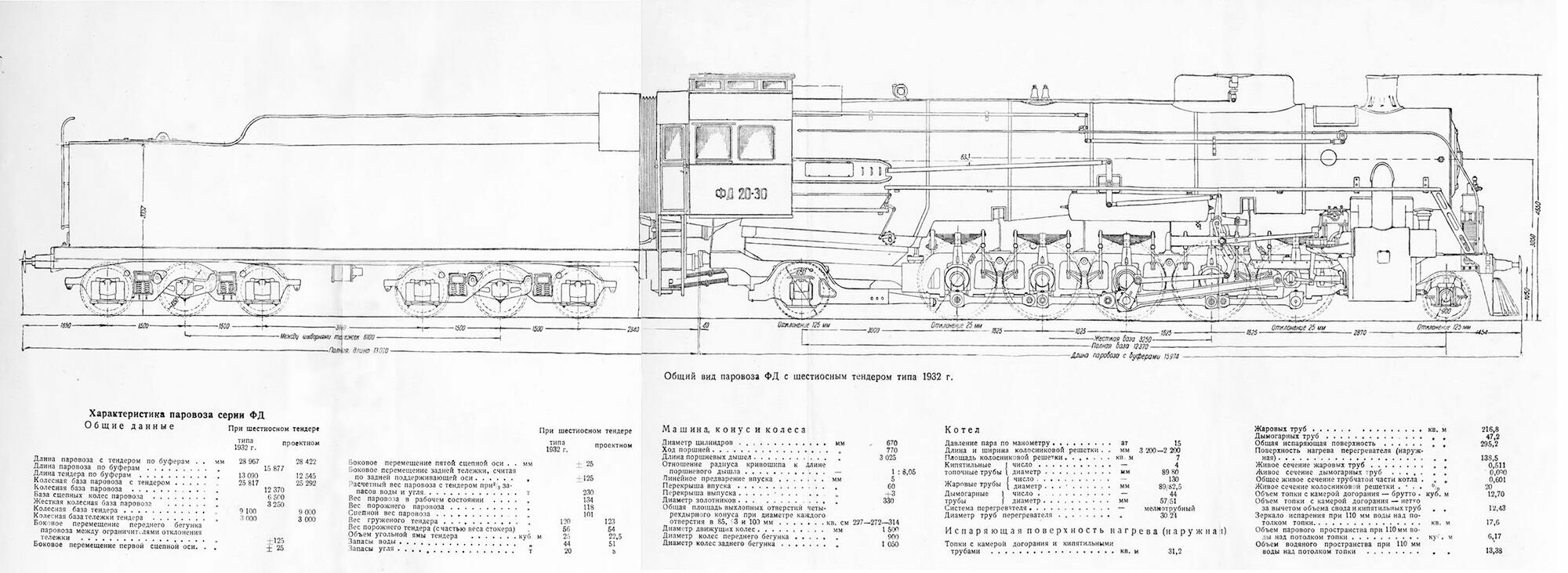
Drawings
and diagrams

History

Chronology

  1. 1928–1932 Industrialisation is underway in the USSR, and there is a need for a new type of freight locomotive.
  2. 1931 Soviet engineers design a new class of locomotive and build the first of them.
  3. 1933 Series production of class FD steam locomotives begins.
  4. 1936 Steam locomotive FD20 1103 is built.
  5. 1941–1945 Class FD steam locomotives are evacuated away from the front and continue to operate.
  6. 1950–1980 The class FD is gradually decommissioned.
  7. 1987 Steam locomotive FD20 1103 is transferred to the military for use as a stationary boiler plant.
  8. 1991 FD20 1103 is bought by the Russian Railway Museum.