Today the museum is closed

Map

Exhibit description

Tank Locomotive 9P 15387

A tank locomotive, derived from the English word “tank” meaning “cistern”, is a type of steam locomotive without a tender. Instead, it stores its water and fuel directly in tanks (cisterns) mounted on the steam locomotive itself. In domestic railways, they were primarily used for shunting operations at stations and branch lines of industrial enterprises.

Water and fuel reserves on tank locomotives were stored in cisterns (tanks) on the steam locomotive itself.

During the industrialisation period of the 1930s, the Soviet Union experienced rapid industrial growth, leading to the modernisation of existing factories and the construction of new ones. Most of these enterprises and construction sites were equipped with railway branch lines, often extending several hundred kilometres at large facilities.


However, the growing demand for industrial locomotives could not be met by simply transferring outdated steam locomotives from public railways. Firstly, these obsolete steam locomotives were still in active use for shunting tasks on public railways. Secondly, the operating conditions of steam locomotives on branch lines differed greatly from those on public railways.


While high capacity was not required for shunters in industrial settings, steam locomotives needed to make frequent stops, navigate tight-radius curves (50 m or less), and be compact enough to operate in confined spaces, such as warehouses, workshops, and industrial stations. Additionally, fuel and coal supply points were typically located near the areas where the steam locomotives operated. Tank locomotives were perfectly suited to meet these requirements.

Tank Locomotives in the USSR

By the mid-1930s, the most widely produced industrial tank locomotive of domestic design was the 0-3-0 type T48 class and its modifications. Between 1929 and 1935, approximately 400 of these locomotives were manufactured at the Nevsky Plant in Leningrad. However, with the cessation of locomotive production at the Nevsky Plant, their manufacturing was discontinued. In addition, the T48 steam locomotives were not adapted to newer manufacturing technologies, such as welding.

To address the need for industrial steam locomotives, the Soviet Union partially relied on purchasing tank locomotives for new facilities from abroad, specifically from Czechoslovakia, Germany, and the USA. However, this approach could not fully meet the industry’s needs, mainly due to a shortage of foreign currency.

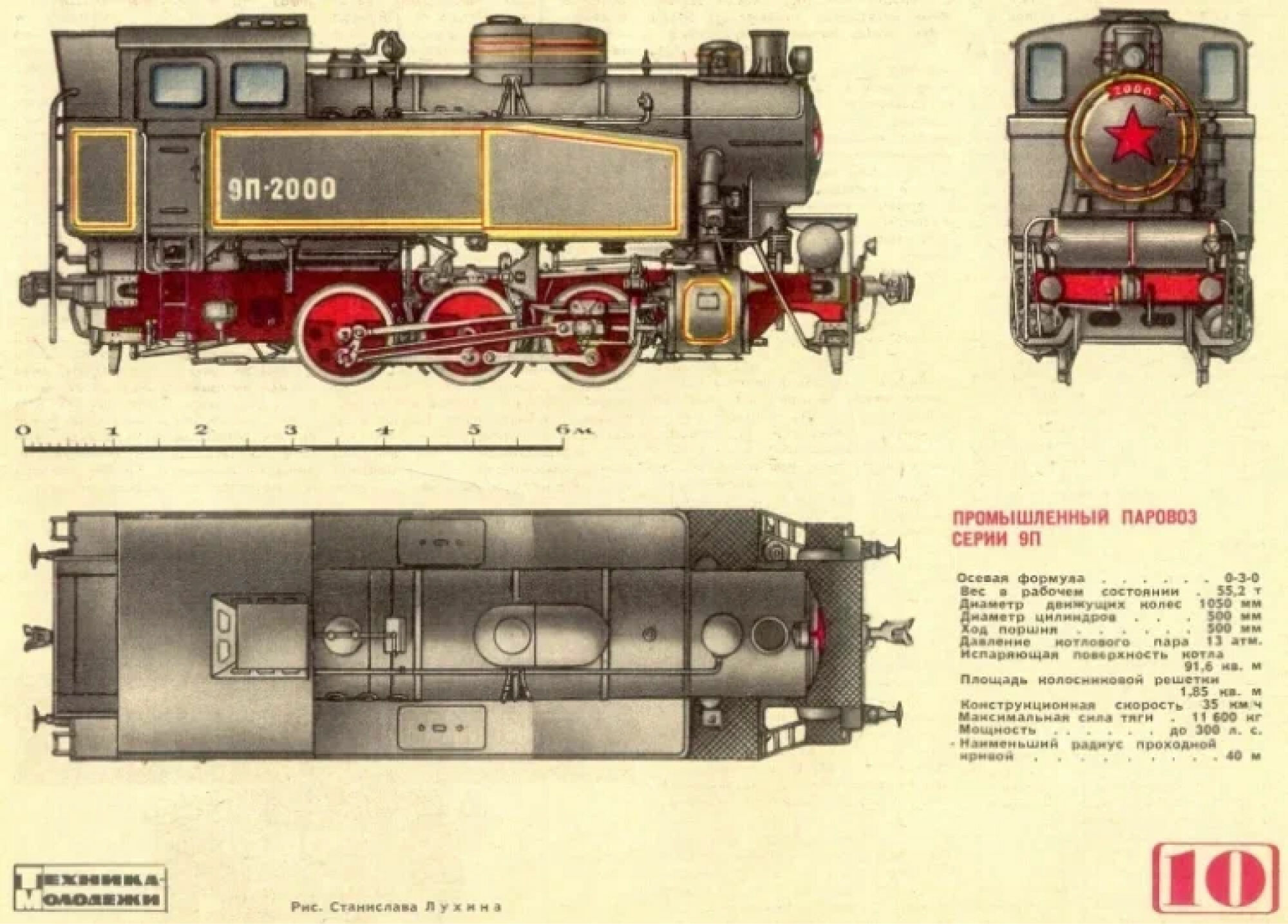
In 1934–1935, the Lokomotivoproekt Bureau of the People’s Commissariat of Heavy Industry designed three types of tank locomotives: 4P with 0-2-0 axle arrangement, 5P with 0-3-0 axle arrangement and a coupling weight of 73.4 t, and 9P with 0-3-0 axle arrangement and a coupling weight of 45 t. 4P steam locomotives were built in small quantities, and the 5P class was never built. The 9P class locomotives were set to become the most widely produced domestically built tank locomotives.

The 9P class became the most widely produced tank locomotive in the USSR.

Mass production of the 9P steam locomotives began at the Kolomna Locomotive Works (factory type 164), with the first one released by 1st June 1936. In total, the Kolomna Locomotive Works built 56 9P machines in 1936. In 1937 and 1938, the 9P locomotives were manufactured at the Novocherkassk Steam Locomotive Plant, where about 80 machines were built. However, due to the transfer of the Novocherkassk Plant to the People’s Commissariat of Armaments system, the production of steam locomotives there ceased.

Construction of the 9P class resumed in Kolomna in 1939. At the same time, the design was modified: the volume of the water tanks was increased to 6.5 m³, the water purifier was removed, and electric lighting equipment was installed, among other changes. Between 1939 and 1941, the Kolomna Locomotive Works produced about 150 machines of the 9P class. In 1941, plans were made to produce two experimental steam locomotives equipped with superheaters, which would have significantly improved their efficiency. However, it has not yet been determined whether these plans were ever realised.

Mass production of 9P steam locomotives began after the end of the Great Patriotic War at the Murom Steam Locomotive Plant. Between 1946 and 1957, approximately 3,000 9P locomotives were built in Murom. Unusually for domestic steam locomotive construction, some machines were numbered using four- and five-digit formats (e.g., 8172 or 21582). There, the second or third digit represented the last digit of the production year. 8172—1951, 21582—1955. This numbering system was never used on any other domestic steam locomotive.


Starting 1st October 1955, the plant began producing modernised steam locomotives, designated as the 9PM series. These featured larger water tanks (8 m³), an air sandbox, an improved braking system, and other upgrades. The 9PM-505 locomotive, built by the Murom Steam Locomotive Plant in 1957, became the last broad-gauge steam locomotive ever produced in the Soviet Union.

A total of 3,300 9P and 9P M steam locomotives were produced.

In total, between 1936 and 1957 the Kolomna, Novocherkassk, and Murom Steam Locomotive Plants built about 3,300 9P and 9PM steam locomotives.

Operation

9P locomotives operated across the Soviet Union, from Vladivostok to Brest and from Norilsk to Central Asia. These locomotives could be found on the tracks of large metallurgical enterprises in the Urals and Kuzbass, where several dozen 9Ps were in service, as well as at small enterprises, where the entire locomotive fleet often consisted of just one or two 9P steam locomotives.


The operation of the “nines”, as the 9P was affectionately called by railway workers, largely ended in the 1970s when industrial enterprises acquired enough diesel locomotives to replace them. In some places, these steam locomotives remained in operation into the early 1980s. For instance, the 9P-19489 locomotive was still in service at TPP-5 “Red October” in Leningrad until 1981.


Another notable chapter in the history of the 9Ps was their use in locomotive depots of the Ministry of Railways network. While most steam locomotives were transferred from the Ministry of Railways network to industrial enterprises, the 9Ps, on the contrary, were often sent to the Ministry of Railways network after working in industry.


This was due to the need to replace obsolete tank locomotives used for shunting operations mainly in roundhouses. The compact dimensions of the 9P made it particularly well-suited for these tasks. The transfer of 9P locomotives to the Ministry of Railways tracks began in the 1960s, coinciding with the gradual transition from steam to diesel traction on industrial railway lines.


In the locomotive depots of the Ministry of Railways, the 9P and 9PM locomotives remained in use until the early 1990s. As of 1st January 1992, the inventory of the USSR Ministry of Railways included 15 9P and 9PM steam locomotives. The last depots to operate the “nines” were Yaroslavl-Moskovsky, Troitsk, Zlatoust, and Sharya.

9P-15387 steam locomotive was built by the Murom Steam Locomotive Plant in 1953 and initially was used at the branch lines of the Estonslanets Trust near the city of Kohtla-Järve. In 1964, it was transferred to the Oktyabrskaya Railway and began operation at the Dno Depot in February of that year. It remained in use for shunting work on depot tracks until the early 1980s. In 1987, the locomotive was added to the collection of full-scale rolling stock being assembled at the Central Museum of the Oktyabrskaya Railway. In November 1987, it was displayed at an exhibition celebrating the 150th anniversary of domestic railways at Pavlovsk station.

Parameters

Technical
specifications

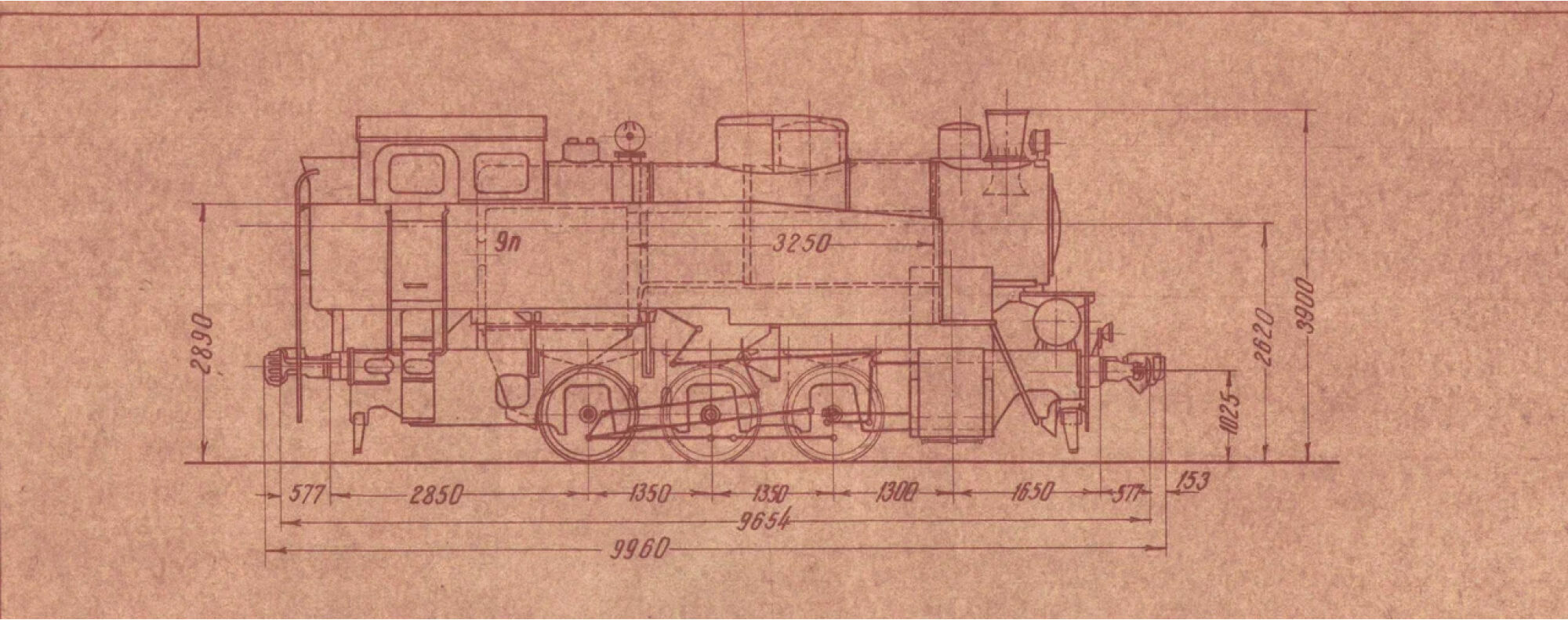
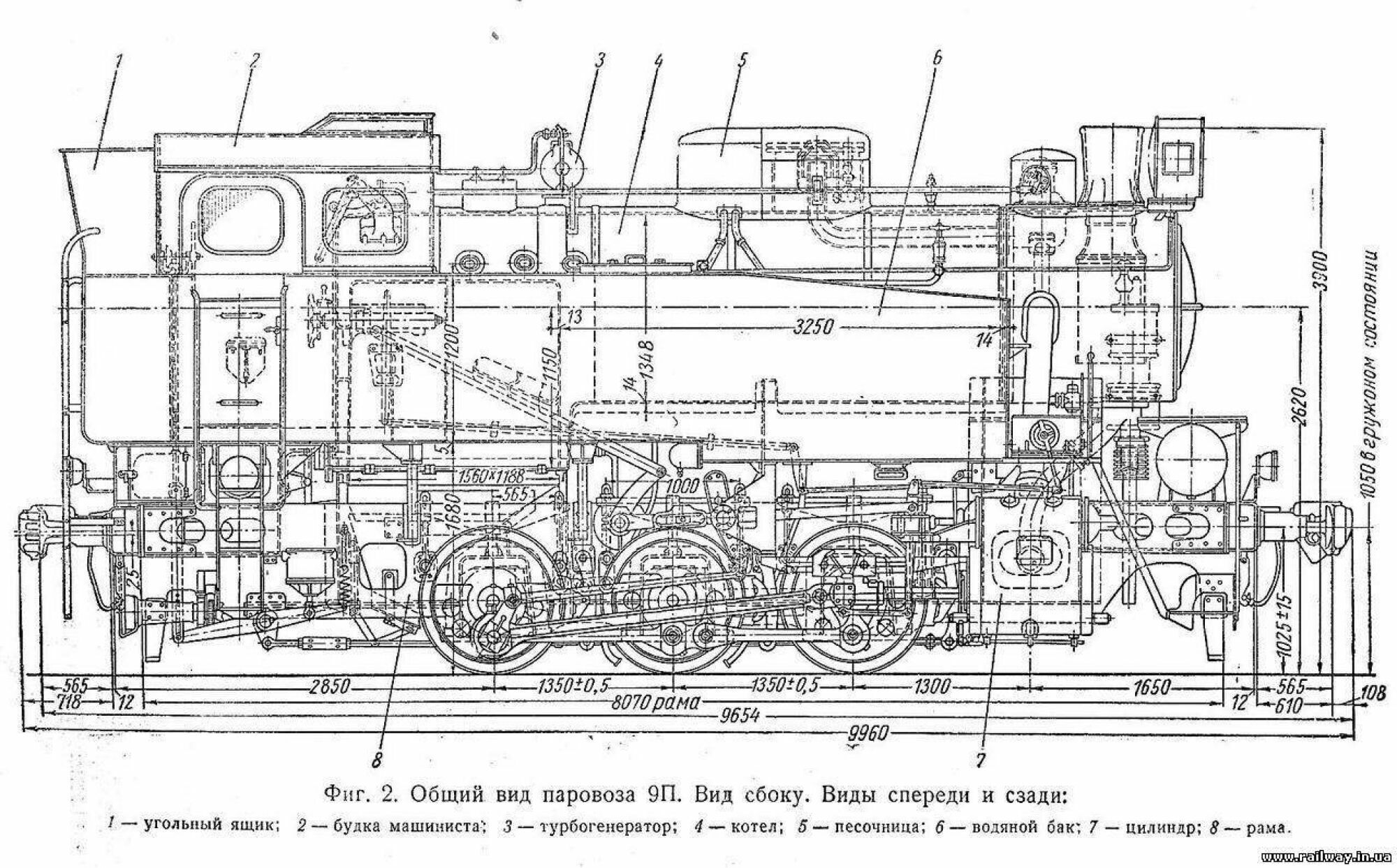
Length, mm
9 960
Height, mm
3 900
Hitch weight, kg
55 200
Conditional traction force, kg
9 300
Design speed, km/h
35
Boiler
Steam pressure, kg/cm2, gauge
13
Grate area, m2
1.85
Distance between tubular gratings, mm
3 250
Smoke pipes
Firebox volume, m3
2,08
Vapor space volume, m3
1,52
Evaporator mirror, m2
5,77
Gas passage, m2
0,266
Fuel reserve, t
2
Water supply, t
6,525
Car
Bore and stroke, mm
2 х 500 х 500
Driving wheels, mm
1 050
Intake cover, mm
32
Exhaust cover
0
Preadmission, mm
4
Spool diameter, mm
200
Steam distribution
Geisinger

Drawings
and diagrams

History

Chronology

  1. 1934–1935 The Lokomotivoproekt Bureau of the People’s Commissariat of Heavy Industry of the USSR designed the 9P tank locomotives.
  2. 1st June 1936 The first 9P steam locomotive was produced at the Kolomna Locomotive Works.
  3. 1946–1955 9P steam locomotives were produced by the Murom Steam Locomotive Plant named after Dzerzhinsky.
  4. 1953 The Murom Pant built the 9P-15387 steam locomotive, which later became a museum exhibit.
  5. October 1, 1955 The Murom Plant began producing modernised steam locomotives, designated as the 9PM class.
  6. 1964 9P-15387 steam locomotive was transferred to the Oktyabrskaya Railway.
  7. 1981 The operation of 9P steam locomotives came to an end.
  8. 1987 9P-15387 steam locomotive was transferred to the collection of full-scale rolling stock created at the Central Museum of the Oktyabrskaya Railway.
  9. November 1987 9P-15387 steam locomotive was displayed at an exhibition celebrating the 150th anniversary of domestic railways at Pavlovsk station.