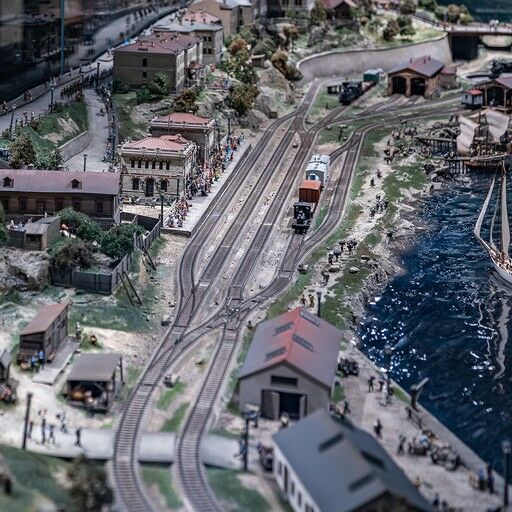
Today the museum is closed

Map

Exhibit description

Diesel locomotive TG102-153/169

Unsuccessful engine

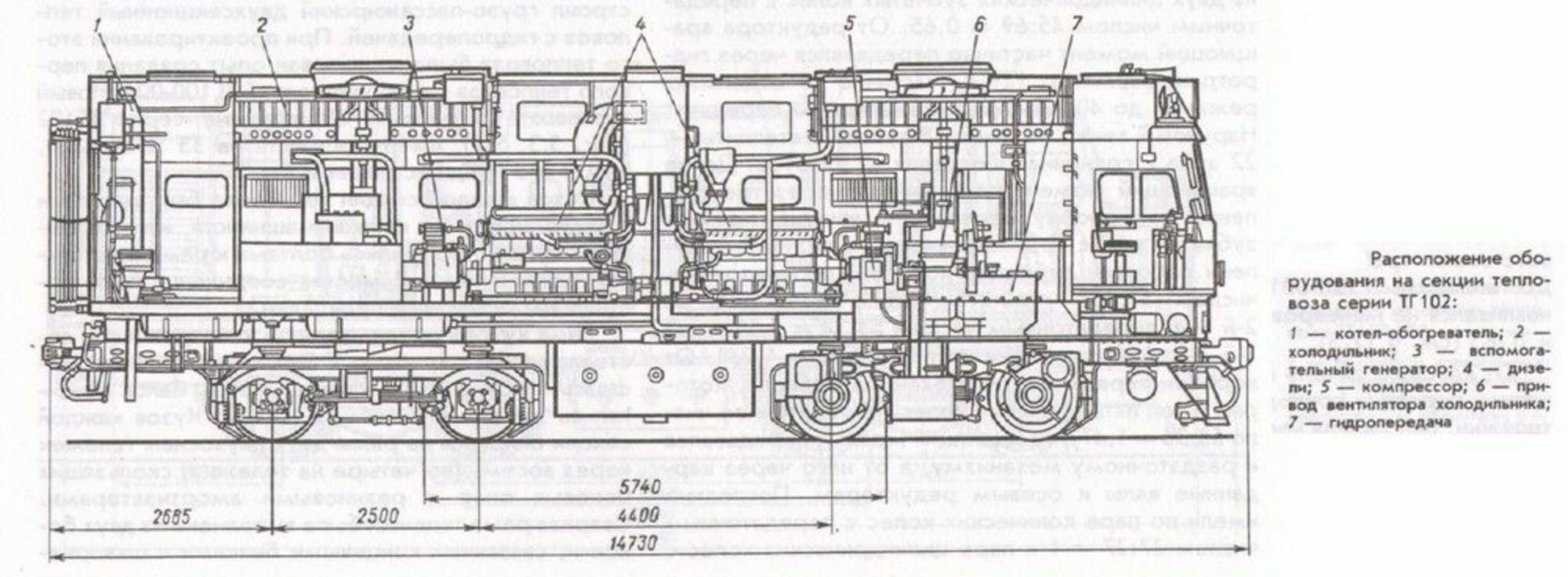
The TG100 design was classic: a welded steel frame with a double backbone beam rested on bogies via kingpins, through which traction and braking forces were transmitted to the locomotive frame. Two diesel engines with centrifugal supercharging of the M751 type were installed on the frame. These V-shaped 12-cylinder engines developed a power of 750 hp each. This diesel was mainly manufactured for military boats and, in terms of its engine life and characteristics, was of little use in rail transport.

However, the industry did not produce any other diesel engine of such power, and engines of this family were forced to be used for traction in rail transport. In particular, they were used on diesel locomotives TGM2, TGM3, TG16, diesel trains DR1 and ACh2.

Each diesel engine used a hydromechanical transmission to drive two wheel pairs of one bogie. Torque was transmitted through a hydraulic transmission, which included a planetary gearbox, which was used in some cases. Then through a three-speed gearbox with friction clutches, through a reversible gearbox and cardan shafts to the axle gearboxes of the wheel pairs.

For the first time in the USSR, an electric automatic control system for the hydraulic transmission was used on a diesel locomotive. The system itself switched the speed of the locomotive and the rotation frequency of the diesel shaft. The mass of each section was 80 t. The traction force of the diesel locomotive at a speed of 25 km/h was 24,800 kgf. The design speed of the diesel locomotive was 120 km/h.

Museum exhibit

The diesel locomotive presented in the museum is made up of two different sections № 153 and № 169, both produced in 1963. They belong to the TG102rk type, that is, with a hydraulic transmission on the frame, a monocoque body and a hydraulic transmission from the Kaluga plant. Diesel locomotives with a monocoque body had a different suspension to the bogies, consisting of eight sliding supports, four per bogie. Not only vertical but also horizontal forces, including traction and braking, were transmitted through these supports.

Mainline diesel locomotives with hydraulic transmission were not built in the USSR in the future. The only exception was the TG16 locomotives for the Sakhalin Island railway with a track width of 1,067 mm, which were assembled by the Lyudinovo Diesel Locomotive Plant.

The diesel locomotives turned out to be very problematic in operation and did not even reach the required 29-year service life. More reliable were the diesel locomotives with Voith hydraulic transmission. The drivers nicknamed them "We'll pull them out of grief 102 times." All the diesel locomotives were operated on the October Railway. 76 of them were operated closer to the manufacturer of the diesel locomotives and engines - at the Leningrad-Vitebsky depot.

In the future, mainline diesel locomotives with hydraulic transmission were not built in the USSR. The only exception were diesel locomotives for the railway on Sakhalin Island, which had a track width of 1067 mm, type TG16. They were built by the Lyudinovo Diesel Locomotive Plant.

Parameters

Technical
specifications

Length of one section, mm
14,730
Wheel diameter, mm
1,050
Distance between bogie axles, mm
5740
Axle boxes
Bearings with cylindrical rollers
Boogie wheelbase, mm
2,500
Diesel
M756
Number of cylinders
12
Diameter, mm (diesel engine)
180
Piston stroke, mm
200 and 209.8
Rated shaft rotation power, rpm (diesel engine)
1,500
Power, hp
1,000
Fuel consumption at rated power, g/e hp h.
165–170
Engine weight, kg
1,800 without oil
Number of water cooling sections
22
For oil cooling
4
For torque converter cooling
10
Auxiliary generator
MVG-25/11
Power, kW
5
Voltage (auxiliary generator)
75 V
Compensator
VV-1.5/9
Performance, l/min
1,500
Battery
32TN-450
Fuel capacity, l
6,200
Sand capacity, kg
600
Service weight, t
2 x 84
Maximum speed, km/h
120
Maximum traction force, kg
32,500

Drawings
and diagrams

History

Chronology

  1. 1846 Serial production of these locomotives according to the drawings of the Lugansk Diesel Locomotive Plant was launched at the Leningrad Diesel Locomotive Plant (Proletarsky Locomotive Repair Plant). It is also the Aleksandrovsky Plant, which built the first steam locomotives for the Nikolaevskaya Railway in 1846.
  2. 1956 Serial production of mainline diesel locomotives began in 1956, when a decision was made to stop building steam locomotives. The first mainline diesel locomotive with hydraulic transmission was the experimental two-section locomotive TG100-001, built in 1959. The design and construction were carried out by the October Revolution Lugansk Diesel Locomotive Plant. The locomotive consisted of two identical sections. Each section rested on two two-axle bogies.
  3. 1959 Considering the experience of building and operating the TG100-001 locomotive, at the end of 1959 the Lugansk Diesel Locomotive Plant built a new locomotive, which received the designation TG-102 (Diesel locomotive with hydraulic transmission, type 102). The locomotives even differed in appearance. If the TG100 diesel locomotive was more reminiscent of the American diesel locomotives of the 1930s and 1940s in design, the new locomotive already had a classic body silhouette. The locomotive driver's cabin was manufactured and attached to the frame and body separately with bolts. The frame was of the same design as the TG100 locomotive. The new locomotive was equipped with four M756 diesel engines from the Zvezda plant, which differed from the M751 engine by the presence of a gas turbine supercharger. The engine power was 1,000 hp at 1,500 rpm.
  4. 1963 The diesel locomotive presented in the museum belongs to the Central Museum of Railway Transport. The locomotive is made up of two different sections, No. 153 and No. 169, both sections were manufactured in 1963. They belong to the TG102RK type, that is, with a hydraulic transmission on the frame, a load-bearing body and a hydraulic transmission from the Kaluga plant. Diesel locomotives with a monocoque body had a different suspension to the bogies, consisting of eight sliding supports (four per bogie). Not only vertical but also horizontal forces were transmitted through these supports, including traction and braking.
  5. 1987 The locomotive entered the museum in 1987.