Today the museum is closed

Map

Exhibit description

Shunting electric locomotive VL41-060

They made do with steam locomotives

Traditionally, Russian railways hardly ever used specially built steam locomotives for shunting work. This work was performed by older type steam locomotives, which could no longer be used for train traction. At the very beginning of railway construction, with little traffic and a lack of branching of station and access roads, this work was performed by train locomotives.

With the transition to electric traction, attempts were made to create a shunting electric locomotive, but its dependence on the contact network limited its scope of application. The situation could have been corrected by installing an independent engine. However, such locomotives would have been significantly more expensive and more difficult to operate, so apart from individual experiments, this branch of electric locomotive construction did not develop.

Rapid development

In the 1950-1960s not only in the USSR, but also throughout the world, new types of technology — and not only railway ones — were rapidly developing. Much of what we use today — is the result of research and development of that period.

Similar experiments were also conducted on narrow-gauge electric locomotives. Thus, at the Demikhov Machine-Building Plant in 1959-1962 several types of electric locomotives with an autonomous engine were built, which successfully operated until the mid-1970s at the Shatura Peat Administration.

One of the attempts to develop a new type was the creation in 1963–1964 at the Dnepropetrovsk Electric Locomotive Plant of an electric locomotive, initially named D92, and then renamed VL41. In 1963 28 electric locomotives were built and in 1964 — 50.

In 1975 according to the MPS Design Bureau project on 13 locomotives ignitron rectifiers were replaced with silicon ones. The converted electric locomotives were designated VL41m. From the plant, locomotives were delivered to the East Siberian, Gorky, West Siberian, Moscow, Odessa-Kishinev, North Caucasus and South-Eastern railways.

However, electric locomotives had insufficient coupling weight and were poorly suited for heavy shunting work, which limited their use. The main part was transferred to coal mining enterprises during 1970–1975. The last VL41 electric locomotives No. 060, 063, 073 and 076 were excluded from the inventory of the Ministry of Railways in 1990. One of these electric locomotives number VL41 060 was transferred to the Central Museum of Railway Transport.

Traditionally, Russian Railways rarely used steam locomotives specially built for shunting work. This work was performed by older type steam locomotives, which could no longer be used for train traction.

With the transition to electric traction, they tried to create a shunting electric locomotive, but its dependence on the contact network limited its scope of application. The situation could be corrected by installing an independent (diesel) engine to move along tracks without a contact network. But such locomotives would be significantly more expensive and more difficult to operate. Therefore, apart from individual experiments with shunting electric locomotives, this branch of electric locomotive construction was not further developed.

From the factory, these locomotives were delivered to the East Siberian, Gorky, West Siberian, Moscow, Odessa-Kishinev, North Caucasian and South-Eastern Railways.

One of these electric locomotives, number VL-41m-60, was transferred to the Central Museum of Railway Transport.

Parameters

Technical
specifications

Number of axles
4
Electric locomotive weight, t
92
Height, mm
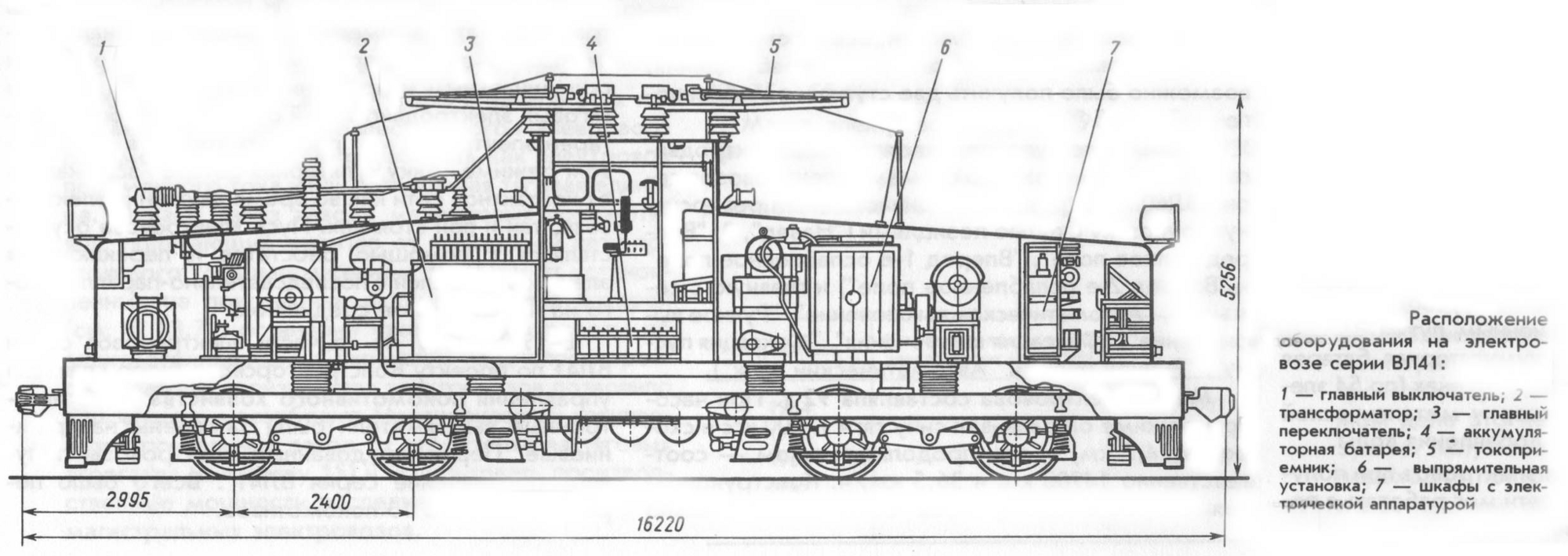
5,256
Length over buffers, mm
16,220
Distance between axles, mm
2,400
Wheel diameter, mm
1,200
Transformer
ОЦР-2800/25
Rated power, kW
2,260
Traction motor
НБ-406
Voltage, V
1,200
Tractive force, kgf
17,500
Speed, km/h
34.7
Design speed, km/h
100

Drawings
and diagrams

History

Chronology

  1. 1963–1964 During one of the attempts to create a new type of electric locomotive in 1963-1964, the D92 electric locomotive appeared at the Dnepropetrovsk Electric Locomotive Plant. It was subsequently renamed the VL-41.
  2. 1963 In 1963, 28 electric locomotives were built (VL41-001 - VL41-028) and in 1964 - 50 (VL41-029 - VL41-078). A total of 78 units.
  3. 1970–1975 However, the electric locomotive had insufficient adhesion weight and was poorly suited for heavy shunting work, which limited its use. Therefore, they began to be transferred to industrial enterprises. For this, the primary windings of the transformer were replaced with a 10 kV supply, that is, the voltage used in industry. The main part was transferred to the tracks of coal mining enterprises during 1970-1975.
  4. 1975 In 1975, according to the project of the Design Bureau of the Main Directorate of Locomotive Facilities of the Ministry of Railways, ignitron rectifiers were replaced with silicon ones on 13 locomotives. The converted electric locomotives were designated VL-41m.
  5. 1990 The last VL-41m electric locomotives No. 60, 63, 73 and 76 were excluded from the inventory of the Ministry of Railways in 1990.