Today the museum is closed

Map

Exhibit description

Diesel train D1 719-3

Long-standing partners

The Hungarian Ganz plant had long-standing ties with Russia. As early as 1906 it delivered two steam locomotive-cars for the Petersburg-Warsaw Railway. In 1945–1946 ten three-car diesel trains, originally built for Argentina on a 1,000 mm gauge (they were named "Rosaria"), were transferred to the USSR as reparations. In 1949–1951 Ganz delivered eight three-car trains of the DP series.

The plant was faced with the task of building a three-car suburban and local passenger train. In 1960 the first train was released under the designation DP-021, later changed to D-021. At the same time in 1964 with the release of three-car diesel trains, they began to build four-car diesel trains, and from the following year they completely switched to their production.

The trains were delivered to the USSR in 1964–1988. The first batch arrived in 1964 and was tested on the Baltic Railway. Diesel trains operated on the Baltic, Oktyabrskaya, Odessa-Kishinevskaya, Gorky, Moscow and other railways.

The last trains of the series arrived in 1988. In the 1960s the plant built 40 trains per year, in the next decade — 30. A total of 605 trains (No. 201–805), 2,540 cars, including 1,210 motor cars and 1,330 trailer cars were delivered.

The motor carriages of the D1 diesel trains were built at the Ganz-MAVAG plant (it received this name in 1949) Trailer carriages No. 201–205 and No. 661–685 were also made there. The order for trailer carriages No. 206–660 was transferred to the Rába carriage-building plant in the city of Győr, and since 1982 — to the Romanian enterprise Astra Wagon.

Additional trailer cars were also built, and trains No. 581–640, built in 1976–1978, were six-car.

The lead car D1-719-3 was built in 1984 It was operated on the October Railway. It was received by the museum from the Vyborg locomotive depot in 2002

Taking into account the experience of this plant in building diesel trains, it was given the task of designing and building a three-car train for suburban and local passenger traffic.

Parameters

Technical
specifications

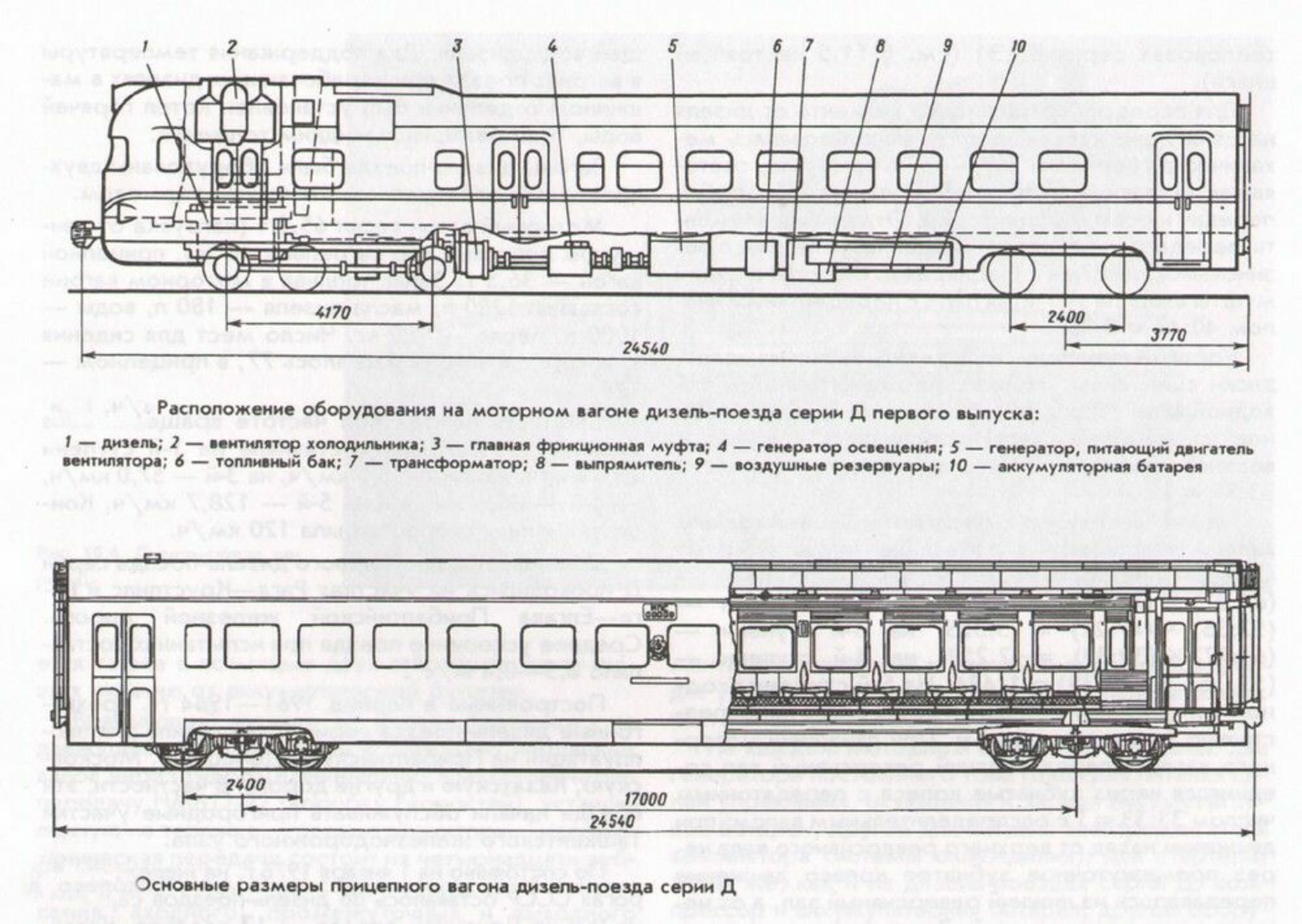
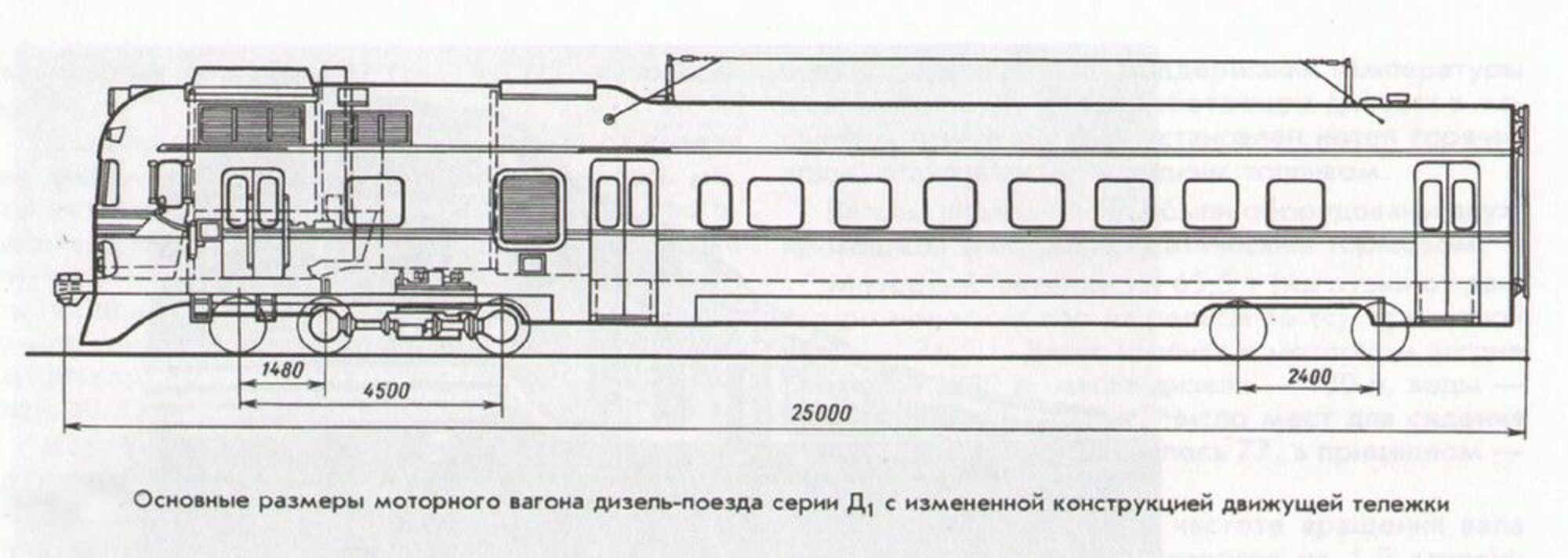
Length by axles of automatic couplings, mm
25,000
Length of trailer, mm
24,540
Car body width, mm
3,076
Motor car weight, t
70.5
Load on driving wheel pairs, tf
16
Fuel capacity, l
1,200
Sand capacity, kg
100
Number of seats in the motor car
77
Number of seats in the trailer
128
Axle characteristic
3-axle
Diameter of wheel pairs, mm
950
Total wheelbase, mm
18,960
Wheelbase of 3-axle bogie, mm
4,170
Distance between axles, mm
1,500
Diesel
Ganz-Endraszek prechamber system
Diesel brand (diesel engine)
12VFE 17/24
Shaft speed, rpm
1,250
Power, hp
730
Cylinder arrangement
V-shaped
Cylinder diameter, mm (diesel engine)
170
Piston stroke, mm
240
Fuel consumption at rated power, g
168
Diesel weight, kgf
4,600

Drawings
and diagrams

History

Chronology

  1. 1906 The Ganz & Co plant also supplied its products to pre-revolutionary Russia. Thus, in 1906, two four-axle steam locomotive cars were built by order of the then Petersburg-Warsaw (later North-Western) Railway. One was for suburban service, and the second was a "saloon car-motor", which received the designation M1 on the road. The latter was used for official trips of the railway management and the Ministry of Railways.
  2. 1945–1946 In the post-war period, in 1945-1946, ten three-car Ganz-MAVAG diesel trains with mechanical transmission manufactured by this plant were transferred to the USSR as reparations. They were built just before the start of World War II for Argentina on a 1,000 mm gauge. There they received the beautiful name "Rosaria" and after conversion to 1,524 mm gauge they were used on Soviet railways. In 1949-1951 the same plant delivered 8 three-car trains of the DP series.
  3. 1960 In 1960, the first train was built under the designation DP-021, later changed to D-021, where the designation DP means passenger diesel train. It consisted of two lead motor cars and one intermediate trailer. The plant built these trains from 1961 to 1964, a total of 89 such diesel trains were built (No. 021-109).
  4. 1964 In 1964, at the same time as the production of three-car trains, the plant began building four-car diesel trains, and in 1965 switched completely to their production.
  5. 1964 The trains were delivered to the USSR from 1964 to 1988. The first batch of five trains arrived in the Soviet Union in mid-1964, after which they were sent for trial operation to the Baltic Railway. The last trains of the series were delivered to the USSR in April 1988.
  6. 1964 In the sixties, the plant built about 40 trains per year, starting in the seventies - 30 per year. Diesel trains of the D1 series were produced from 1964 to 1988. A total of 605 trains (No. 201–805) and 2,540 carriages were built, including 1,210 motor carriages and 1,330 trailer carriages. The motor carriages of the D1 diesel trains were built at the Ganz-MAVAG plant, where trailer carriages in the No. 201–205 and No. 661–685 ranges were also built. Trailer carriages in the No. 206–660 range (1964–1982) were built at the Rába Magyar Vagon-és Gépgyár carriage factory in the city of Gyor (People's Republic of Hungary).
  7. 1982 After 1982 (starting with D1-686), within the framework of cooperation between the CMEA countries, the production of trailer cars was transferred to the Astra Vagoane plant in the city of Arad (Socialist Republic of Romania).
  8. 1984 The lead car D1-719-3 was built in 1984. It was operated on the October Railway. It was received by the museum from the Vyborg locomotive depot in 2002.