Today the museum is open from 10:00 to 18:00

Map

Exhibit description

Freight locomotive L 2298

In 1943, a breakthrough year in the course of the Great Patriotic War, questions arose regarding what steam locomotives to build in the USSR after the victory, when the country would need to return to peacetime and restore the destroyed national economy. In early 1944, a commission was organised under the chairmanship of academic S.P. Syromyatnikov. Its task was to select the type of new freight steam locomotive to be built after the war.

The axle load of the newly designed steam locomotive could not exceed 18 t due to the condition of the rail track equipment.

The specialists of the commission concluded that, first of all, it was necessary that the axle load of the steam locomotive would not exceed 18 t. This was due to the condition of the rail track equipment on Russia’s railways. The construction of old types of steam locomotives — the classes ER and SO — were permitted as a temporary measure, as they had become technically obsolete by the mid-1940s.

Preliminary designs for 1-5-0-type steam locomotives with an axle load of 18 t and coupling wheelset diameter of 1,500 mm were submitted for consideration in March 1944 by the Traction Department and the Central Research Institute of the People’s Commissariat of Communication Routes, as well as the Kolomna Locomotive Works.

Class P

In March 1945, the Kolomna Locomotive Works’ design — factory type P32 — was selected for production, which was assigned to the plant that had developed the design. The steam locomotive, which was named the class P (for “Pobeda”, Russian for “victory”) made its first trip on 5th October 1945 on the Kolomna-Rybnoye section.

The new steam locomotive had a bar frame, mechanical stoker, centralised lubrication of vehicle and cab, and a Vanderbilt-type tank tender with a cylindrical water tank, pretty new for Soviet railways.

At the end of the year, the second steam locomotive, P 0002, was built. In 1946, the Kolomna Locomotive Works built 76 new locomotives, and the restored Bryansk Locomotive Works built its first post-war vehicle — P 1001.

Some of the class P steam locomotives were fitted with original Vanderbilt-type tank tenders, which were less likely to break under large volumes of water during travel and supply.

Only Kolomna-built steam locomotives had original Vanderbilt-type tank tenders. Despite the fact that these types of tenders broke less often under large volumes of water during travel and supply, they had significant disadvantages: they were more difficult to build and had an increased length, which mean that locomotives with these tenders could not fit in bays designed for type 1-5-0 SO- and Ye-class steam locomotives. This led to tank tenders being gradually replaced by conventional rectangular type P33 tenders by 1947.

Class L

In January 1947, when the new 1-5-0 steam locomotives were approved for series production by the Council of Ministers of the USSR, they were given the class designation L after chief designer L.S. Lebedyansky. Correspondingly, the few class L 2-3-1 passenger steam locomotives in the railway fleet of the USSR were assigned the index P to differentiate them from the new locomotives. All previously manufactured class P vehicles were renamed.

The Kolomna Locomotive Works engineers L.S. Lebedyansky, G.A. Zhilin, V.K. Chistov, D.V. Lvov, V.D. Utkin and V.D. Dyakov were awarded the Stalin Prize in 1947 for the development of the new freight locomotive.

In 1947, the class P was renamed to L. A total of 4,200 steam locomotives were produced, one of which was sent to China.

Series production of the class L continued until 1954 at the Kolomna Locomotive Works (1,762 locomotives built), until 1950 in the Bryansk Locomotive Works (389 locomotives) and until 1955 in the Voroshilovgrad Locomotive Works (2,049 locomotives). In total, 4,200 class L steam locomotives were produced. 4,199 were put into operation on the railways, and L 2143, manufactured at the Kolomna Locomotive Works, was sent to the People’s Republic of China.

Class L steam locomotives did have their disadvantages, mainly due to the designer’s desire to reduce the weight of assemblies and parts. The weakest points were the cylindrical half-blocks, connection to the firebox, steam chest bushing, coupling rods, and several other parts: cracks would form in them during operation. To prevent this, a decision was made in 1952 to revise the design and reinforce these assemblies and parts. From the end of 1952, the locomotives began to be built according to the revised drawings.

The large number of class L steam locomotives constructed ensured their wide distribution on the rail network of the USSR. They were in operation from Transbaikalia to Belarus and the Arctic Circle to the Caucasus.

Drivers affectionately nicknamed L-class locomotives “Lebedyankas” and appreciated them for their reliability, powerful boiler, and high speed.

Drivers loved these locomotives and affectionately nicknamed them “Lebedyankas”. Senior drivers appreciated their operational reliability, powerful boiler providing steam in all operating modes, and the relatively high speed. The 80 km/h design speed meant that the locomotives could successfully drive any passenger trains — even express ones — on steep gradients.

With freight traffic on a flat gradient, these steam locomotives operated with heavy trains of up to 5000 t. Among the drawbacks of the Lebedyankas was a slight tendency towards slippage due to the lack of coupling weight and rough running at high speeds, due to the use of a rearward fifth wheelset to improve the locomotive’s weight distribution.

Class L locomotives were in operation on the USSR’s railways until the very end of steam locomotive traction. Some vehicles were in operation pulling trains until the late 1970s on the Oktyabrskaya, Gorky, Baltic and other railways. Class L steam locomotives were used for service work until the late 1990s, and for heating depots and other railway enterprises, up to the 2000s.

Some class L steam locomotives were used for their intended purpose until the late 1970s, and for service work up until the 2000s. Even today, these vehicles can be found in operational condition.

Mass decommissioning and scrapping of class L locomotives began in the 1980s. As of 1st January 1992, there were 3,091 steam locomotives ofмthis class on the Ministry of Railways’ inventory. In the countries of the former Soviet Union, these locomotives can be found in large numbers in railway museums and on plinths. There are also still class L steam locomotives in operational condition.

L 2298

Freight steam locomotive L 2298 was built by the Kolomna Locomotive Works in 1954 under serial number 10084. The locomotive was fitted with decorative elements — testament to the fact that it was built to commemorate the 12th Congress of the Komsomol. The sides of the water tank were also inscribed with words to that effect.

In March 1954, the locomotive arrived for operation on the Moscow-Ryazan Railway. Since October 1959, it has been listed in the Moscow Railway fleet inventory. After the end of operations, it was moved to storage and housed at various storage bases on the Moscow Railway.

Parameters

Technical
specifications

Plant
Kolomna Locomotive
Year
1954
The locomotive's serial number
10084
Weight of the locomotive in working condition without tender, t
102.1
Weight of the locomotive in working condition with tender, t
170
Design speed, km/h
80
Maximum power at the wheel rim, hp
2,200
Axial formula
1-5-0
General data
Empty weight of a steam locomotive, t
92
Adhesive weight of a steam locomotive, t
90.1
Complete wheelbase of a steam locomotive with tender, mm
20 688
Length of a locomotive with tender along the axles of the automatic coupling, mm
23,717
Diameter of driving wheels, mm
1,500
Minimum radius of a passable curve, m
105.5
Tender type
Four-axle
Boiler
Steam pressure, kg/cm2
14
Firebox type
Radial
Grate area, m2
6.0
Total evaporating heating surface of the boiler (water), m2
222.3
Heating surface of superheater pipes (gas), m2
113
Number of smoke tubes, pcs.
111
Smoke tube diameter (outer), mm
51
Number of fire tubes, pcs.
50
Diameter of fire tubes (outer), mm
133
Superheater type
Double-turn
Superheater tube diameter (outer), mm
35
Type of heating
Coal, mechanical
Car and crew
Number of cylinders, pcs.
2
Cylinder diameter, mm
650
Piston stroke, mm
800
Diameter of valves, mm
300
Steam distribution system, t
Walschaer
Tender
Frame thickness, mm
140
Frame type
Block
Empty weight, t
36
Weight with full supply of water and coal, t
82
Water supply, m3
28
Coal stock, t
18
Type of trolleys
Cast
Suspension
Single spring

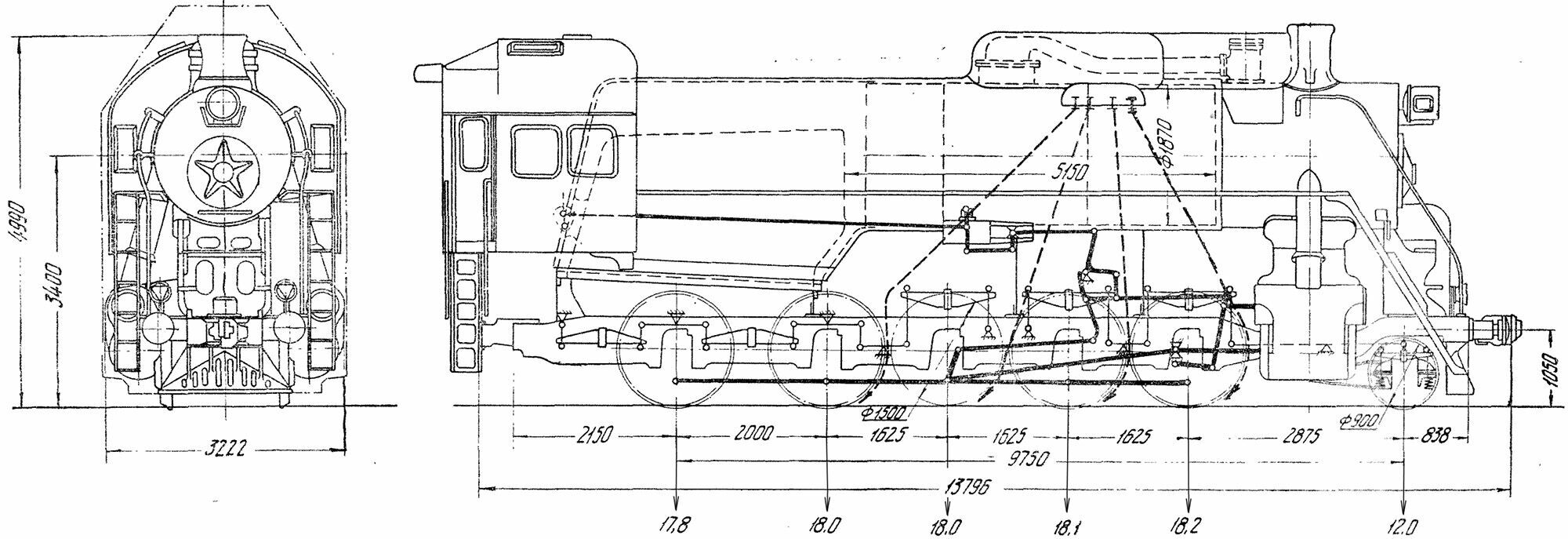
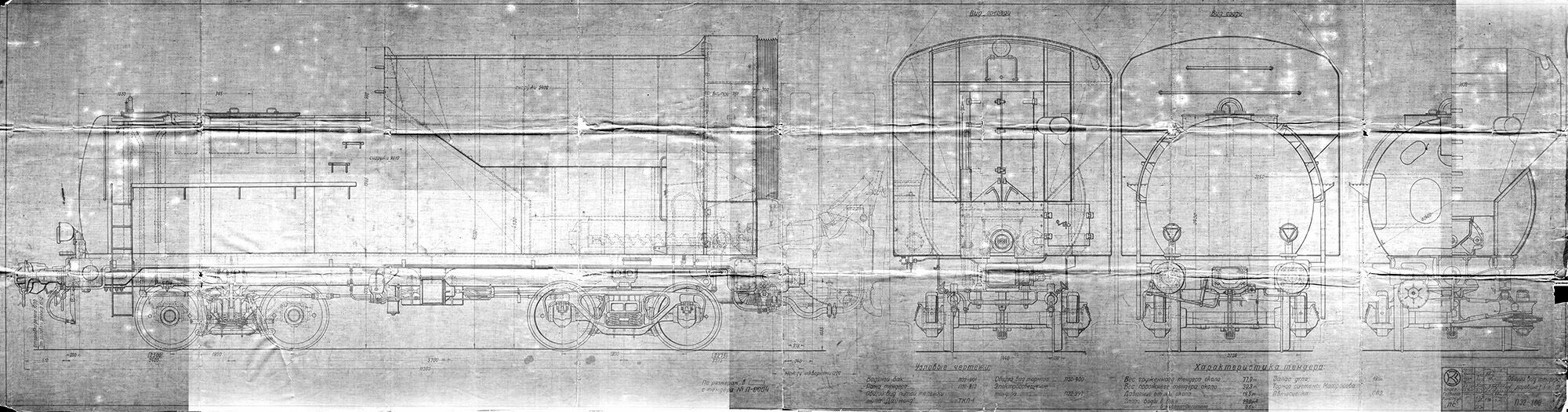
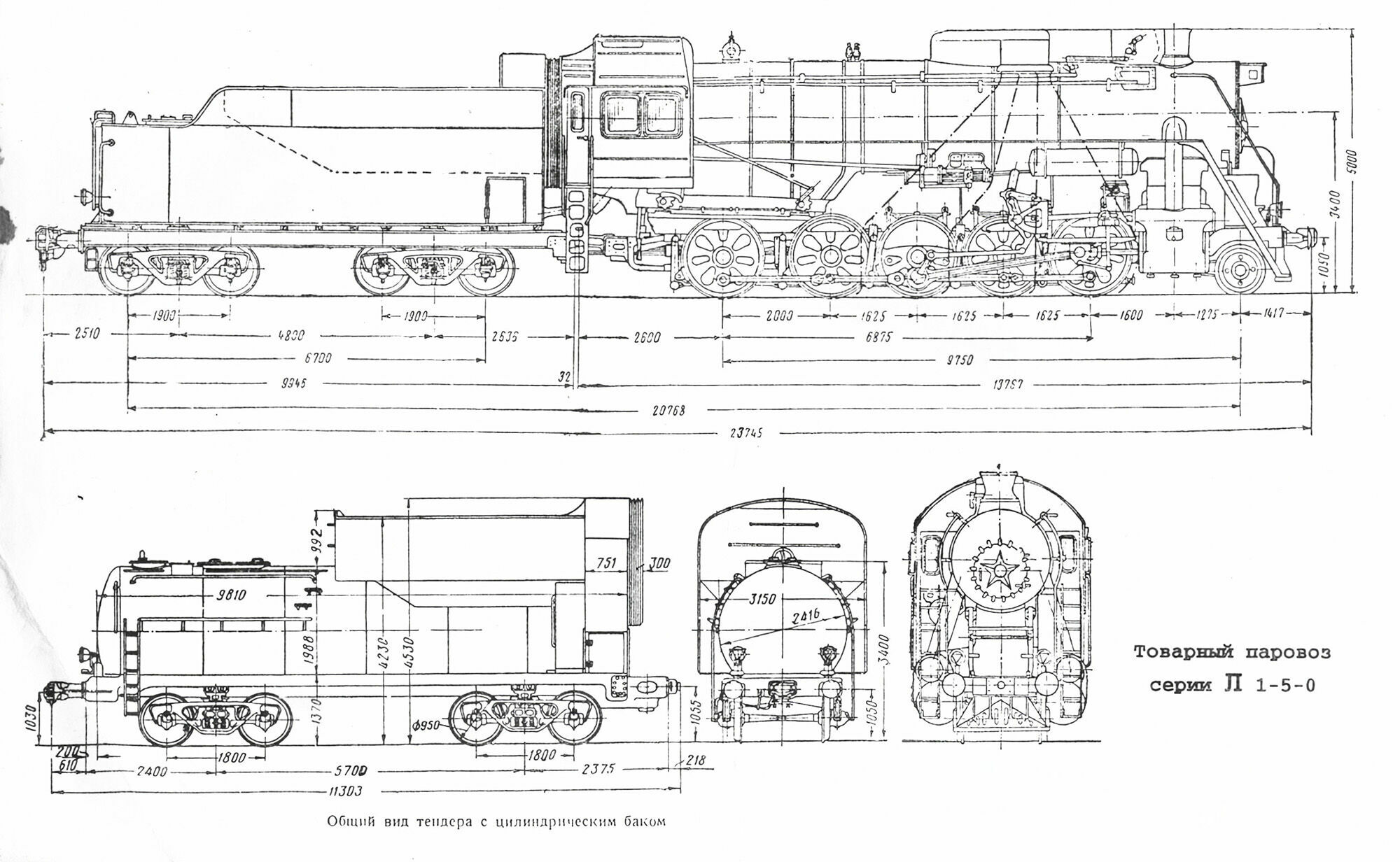
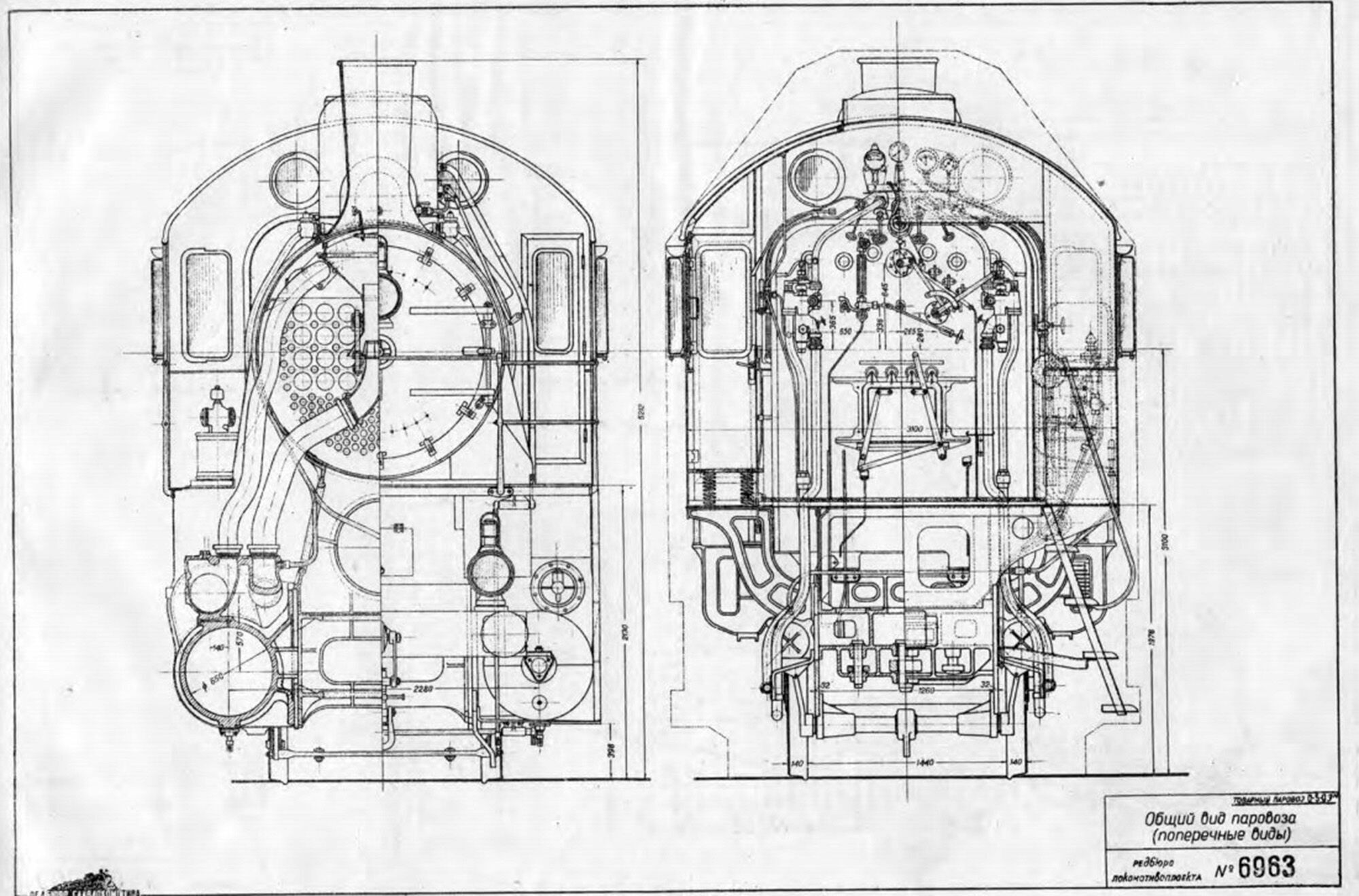
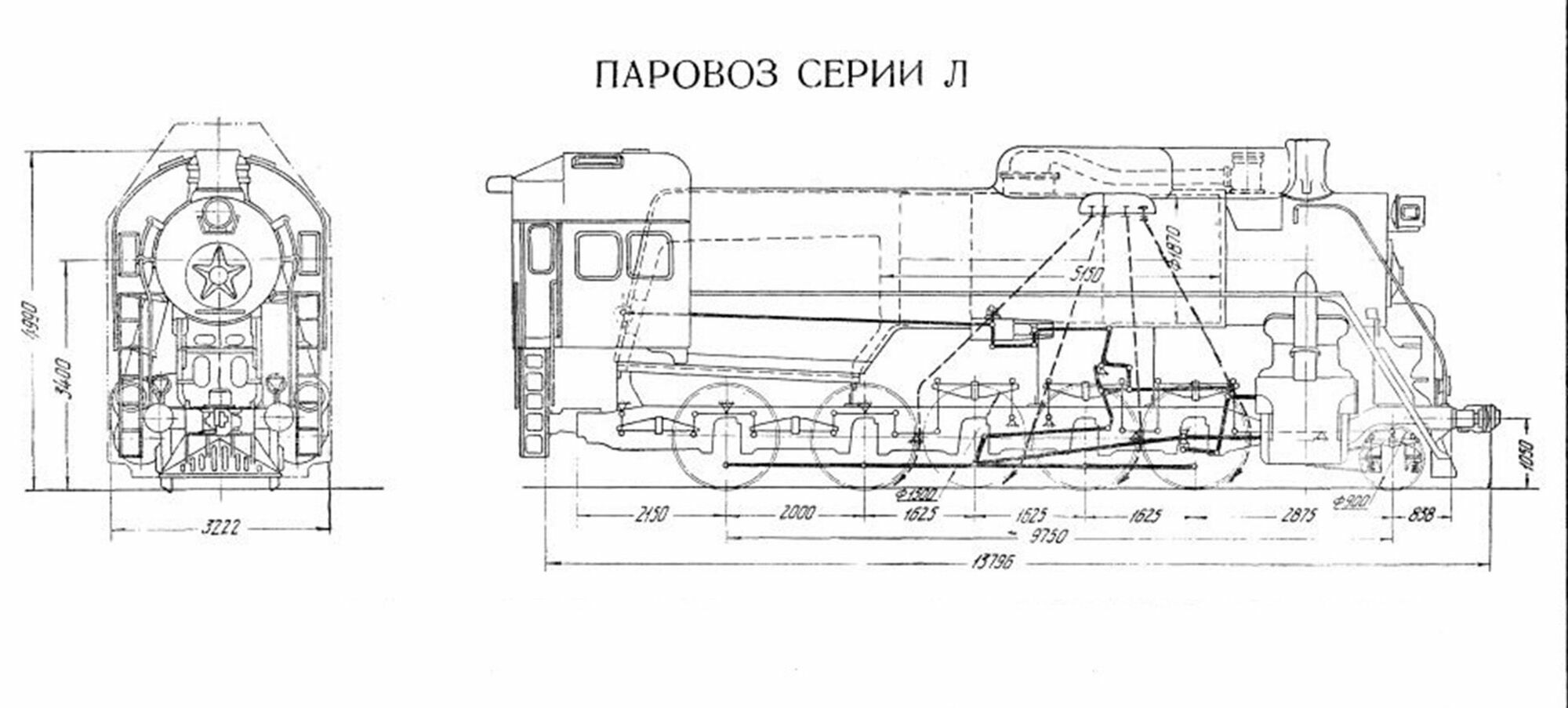
Drawings
and diagrams

History

Chronology

  1. 1943 Questions arise regarding what steam locomotives to build in the USSR after the victory.
  2. Early 1944 A commission is organised under the chairmanship of academic S.P. Syromyatnikov to select the new type of freight steam locomotive.
  3. March 1944 Preliminary designs for 1-5-0-type steam locomotives with an axle load of 18 t are submitted for consideration.
  4. March 1945 The Kolomna Locomotive Works design is selected for the production of the class P.
  5. October 5, 1945 The first class P steam locomotive (for “Pobeda”, Russian for “victory”) makes a trip on he Kolomna-Rybnoye section.
  6. End of 1945 The Kolomna Locomotive Works builds steam locomotive P 0002.
  7. 1946 The Kolomna Locomotive Works produces 76 class P steam locomotives, and the Bryansk Locomotive Works builds its first post-war steam locomotive, P 1001.
  8. January 1947 The class P is renamed to the class L in honour of its chief designer L.S. Lebedyansky.
  9. 1947 Tank tenders are replaced with conventional rectangular type P33 tenders.
  10. 1950 End of the steam locomotive class L production at the Bryansk Locomotive Works with a total of 389 vehicles built.
  11. 1952 The design of the class L is revised to improve reliability.
  12. 1954 Steam locomotive L 2298 is built by the Kolomna Locomotive Works. End of class production at the Kolomna Locomotive Works with a total of 1,762 vehicles built.
  13. 1955 End of the class production at the Voroshilovgrad Locomotive Works with a total of 2,049 vehicles built here, and a total of 4,200 across the entire country.
  14. Late 1970s End of use of the class L in train operations.
  15. 1980s Mass decommissioning and scrapping of class L locomotives.
  16. Late 1990s End of use of class L steam locomotives in service operations.
  17. 1st January 1992 3,091 class L steam locomotives remain in the Ministry of Railways’ fleet inventory.
  18. 2000s End of use of class L steam locomotives for heating in industry.