Today the museum is open from 10:00 to 18:00

Map

Exhibit description

Freight locomotive TE 6769

One of the consequences of Nazi Germany’s “eastward expansion of living space” (also referred to as Lebensraum) was an increase in the length of the railway lines in operation. This inevitably led to a shortage of rolling stock, especially locomotives.

The eastward advance of the German army stretched its supply lines. Old-fashioned steam locomotives could not cope with the Russian winter and froze.

The use of old-fashioned German and western European class locomotives on the Eastern Front in the 1941–1942 campaign led to enormous difficulty in supplying the Wehrmacht strike groups that had moved further into Soviet territory. These steam locomotives, which were completely unsuited to the Russian winter, froze. There was a shortage of spare parts for their maintenance and repair due to the different types and class being used.

War Locomotive

The solution to this situation was the development of the “war locomotive” (in German, Kriegslokomotive or Kriegslok), which was given class number 52 according to the German system. The main goals of the designers when creating this vehicle was as little use of scarce non-ferrous metals as possible, high ease and low cost of manufacture, and simple maintenance.

Compared to Class 50, which uses 3 t of non-ferrous metals, Class 52 used only 200 kg.

Class 52 was based on the contemporary German Class 50 locomotive, with the design as simplified as was possible. Instead of the 3 t of non-ferrous metals used in Class 50, the new locomotive used about 200 kg. The service life of the locomotive was dismissed as secondary:class 52 locomotives were intended to be melted down after the Third Reich’s victory.

The first locomotive — 52 001 — was manufactured at the Borsig plant in September 1942, and in January 1943, Class 52 war locomotives entered mass production at locomotive plants in Germany and countries under German occupation: Poland, Czechia, Austria and France. Mass production of Class 52 continued until 1945, and some individual batches were not completed until several years after the end of World War II. According to estimates, more than 6,100 steam locomotives were produced.

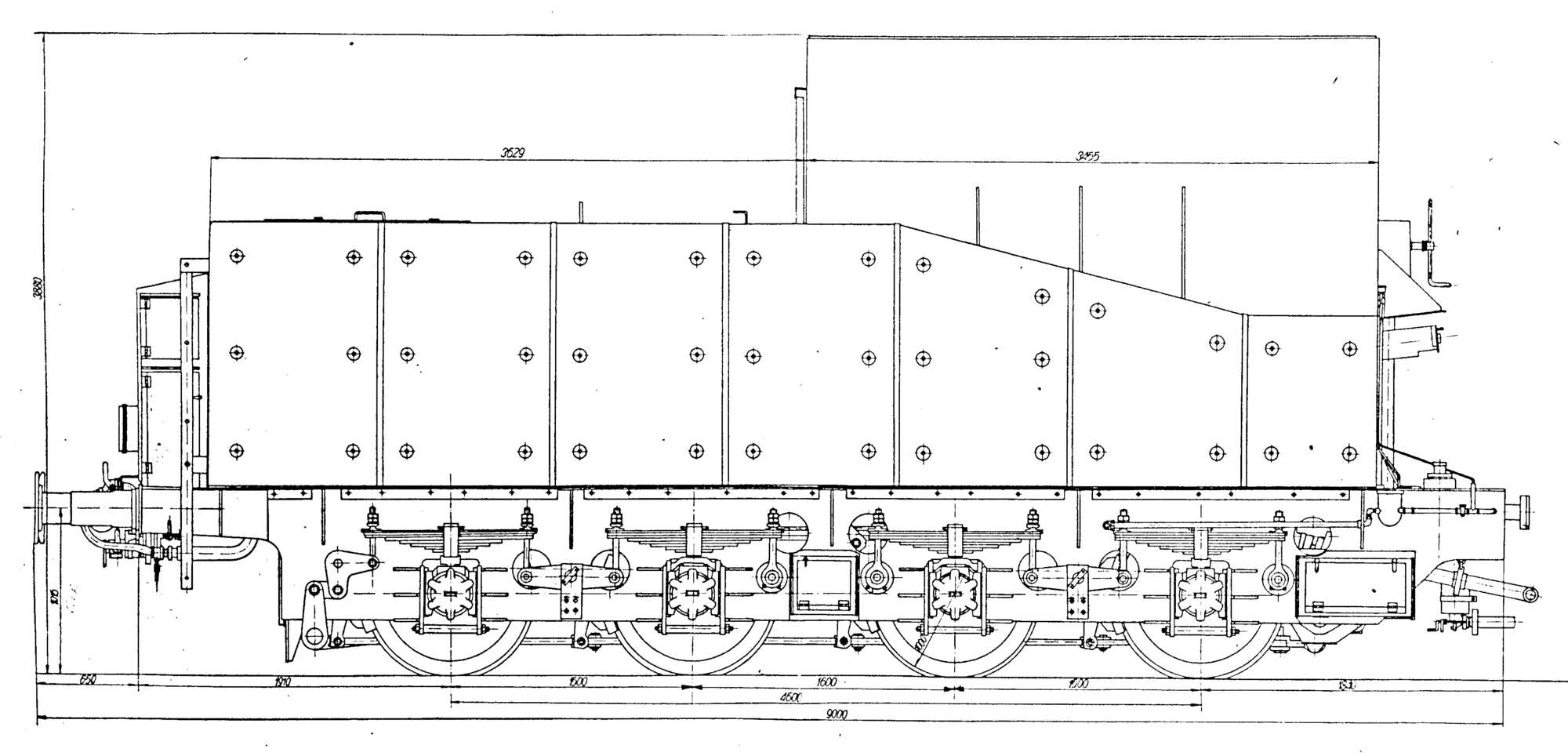
The design of Class 52 steam locomotives could vary greatly. For example, some of them used a bar frame, while the majority were based on a plate frame. In addition, several different types of tenders were coupled to Class 52 steam locomotives during production. The K4T30 tender, with four axles in a rigid frame, and the K2 2 T30 tender, which was frameless with a trough-shaped water tank, had no analogues in Russian steam locomotives.

Approximately 170 Class 52 condensing steam locomotives were produced for operation on sections without water and lines with poor water quality.

Among Class 52 locomotives produced, special mention should be made of the approximately 170 condensing steam locomotives designed for operation on sections without water and lines with poor water quality.

Soviet Trophies

Class 52 steam locomotives first fell into the hands of Soviet troops as trophies in 1943. Later, as the Soviet troops advances westwards, the number of captured Class 52 locomotives steadily increased. Some of them were used by Soviet military railway workers. On 25th April 1945, steam locomotive 52 1168, driven by A.Ye. Lesnikov of the 29th Railway Brigade, carried the first Soviet troop train into Berlin, where the fighting was still ongoing.

The first Soviet troop train to enter Berlin in 1945 was captured steam locomotive 52 1168.

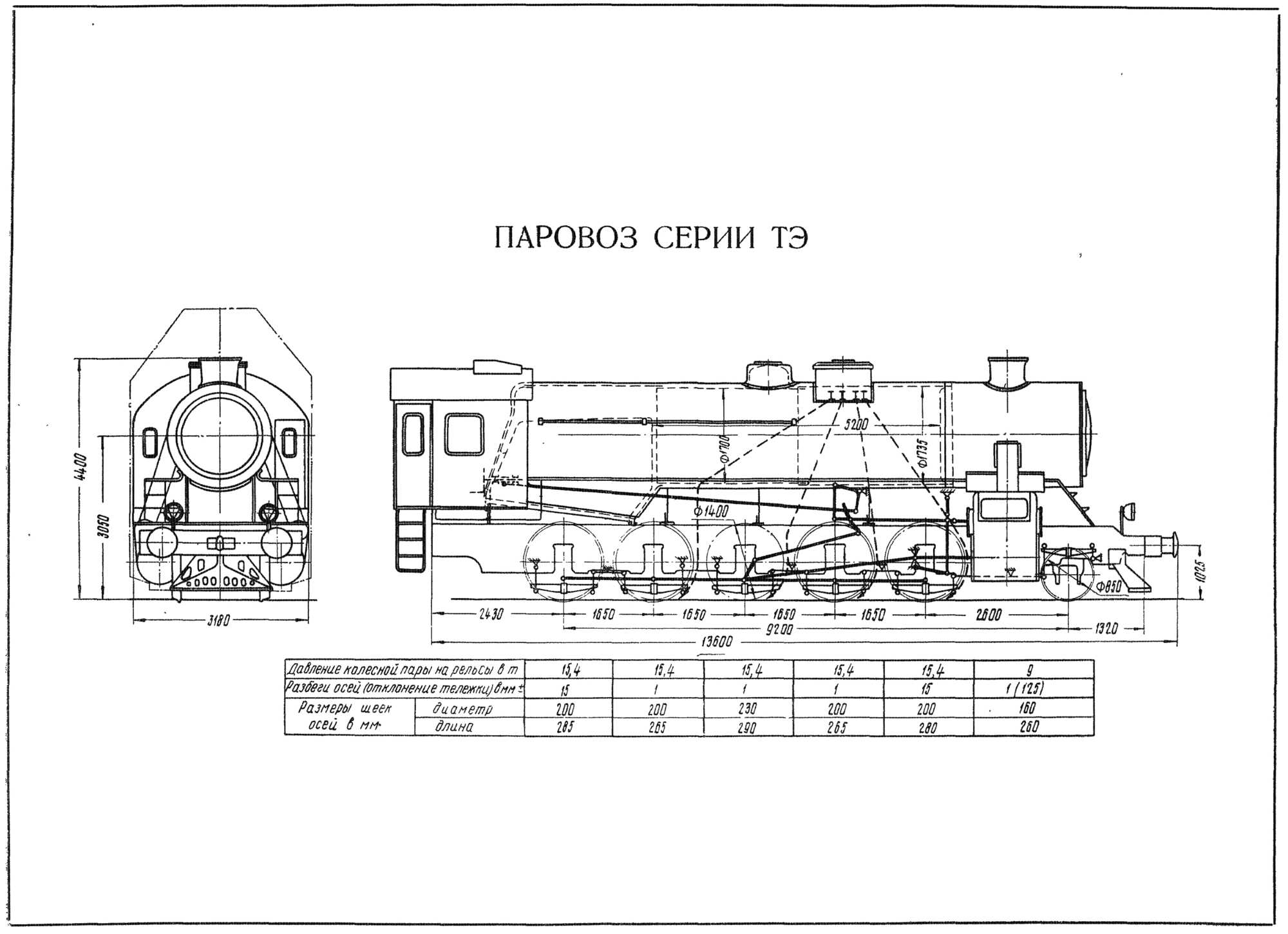
In total, approximately 2,000 Class 52 steam locomotives ended up in the USSR as trophies and, later on, as part of reparations. The German designation was retained until 1952, when, by order V-60570 of the Soviet Ministry of Railways of 23rd August 1952, Class 52 locomotives were renamed to the Soviet class TE (for “trophy”), with characteristics similar to E-class steam locomotives. The numbering of the steam locomotives remained unchanged throughout their period as part of the Soviet railway fleet.

1,435-mm-gauge vehicles went to the locations where the captured steam locomotives were based, where they were converted in the field to 1,524-mm gauge via a temporary fix and then sent on at limited speed to locations for major alteration works. Mass conversion of Class 52 steam locomotives to Soviet domestic gauge began in 1946 in the workshops at the Unecha Station on the Moscow-Kyiv Railway. The design change consisted in adjusting the wheel centres on the axles.

Some Class 52 steam locomotives were not converted to Soviet gauge, but left in border regions and at storage bases in case of military action.

Later on, steam locomotive repair plants in the western parts of the USSR joined the conversion effort. Many steam locomotives that came to the USSR as reparations were converted to Soviet gauge in workshops in Czechoslovakia (now Czechia) and  Romania. Some locomotives in the USSR remained on western European gauge for operation in border regions and at storage bases for use in case of military action.

Being relatively new and arriving in the USSR in significant number, Class 52 locomotives — unlike captured locomotives from older classes — had to be refurbished to meet Soviet standards and operation requirements. To begin with, for example, Class 52 steam locomotives did not have level plugs.

In order to establish a unified program of locomotive conversion and refurbishment, in 1947, the Soviet Ministry of Railways specified the design changes required when overhauling steam locomotives at plants and depots. For example, the installation of two V-250 vertical injectors and Everlasting blowdown valves, the outfitting of furnace grates with chain grates, and the installation of segment piston rings, Nathan forced-feed cylinder lubricators and more were deemed mandatory. In addition to the mandatory modifications to the steam locomotives, other measures were also taken to improve their operation.

In the late 1940s, approximately 35 Class 52 steam locomotives were assembled from the parts of damaged locomotives.

In the late 1940s, approximately 35 steam locomotives were assembled using parts from damaged locomotives at the Stanislavsky (Ivano-Frankivsky) Locomotive Repair Plant. They were numbered from 8001 to 8036.

TE (Class 52) steam locomotives were mainly put into operation on lines previously served by E-class steam locomotives of all kinds, without any change to the existing train weight norms. Steam locomotive engineers nicknamed these locomotives “Frau”; significantly less often, they referred to them as “Nemka” (Russian for “German woman”); and occasionally, the class TE was referred to as “Thälmann Ernst”.

TE steam locomotives became widespread on the tracks of the European part of the USSR. On track sections with a level profile, TEs sometimes pulled heavy trains weighing up to 4,500 t. In general, however, the normal weight was 1,200–2,000 t.

Equipping steam locomotives with oil heating in the late 1950s and early 1960s allowed the originally calculated impulse excitation to be increased and traction characteristics to be improved. Due to their good ride performance, TE locomotives were often used for passenger transport. Some of these locomotives were painted green or blue.

Among the drawbacks of TE steam locomotives was the weakness of the connecting rods, which frequently broke, sometimes with severe consequences. When the German connecting rods were replaced with reinforced ones in the 1950s, the balancing was put out of equilibrium, which resulted in reduced running smoothness at high speeds. A significant drawback of the steam locomotive design was the small boiler steam space. In addition to the lack of a steam desaturator and the low siting of the regulator heads, this led to water being “thrown” and carried into the cylinders.

In the early 1960s, in connection with the broad introduction of new types of traction, approximately 700 class TE steam locomotives were transferred to the socialist countries of Eastern Europe. At the same time, TEs began to be transferred to industrial works railways. They were put to work at plants and mines in the Urals and Donbas, forestry operations in the Arkhangelsk and Kirov Oblasts, and at many other enterprises of the Soviet Union.

A significant number of TE steam locomotives were converted back to Western European gauge in the 1960s and sent to storage bases along the western border of the USSR. They remained there until the late 1980s, undergoing routine tests and preventive maintenance.

Those steam locomotives left on the wider gauge in most part remained in operation until the 1960s-70s. Some were still used for service and export work up to the 1980s. As of 1st January 1992, the fleet inventory of the Ministry of Railways reported 48 wide-gauge TE steam locomotives. Mass decommissioning of the class was carried out in the 1980s-90s.

TE steam locomotives are preserved in railway museums in the countries of the former USSR, where about ten of them are installed on plinths. Several steam locomotives in Russia and Belarus are maintained in operational condition for driving historical trains.

Museum Exhibit

Steam locomotive 52 6769 was manufactured at the Florisdorf plant in Vienna, Austria, in 1943 and was assigned serial number 16222. Today, it is hitched to a TE 102 steam locomotive tender.

The history of this locomotive in post-war Europe — much like that of other Class 52 locomotives — is rather complicated. In 1945, the steam locomotive was on the Austrian railways. On 6th June 1945, it was transferred to  Hungary, and on 12th March 1948, it came to Romania’s Căile Ferate Române railways. On 11th August 1950, the steam locomotive was converted to Soviet gauge, and in October of the same year, it was delivered to the railways of the Soviet Union.

The steam locomotive transferred to the Chișinău Railway, where it was in operation in the Bender Depot until May 1955. It then ended up in Lithuania and Estonia, operating from June 1955 in the Kaunas Depot and then the Tapa Depot. In June 1963, the steam locomotive was transferred to the Belarusian Railway. In 1965, it was included in the Luninyets Depot fleet inventory. After the end of operations, the locomotive was sorted at the storage base in Luninyets. In 1984, it was assigned a new eight-digit “computer” number: 1042.487-7.

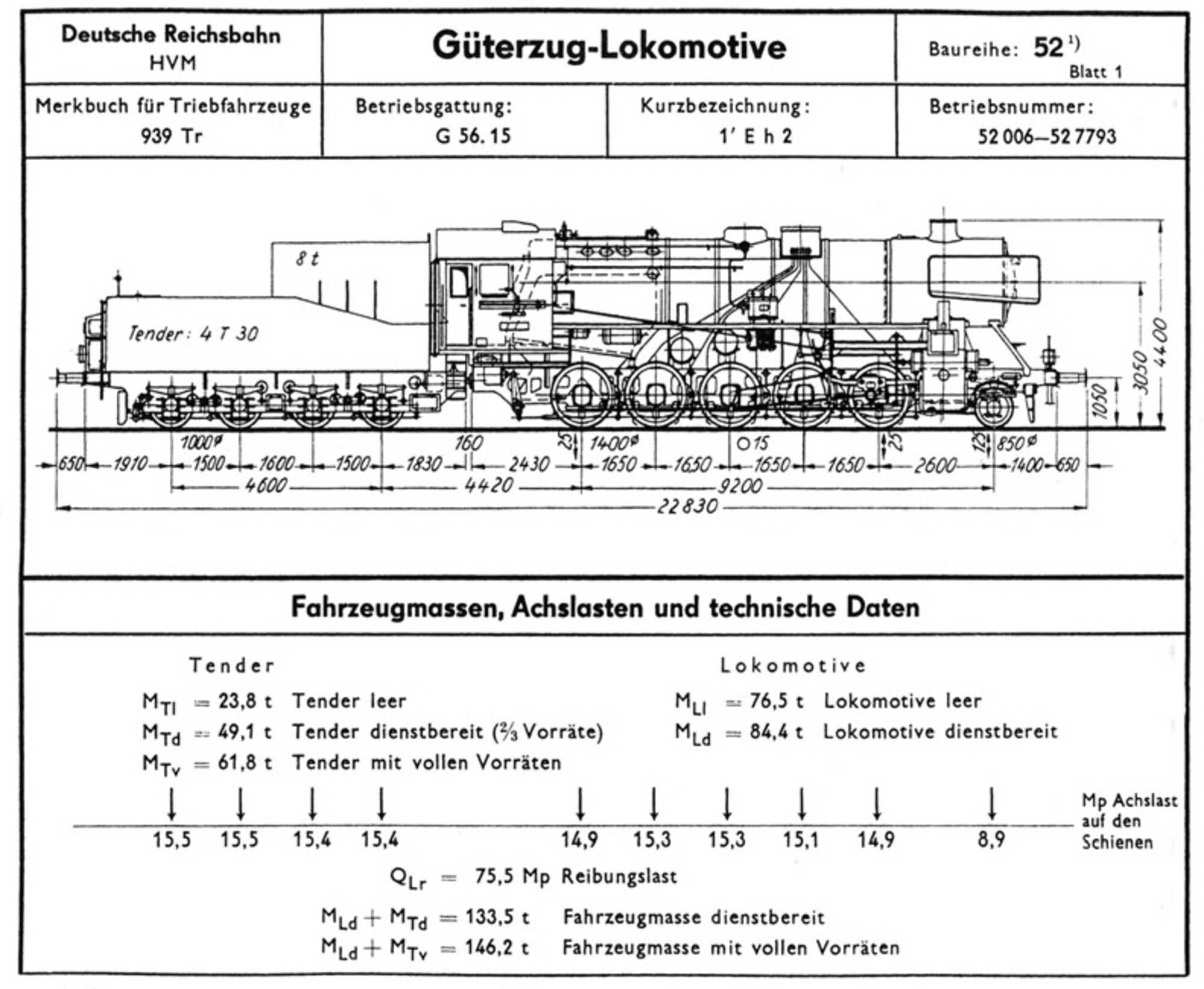
Parameters

Technical
specifications

Factory
Floridsdorf, Austria
Serial number
16222
Year
1943
Weight of the locomotive in working condition without tender, t
86
Weight of the locomotive
in working condition with tender, t
135
Design speed, km/h
80
Maximum power at the wheel rim, hp
1500
Axial formula
1–5–0
General data
Empty weight of a steam locomotive, t
76
Adhesive weight of the locomotive, t
77
Tender type
Four-axle
Full wheelbase of the locomotive with tender, mm
18,230
Length of the locomotive with tender over buffers, mm
22,340
Diameter of driving wheels, mm
1,400
Smallest radius of the passable curve, m
110
Boiler
Steam pressure, kg/cm2
16
Furnace type
Crampton
Grate area, m2
3.92
Total evaporating heating surface of the boiler (water), m2
192.5
Heating surface of superheater tubes (gas), m2
63.7
Number of smoke tubes, pcs.
113
Smoke tube diameter (outer), mm
54
Number of flame tubes, pcs.
35
Diameter of fire tubes (outer), mm
133
Type of superheater
Double-turn
Diameter of superheater tubes (outer), mm
35
Type of heating
Coal, manual
Car and crew
Number of cylinders, pcs.
2
Cylinder diameter, mm
600
Piston stroke, mm
660
Spool diameter, mm
300
Frame type
Sheet
Frame thickness, mm
30
Steam distribution system, t
Walschaer
Tender
Tender type
K4T30
Empty weight, t
23.8
Weight with full water and coal reserves, t
61.8
Water reserves, m3
30
Coal reserves, t
8
Truck type, axles in a rigid frame
4

Drawings
and diagrams

History

Chronology

  1. 1941 As German troops advance eastwards, Germany requires more winter-resistant steam locomotives.
  2. 1942 The new Class 52 is developed with a simplified design, and its mass production begins.
  3. September 1942 The Borsig plant manufactures the first 52 001 steam locomotive.
  4. January 1943 Class 52 war locomotives enter mass production at locomotive plants in Germany and countries under German occupation: Poland, Czechia, Austria and France.
  5. 1943 The Soviet army captures Class 52 steam locomotives as war trophies. Steam locomotive 52 6769 is manufactured at the Florisdorf plant in Vienna, Austria.
  6. 1945 Steam locomotive 52 6769 is on the Austrian railways.
  7. 25th April 1945 The first Soviet troop train enters Berlin with steam locomotive 52 1168.
  8. 6th June 1945 Steam locomotive 52 6769 is transferred to Hungary.
  9. 1946 Mass conversion of Class 52 steam locomotives to Russian domestic gauge begins at the Unecha Station on the Moscow-Kyiv Railway.
  10. 1947 The Soviet Ministry of Railways specifies the design changes required when overhauling steam locomotives at plants and depots.
  11. 12th March 1948 Steam locomotive 52 6769 comes to the Romania’s Căile Ferate Române railways.
  12. Late 1940s Approximately 35 steam locomotives were assembled using parts from damaged locomotives at the Stanislavsky (Ivano-Frankivsky) Locomotive Repair Plant. They were numbered from 8001 to 8036.
  13. 1950 Steam locomotive 52 6769 is transferred by Germany to the railways of the USSR.
  14. 11th August 1950 Steam locomotive 52 6769 is converted to Soviet gauge.
  15. October 1950 Steam locomotive 52 6769 is delivered to the railways of the Soviet Union.
  16. 23rd August 1952 By order V-60570 of the Ministry of Railways, Class 52 is renamed the class TE.
  17. May 1955 Steam locomotive 52 6769 finishes work at the Bender Depot on the Chișinău Railway.
  18. June 1955 Steam locomotive 52 6769 is in operation in Lithuania and Estonia, first at the Kaunas Depot and then at the Tapa Depot.
  19. Late 1950s The class TE is equipped with oil heating.
  20. Early 1960s In connection with the broad introduction of new types of traction, approximately 700 TE steam locomotives are transferred to the socialist countries of Eastern Europe.
  21. June 1963 Steam locomotive 52 6769 is transferred to the Belarusian Railway.
  22. 1960s A significant number of TE steam locomotives are converted back to Western European gauge and sent to storage bases along the western border of the USSR.
  23. 1965 Steam locomotive 52 6769 is included in the Luninyets Depot fleet inventory.
  24. 1970s End of use of almost all wide-gauge TE steam locomotives.
  25. 1980s Use of some TE steam locomotives for service and export work.
  26. 1984 Steam locomotive 52 6769 is assigned new eight-digit “computer” number 1042.487-7.
  27. 1st January 1992 There are 48 wide-gauge TE steam locomotives in the Ministry of Railways fleet inventory.
  28. 1993 Steam locomotive 52 6769 comes into the care of the Oktyabrskaya Railway Museum, where it is displayed in the museum grounds in Shushary and at the former Varshavsky Station in St. Petersburg.