Today the museum is closed

Map

Exhibit description

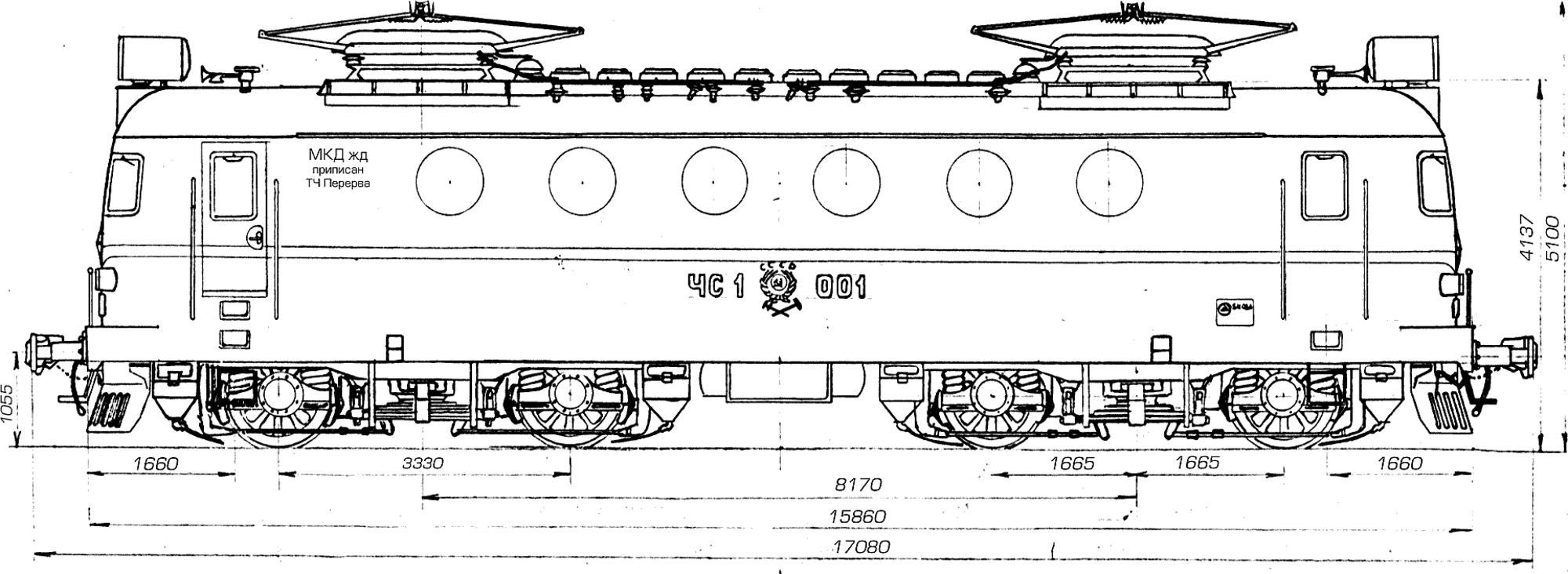
Direct Current Passenger Electric Locomotive ChS1 041

The mid-1950s marked a major initiative in the USSR’s railway network to replace steam locomotives with innovative types of traction — diesel and electric. For train operations on sections and entire railway lines being converted to electric traction, a large number of new, powerful electric locomotives were needed to replace steam locomotives. For freight locomotives, this need was addressed by initiating the mass production of VL8 and VL23 electric locomotives.

The 1950s marked a major initiative in the Soviet railways to replace steam locomotives with innovative types of traction — diesel and electric.

For passenger locomotives, however, the challenge was more acute. Developing dedicated passenger electric locomotives required significant time, so it was decided to use foreign experience to quickly expand the fleet of such machines. Additionally, the political aspect played a role: in order to strengthen the newly formed Council for Mutual Economic Assistance, specific decisions regarding economic cooperation between the countries of the socialist camp had to be adopted.

Czechoslovakian Project

As a result, in the mid-1950s, an order for the production of passenger electric locomotives for Soviet railways was placed with the Škoda Plant in Pilsen, Czechoslovakia — a large engineering enterprise founded in 1859. In the post-war period, the Škoda plant produced a four-axle DC electric locomotive, designated E499 in the Czechoslovak Socialist Republic, with factory type 12E. The locomotive proved to be so successful that it became the basis for a large family of both freight and passenger electric locomotives, which were also exported to Poland, Bulgaria, and the DPRK. It was decided to purchase this particular type of electric locomotive for Soviet railways.

In 1957, two factory-type 24E electric locomotives, which were modified 12E locomotives designed for use on the Ministry of Railways network, arrived in the USSR. These vehicles were designated ChS1 (Czechoslovakian, first type) and were tested on the Moscow-Serpukhov and Moscow-Kalinin lines, as well as on the test loop of the Railway Research Institute in Shcherbinka. Based on the test results, Škoda made several changes to the ChS1 design and, in 1959, began the mass production of factory type 41E electric locomotives.

In 1959, the Czechoslovakian Škoda Plant began mass production of the ChS1 electric locomotives.

Unlike the 24E, the 41E featured several modifications: sandboxes were placed in the body, changes were made to the shape of the windows in the engine room (rectangular with vents instead of round ones), dead-woods, and track-cleaners; the trucks were equipped with a new spring suspension system, and various changes were introduced to mechanical components.

In 1959, electric locomotives of the ChS1 class — Nos. 003–005 of factory type 41E0 and Nos. 006–017 of type 41E1 — were built, followed by Nos. 018–101 of type 41E2 in 1960. On the last factory-type 29Е0 ChS1 locomotive (No. 102) manufactured in 1960, new traction electric motors with increased capacity were used as part of an experiment. Later, a class of similar locomotives was produced, designated ChS3 with factory types 29E1 and 29E2.

The main feature of the ChS1 class electric locomotives was the use of a support-frame suspension for the traction electric motors. The torque from the engine to the axle gearbox was transmitted via elastic crossings and a shaft, utilizing the Secheron system drive. The gearwheel was rigid, straight, and one-way. The electric locomotive’s control system was a rheostat-contactor system, with two possible engine connections: series and parallel. The body also housed two motor-compressors and two motor-fans.

Initially, the ChS1 passenger electric locomotives were used on the Moscow Railway, servicing the Moscow-Kursk-Kharkiv, Moscow-Vladimir, and Moscow-Ryazan lines, as well as the Leningrad-Moscow line on the Oktyabrskaya Railway. In the 1960s, as new and more powerful ChS2 electric locomotives arrived, the ChS1s were gradually transferred from the Oktyabrskaya and Moscow Railways to the Prydnipro and West Siberian Railways.

Initially, the ChS1 electric locomotives were used on the Moscow and Oktyabrskaya Railways.

In the late 1960s, some electric locomotives were modernised to operate in a two-section coupling using the “multiple-unit system”. Most of the ChS1 class electric locomotives remained in service on the Soviet railways until the late 1970s and early 1980s.

The electric locomotive ChS1 041, presented in the museum, was built in 1960 and sent from the plant to the Moscow Railway, and in 1968 it was transferred to the West Siberian Railway.

Parameters

Technical
specifications

Years of production
1957–1960
Number built units
102
Rated voltage of contact network, V
3,000
Axle characteristic
20 – 20
Continuous mode power, kW
2,032
Type of current, t
Direc
Presence of electric brake
No
Type of traction electric motor, T
AL-4846z
Gear ratio of axle reducer
2.27
Type of suspension of traction electric motor on axle
Support-frame
Type of pantograph, PP
9
Wheel diameter, mm
1,250
Axle load on rails, tf
21,25
Hourly mode parameter power, kW
2,344
Speed, km/h
62,3
Traction force, kgf
13,500
Continuous speed, km/h
65,4
Length over coupler axles, mm
17,080
Body width, mm
3,030
Body height, mm
5,100
Truck wheelbase, mm
3,330
Smallest radius of passable curves, m
120

Drawings
and diagrams

History

Chronology

  1. 1950s A major initiative took place in the USSR’s railway network to replace steam locomotives with innovative types of traction — diesel and electric. The USSR placed an order with the Czechoslovakian Škoda Plant to produce passenger electric locomotives for Soviet railways.
  2. 1957 Two modified electric locomotives were delivered to the USSR and designated as ChS1.
  3. 1959 The Czechoslovakian Škoda Plant began mass production of the ChS1 electric locomotives.
  4. 1960s ChS1 from the Oktyabrskaya and Moscow Railways were transferred to the Prydnipro and West Siberian railways.
  5. 1960 Electric locomotive ChS1 041 was built.