Today the museum is closed

Map

Exhibit description

Passenger carriage Class 2 Coach Car № 207 of the Ryazan-Ural Railway

Private Roads

The fleet of passenger cars of private railways was distinguished by significant diversity. The cars of the Ryazan-Ural Railway, not differing from the cars of state-owned roads in their basic design solutions (metal frame, wooden body, lack of skylights), stood out with characteristic details, in particularly — the profile of the car roofs.

In 1899 this road received 38 cars II class (soft), built by the Kolomna Machine-Building Plant and the Sormovo Plant. All the cars were on bogies of the Kolomna Plant type. In 1901 six more similar carriages on Pullman bogies were manufactured by the Dvigatel plant in Reval (now Tallinn).

The Class II carriage (soft) was built for the private Ryazan-Ural Railway by the Kolomensky Plant in 1899. At that time, its passenger trains had central steam heating and gas lighting. Later, the nationalization of the private railway and the electrification of the USSR led to the installation of a hot-water heating boiler in the carriage and the replacement of gas lighting with electric lighting. In addition, Pullman bogies were pumped up under this carriage.

The carriage was delivered to the museum from the track machine station No. 29 (Toksovo) of the October Railway. Restored during repair work carried out by OOO "ARS-M" in 2015–2016

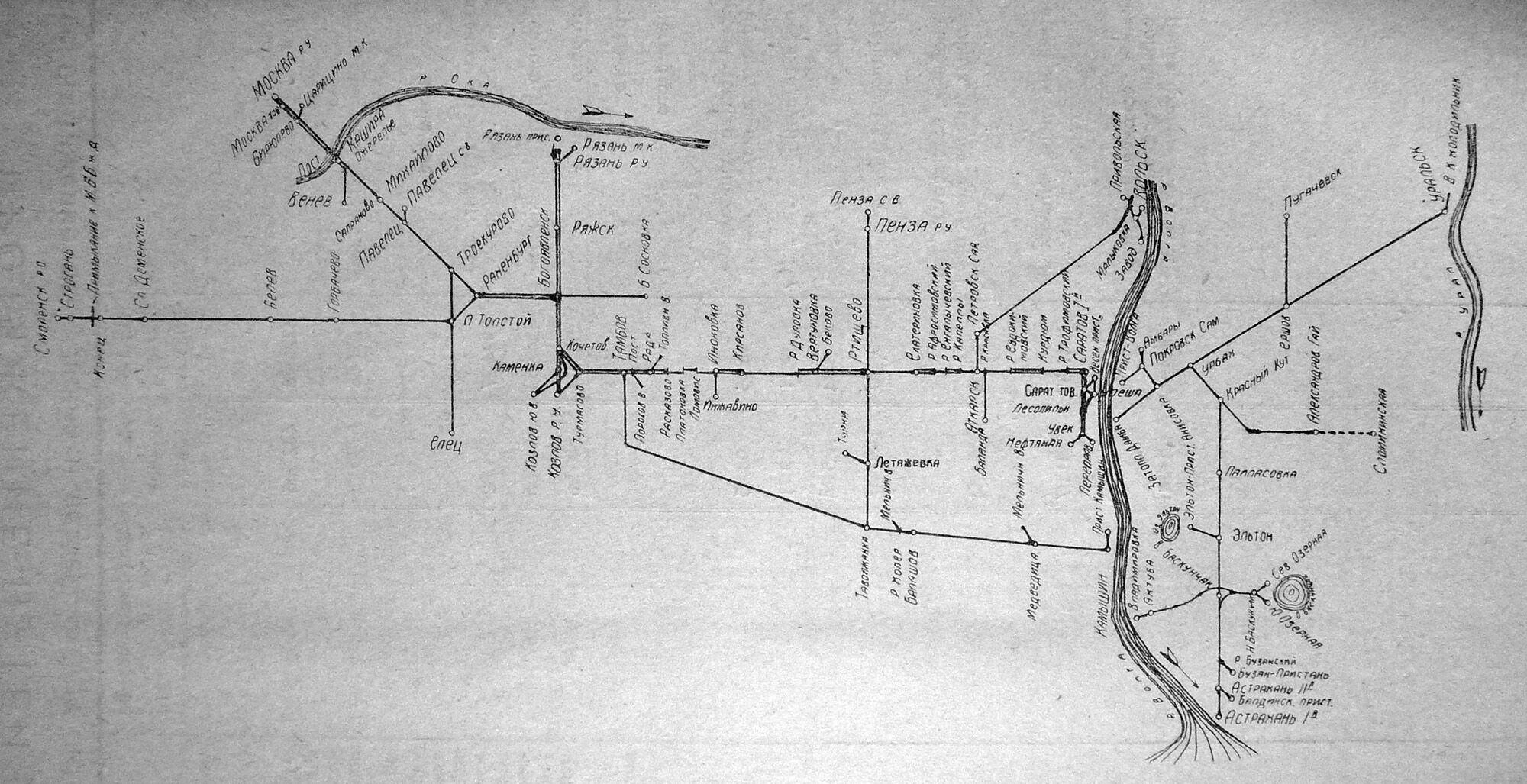
The Ryazan-Uralsk private railway was one of the largest in the Russian Empire. It stretched from the Saratovsky (Paveletsky) railway station in Moscow through Saratov to Astrakhan, from Ryazan to Smolensk, with branches to Kamyshin, Volsk, Penza, Uralsk, Aleksandrov Gai and Pokrovsk.

The great length of the railway required more comfortable carriages for long-distance passenger travel. Not all trains during the Russian Empire were direct. Many trains operated only within the railway that owned them. Therefore, passengers had to change trains at junctions.

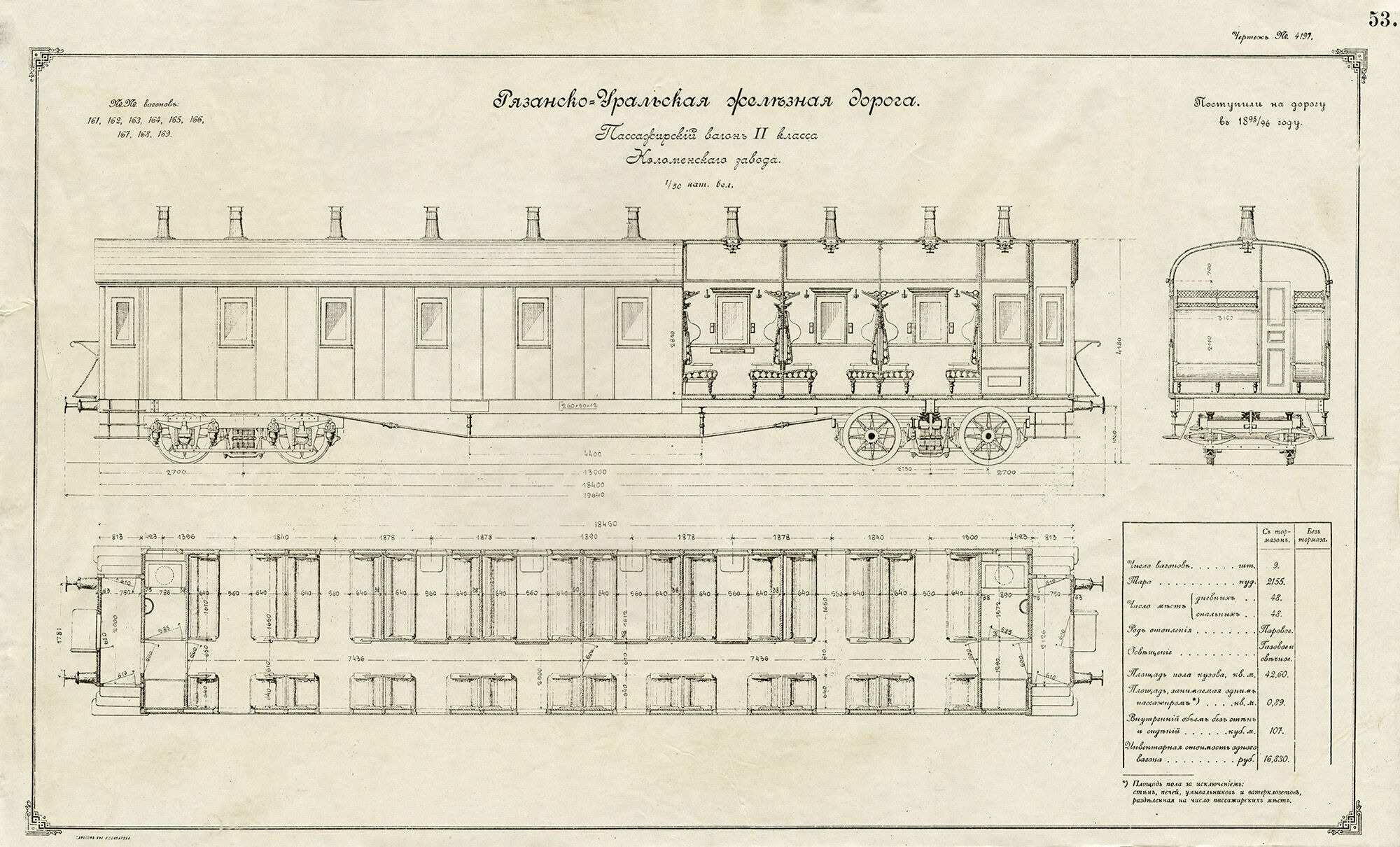
Therefore, the design decision to increase the size of the roof is understandable. The drawings of the carriages, among other technical characteristics, provide data on the size of the carriage floor and the volume per passenger. The carriages of the Ryazan-Uralskaya Railway type were also used on the private Vladikavkaz Railway.

The carriage was built by the Kolomna Plant, as evidenced by the traces on the frame from a factory plate once installed on it with the year and factory number of the carriage. On freight carriages, the Kolomna Plant only installed plates with the date (year) of manufacture. The factory number was written on the frame.

Parameters

Technical
specifications

Customer
Kazyonnye (State) Railways
Carriage model
2nd Class(suburban)
Axles
4
Seats
78
Car buffer length, mm
23 190
Car frame length, mm
22 000
Outer body width, mm
3 140
Distance between trolley pivot beams, mm
15 770
Floor-to-rooftop height, mm
2 975
Heating
Water
Lighting
Candle
Ventilation
Natural with roof-top air baffles
Bow spring suspension
Double, Fette trolley

Drawings
and diagrams

History

Chronology

  1. 1875 The first passenger carriages of railways were distinguished by a low and almost flat roof. The volume of air in these carriages was small, so in 1875 it was decided to increase the internal volume of a passenger carriage. During repairs on old-type carriages, the roof was made more convex or the height of the walls and roof was increased. In some cases, so-called skylights were installed. This is an add-on not across the entire width, but along the entire length of the roof of the carriage, in which there were small windows for additional lighting and ventilation.
  2. 1899 In 1899, 38 second-class (soft) carriages built by the Kolomna Machine-Building Plant and the Sormovo Plant arrived at the Ryazan-Uralskaya Railway. All the carriages were on Kolomna Plant type bogies. In 1901, the Dvigatel Plant in Revel produced six more of the same carriages, but on Pullman bogies.
  3. 1912 The wide variety of passenger fleets began to acquire certain standards only in 1912, so it was very difficult to organize ticket sales and calculate passenger fares, which required separate agreements between railways on the use of a specific type of carriages in these trains, taking into account their class and layout.
  4. 2015–2016 The car was delivered to the museum from track machine station No. 29 (Toksovo). It was restored during repair work carried out by ARS-M LLC in 2015–2016.