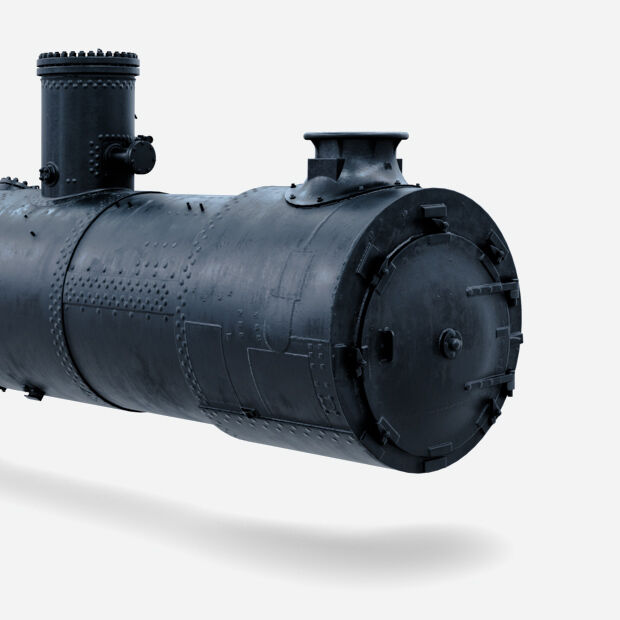
In 1892, the term "normal steam locomotive" or "normal steam locomotive" appeared on Russian railways, meaning a standardized locomotive that met certain standards. Early normal steam locomotives, of the 1892, 1893, and 1897 types, had four driving wheel pairs (0-4-0 axle arrangement), a Joye steam distribution mechanism, and a compound engine—a type in which steam first enters the high-pressure (right) cylinder, which has a smaller diameter, and then, after working there, enters the low-pressure (left) cylinder, which has a larger diameter. It was assumed that reducing the temperature difference in the cylinders during the power stroke and, consequently, reducing heat loss during steam condensation would save fuel—this is the principle behind the compound engine. Yet, despite their many advantages, "normal type" steam locomotives with Joy's steam distribution demonstrated poor fuel efficiency, consuming more fuel per unit of work performed than their predecessors, which, despite a similar design, had a simple steam engine (with identical cylinders) and a more archaic steam distribution system with a rocker mechanism inside the frame.
Tests of "normal type 1897" steam locomotives, conducted from 1898 to 1900 on the Kharkov-Mykolaiv Railway, revealed unsatisfactory steam distribution on these locomotives. Therefore, engineer Yu.V. Lomonosov proposed a project to redesign their steam distribution mechanism. However, subsequent tests of the redesigned locomotives demonstrated the inadequacy of this measure.
In 1900, the Kolomna Machine-Building Plant built two steam locomotives (factory type 66) for the Southwestern Railways with a Walschaert steam distribution mechanism, modified by the plant to reduce stone play in the gear linkage. Their design also included other changes, including a smaller heating surface and an increased cylinder diameter, which led to a mismatch between the boiler and the engine. Although the first 0-4-0 locomotives with the Walschaert mechanism were unsuccessful, this did not apply to their steam distribution system.
The following year, in 1901, the 23rd Consultative Congress of Traction Service Engineers developed a list of measures aimed at improving the existing steam locomotive "normal type 1897." These measures included replacing Joy's steam distribution systems with Walschaert mechanisms, replacing Ramsbottom's safety valves with lever-and-spring valves, and using four-axle tenders designed by the Kharkov plant alongside three-axle tenders. That same year, the Putilov plant began producing locomotives in accordance with the congress's decisions. These locomotives became known as the "Normal Type 1901" locomotives.
The "Normal Type 1904" locomotives differed from the "Normal Type 1901" locomotives in several ways, including increasing the boiler steam pressure from 11.5 to 12 kgf/cm2.
From 1903 to 1907, the Kolomensky Plant built steam locomotives (factory type 89) similar to standard locomotives (factory type 88), but with a steam distribution mechanism modified similarly to that of the factory type 66.
The changes made by the Kolomensky Plant to the steam distribution system did not directly affect the Walschaert linkage. The mechanism for driving the linkage rocker was modified. Instead of the previously used drive from the reverser transfer shaft via rods, a method using a sliding clutch was used, which was expected to reduce the rocker's play relative to the linkage during locomotive movement.
Subsequently, a similar mechanism was used only once on domestic steam locomotives, namely on the 9P series industrial tank locomotives, also developed by the Kolomensky Plant, which began mass production in 1936. Increased traffic necessitated, and strengthened tracks allowed, the use of more powerful locomotives than the "normal" 0-4-0 locomotives. Production of the "normal 1905 type" steam locomotives with a 1-4-0 axle arrangement began (in 1912, this series received the designation Щ). After this, orders for 0-4-0 steam locomotives continued, but significantly decreased. Some 0-4-0 steam locomotives from 1907 onward were equipped with superheaters during construction. Furthermore, superheaters began to be installed on previously built "normal" steam locomotives.
In 1912, a unified system for designating locomotive series was established in Russia. According to it, all "normal" locomotives with the 0-4-0 axle arrangement were assigned the O series, from the word "main." Locomotives of the "normal types of 1901 and 1904" with a compound engine and Walschaert's steam distribution mechanism were designated OB, while locomotives with Walschaert's steam distribution mechanism, modified by the Kolomna Plant, were designated OK. The indexes indicated the authorship of Walschaert and the Kolomna Plant. For the same reasons, locomotives with Joye's steam distribution mechanism were designated: "normal types of 1892 and 1893" - Od, "normal type of 1897" - Od. — OD, and those with steam distribution modified at the suggestion of Yu. V. Lomonosov — OL. 0-4-0 steam locomotives with superheaters received the designation OP.
When a unified series designation system was introduced, both Type 66 locomotives from the Kolomna plant received the same OK designation as the "normal" Type 89 locomotives, despite significant differences.