Today the museum is closed

Map

Exhibit description

Diesel locomotive 2TE121-026

New transport

In the 1960s in the USSR there was an increase in freight turnover. Diesel locomotives of the TE10 and TE116 series could no longer cope with the loads. The Ministry of Railways decided to develop freight locomotives with a capacity of 4,000 hp

However, due to the increased power, the mass of the locomotive increased. It was impossible to keep it within the limits of 21–23 tf from the axle to the rails, so the Central Research Institute of the Ministry of Railways proposed to create six-axle machines with an axle load of 27 to 30 tf. This was due to plans to lay heavier rails that would allow such loads.

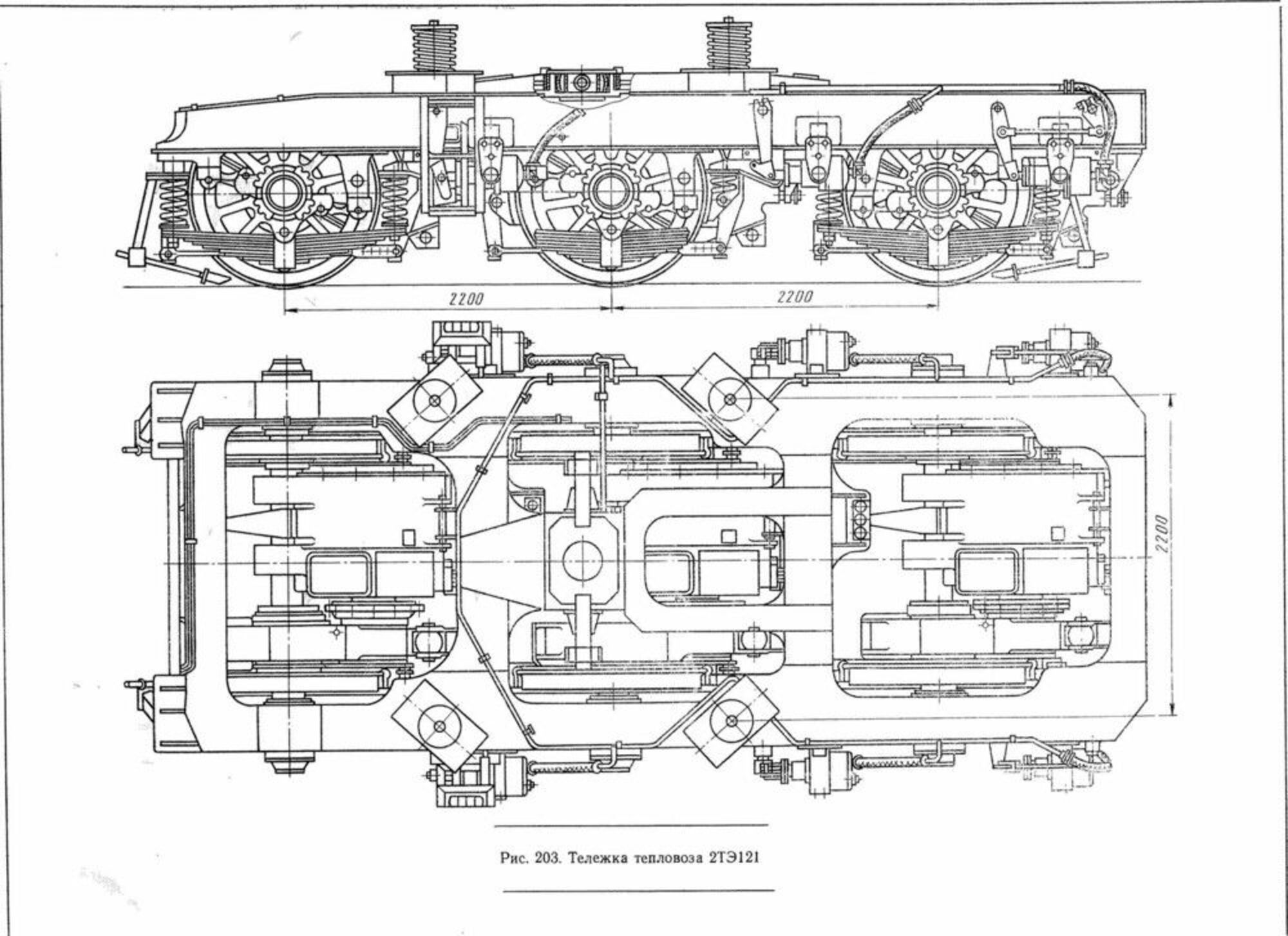
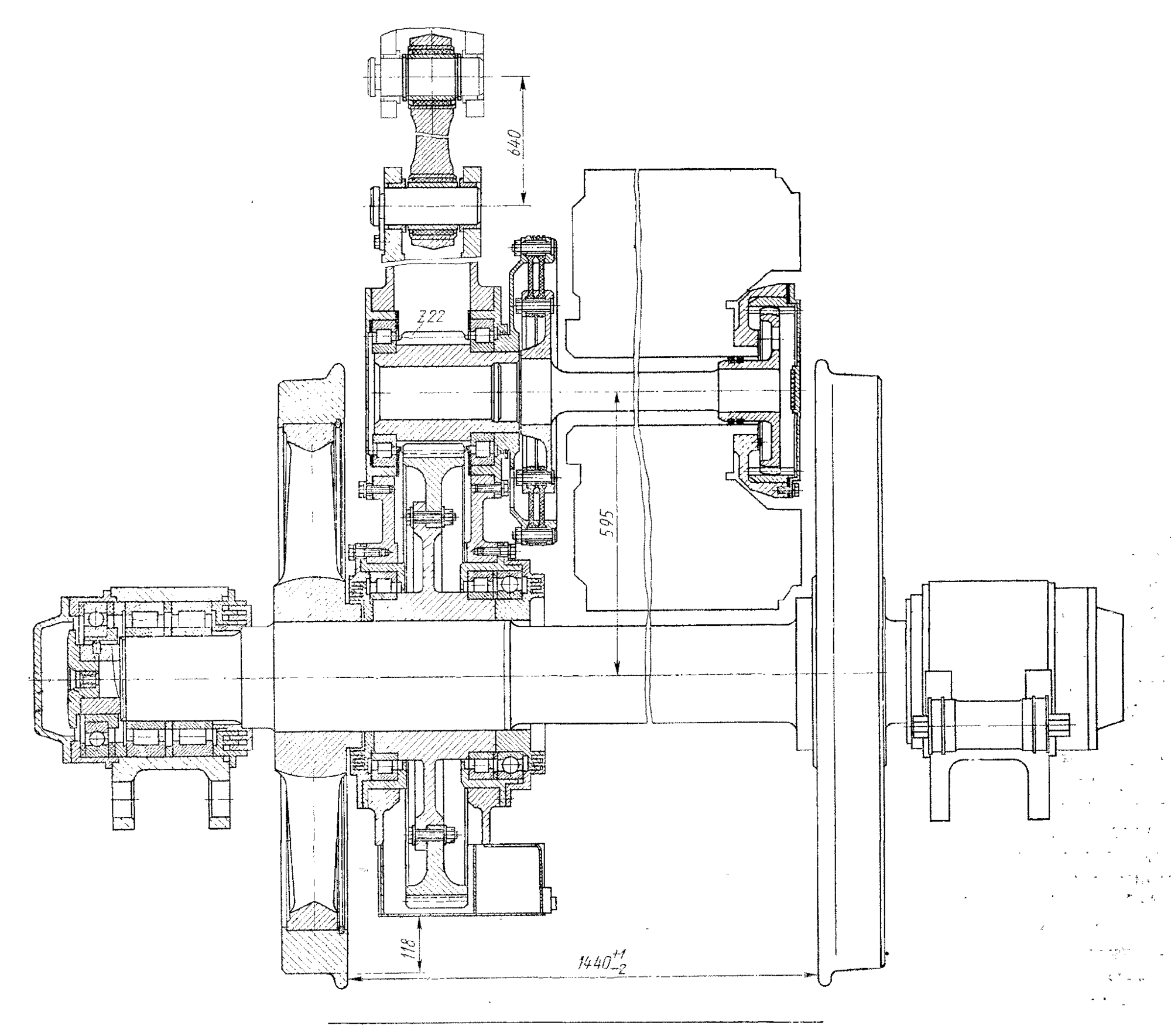
By the mid-1970s, it was recommended to increase the axle load for diesel locomotives with a power greater than 3,000 hp. It was also considered advisable to increase the diameter of the locomotive wheels from 1,050 mm to 1,250 mm and to use a support-frame traction drive instead of a support-axle drive. This required the development of a new freight locomotive bogie that had no analogues.

In 1968, the Ministry of Railways issued technical requirements for a diesel locomotive with a power of 4,000 hp. s. In 1970 the requirements specified a wheel diameter of 1,250 mm and an axle load of 23 tf. Three years later, the Ministry of Railways agreed to increase the axle load to 25 tf for the series, as well as the use of a two-stage spring suspension and a support frame drive.

The long-awaited start

In 1978 the first diesel locomotive 2TE121-001 was built with a wheel pair load on the rails of 26.8 tf. In the same year it passed track and dynamic tests on the Maikop - Belorechenskaya section of the North Caucasian Railway under the supervision of VNIIZhT, VNITI and the manufacturer at a speed of up to 120 km/h. Based on the test results, a number of proposals were made to change the design.

Until 1983, an experimental series of diesel locomotives 002–004 was produced, which were tested. Locomotive 003 was constantly used in VNITI during the 1980s to test various variants of the undercarriage.

Based on the results of the tests, changes were made to the traction drive, bogie design, and auxiliary systems. The length of the body was shortened by one meter, the axle load was reduced to 25 tf. In addition, the machine could now operate not only on R65 rails, but also on R50.

The 2TE121 series was often rejected due to manufacturing defects. This arose because the plant increased the production of locomotives before it had worked out their serial production and installation of components from other enterprises.

The 2TE121 diesel locomotives required an increase in the production culture and adherence to technological discipline. In addition, there was no appropriate repair base.

Due to frequent failures and manufacturing defects, it was decided to discontinue the 2TE121 series of freight diesel locomotives in the design approved by the Ministry of Railways in 1987. By 1992 76 two-section diesel locomotives were produced, i.e. over 150 sections. However, due to the crisis and the collapse of the USSR, the Ministry of Railways suspended the purchase of diesel locomotives produced in other countries.

Museum exhibit

The 2TE121-026 presented in the museum was built at the Voroshilovgrad Plant named after October Revolution in 1987 It was used at the Northern and track machine stations of the October Mainline. The diesel locomotive was transferred to the Museum of Russian Railways in December 2009

With such engine power, the mass of the locomotive increased, and it was impossible to keep it within the limits of 21–23 tf from the axle to the track. Therefore, the Central Research Institute of the Ministry of Railways (TsNII MPS) proposed the development of six-axle freight vehicles with an axle load increased in the future to 27–30 tons.

Most of the changes were applied to diesel locomotive 2TE121-005. The first production batch was sent to work at the Pechora depot of the Northern Railway.

At the same time, the number of failures for locomotives of this batch increased sharply compared to previously produced models. In addition, diesel locomotive 2TE121 required an improvement in the production culture and adherence to technological discipline during depot repairs, which was also perceived ambiguously. There was no corresponding repair base.

Parameters

Technical
specifications

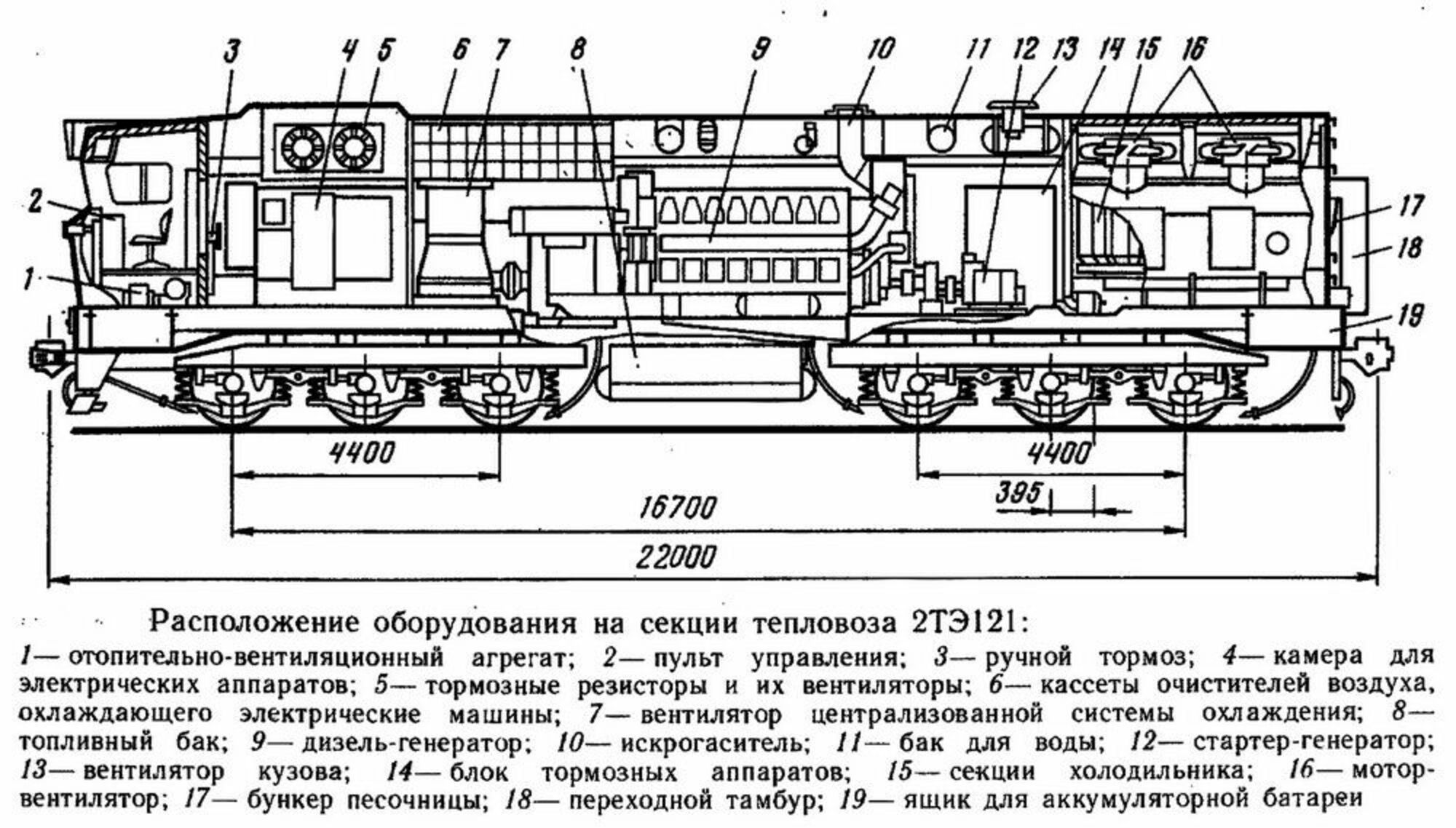
Axial formula
2 (3₀-3₀)
length by axles of automatic couplings, mm
21 000 × 2 = 42 000
Height from crown of rail, mm
5 110
Width, mm
3 200
Wheel base, mm
16 700
Design speed, km/h
100
Service weight, t
150 × 2 = 300
Wheelset load, kN
245
Specific fuel consumption, g/(kW·h)
210
Min. curve radius, m
125
Fuel stock, kg
7 500 × 2 = 15 000
Sand stock, kg
1 000 × 2 = 2 000
Wheel diameter, mm
1 250
Product type
16ChN 26/26 (2A-5D49)
Power
2 940 × 2
Number of cylinders
6
Cylinder location
V-shape with gas turbine charging
Cooling device
Water, double loop, automatic cooling agent thermal adjustment
Electric machine cooling system
Centralized
Brake type
Pneumatic (shoe) and electric (rheostatic)
First stage static deflection, mm
100
Second stage static deflection, mm
16-18
Length at automatic coupling axes
21 000 × 2

Drawings
and diagrams

History

Chronology

  1. 1960s The growth of freight turnover on the Soviet railway network began in the 1960s. The TE10 and TE116 series diesel locomotives of various modifications, which were built at that time, had a sectional power of 3,000 hp. Therefore, the USSR Ministry of Railways raised the issue of the feasibility of building diesel locomotives with a sectional power of 4,000 hp.
  2. 1968 In 1968, the MPS issued technical requirements for a 4,000 hp diesel locomotive. with the expectation of its further production at the Voroshilovgrad Diesel Locomotive Plant named after the October Revolution. For the above reasons, in 1970 the technical specifications specified a wheel diameter of 1,250 mm and an axle load of 23 tons. And in 1973 the Ministry of Railways agreed to increase the axle load to 25 tons in the serial version and the use of a two-stage spring suspension and a support-frame drive.
  3. 1978 In 1978, the first diesel locomotive 2TE121-001 was built, which had a load from the wheelsets on the rails of 26.8 tf, which met the requirements for the first prototype. In the same 1978, the locomotive passed track and dynamic tests on the Maykop-Belorechenskaya section of the North Caucasian Railway.
  4. 1983 Before 1983, a pilot series of diesel locomotives 002–004 were produced, which underwent various tests. In particular, diesel locomotive 003 was constantly used in the VNITI during the 1980s to test various variants of the undercarriage.
  5. 1987 These and other factors influenced the hasty decision "to consider further production of 2TE121 diesel locomotives in the existing design inappropriate", which was approved by the interdepartmental commission in 1987.
  6. 1987 2TE121-026 was built at the Voroshilovgrad Diesel Locomotive Plant named after the October Revolution in 1987. The serial number of the locomotive is 0026. It was operated on the Northern Railway, and from the mid-1990s it worked in the track machine stations of the October Railway.
  7. 1992 By 1992, 76 two-section diesel locomotives were produced, i.e. over 150 sections. After that, due to the crisis and collapse of the USSR, the Ministry of Railways suspended the purchase of diesel locomotives produced in other countries.
  8. 2009 Transferred in December 2009 from TC-18 Dno to the October Railway Museum, now the Russian Railway Museum.