Today the museum is closed

Map

Exhibit description

Electric train ER200-1

Exhibit design

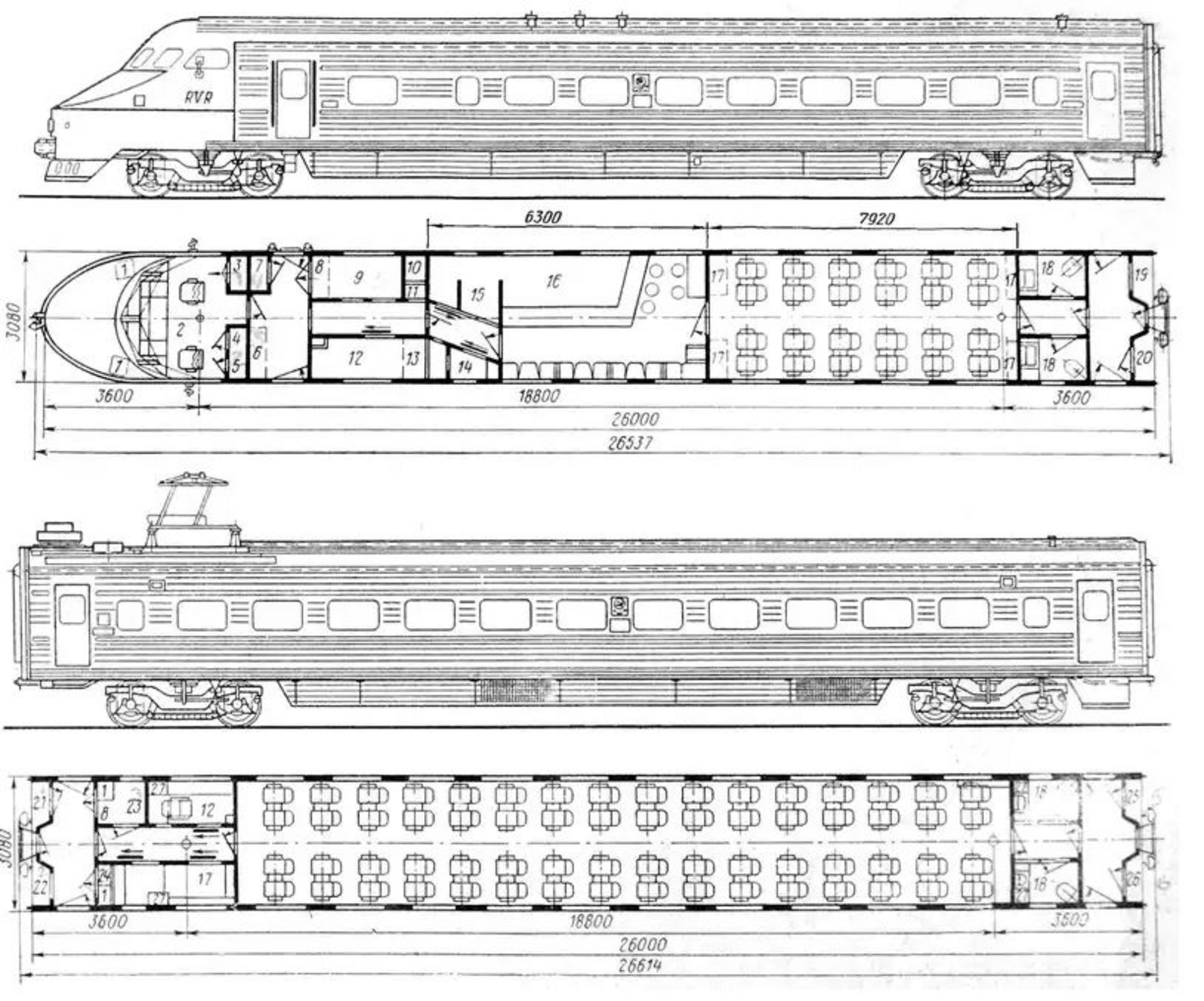
In 1969 the Riga Carriage Works completed the design of a fourteen-car electric train. The head cars were made without a motor to better fit the train into curves, as well as to install speedometer sensors on them. Construction was completed in 1973–1974. The new electric train was designated ER-200.

The bodies of the train cars are made of aluminum alloys — pressed sections and corrugated sheets. The shape of the head part was chosen based on the minimum aerodynamic drag and the plant's capabilities when working with aluminum.

The undercarriage equipment is equipped with bulwarks for better aerodynamics and to protect the undercarriage equipment from damage by objects raised by air currents when the train moves along the track. Exit from the cars is provided only on high platforms. Passengers are provided with aircraft-type seats that can be rotated by 180 degrees, and therefore passengers always sit in the direction of the train's movement.

The length of the car bodies was 26,000 mm, the width was 3,130 mm. The head cars are equipped with an automatic СА-3 coupling, and the inter-car couplings are of the Scharfenberg type. The traction electric motors are mounted on the bogie frames and, via a rubber-cord clutch and a single-stage gearbox, drive the wheel pairs with a diameter of 950 mm.

The wheelbase of the bogie is 2,500 mm, the total wheelbase of the car is 21,300 mm. The electric train had a rheostatic electric brake, a disc brake (except for the first bogie of the lead car) with electric and electropneumatic control, and magnetic rail brakes for emergency braking.

The motor cars of the electric train had 64 seats, and the head cars had 24 seats. The actual weight of the head car is 48.5 t, the motor car without pantograph is 56.3 t, the motor car with pantograph is 58.5 t.

In April 2008 Russian Railways decided that after the launch of the high-speed highway project St. Petersburg - Moscow there would be no need for these trains and they would be removed from the schedule.

The Riga high-speed electric train ER200 is one of the symbols of the era of high-speed movement in Soviet engineering thought.

Parameters

Technical
specifications

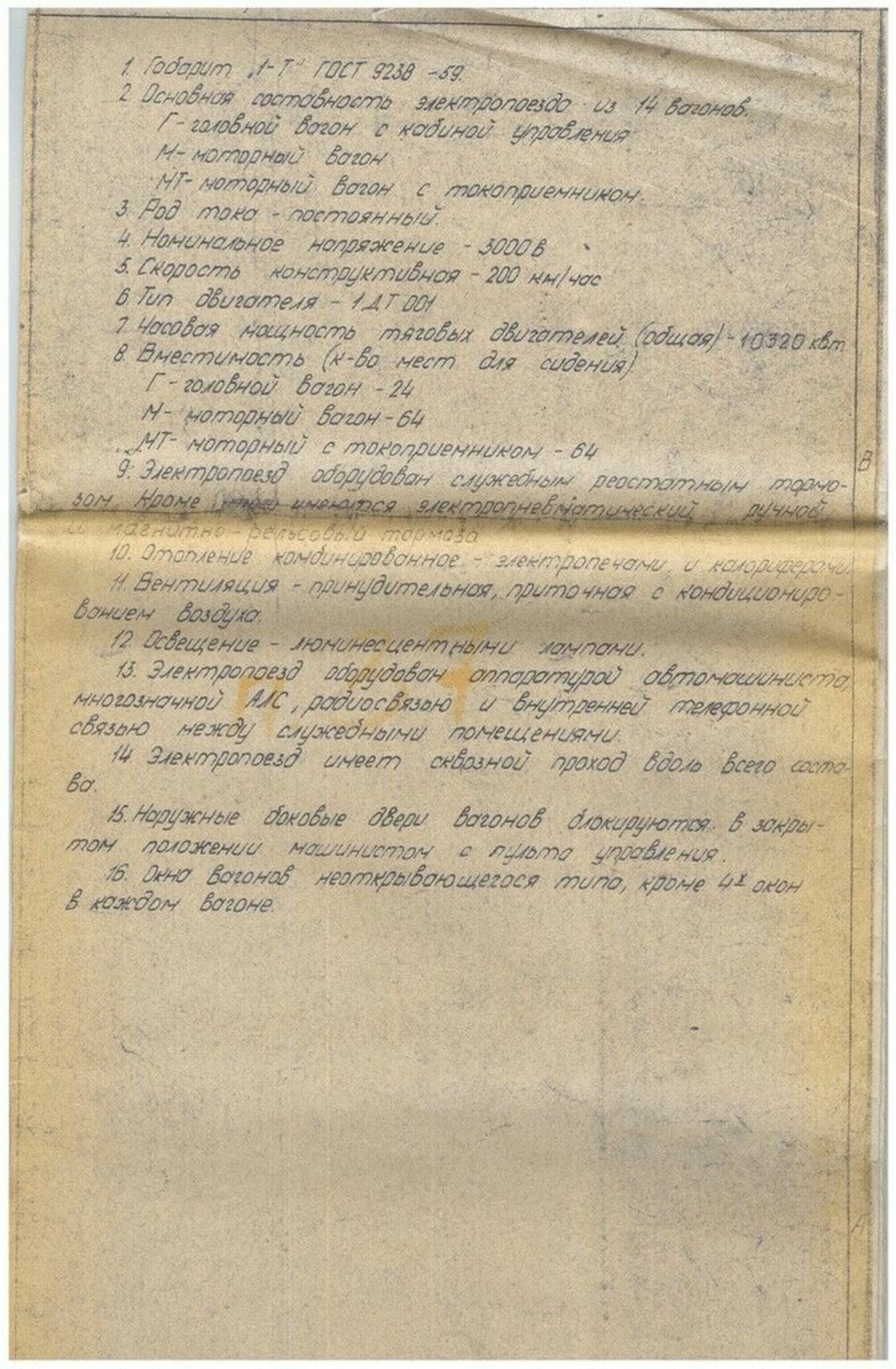
Number of wagons in the train
14
Number of axles in the wagon
4
Rated voltage of the contact network, V
3,000
Composition
2 head cars, 6 motor cars without pantograph and 6 motor cars with pantograph
Car length, mm
26,000
Distance between bogie axles, mm
18,800
Car width, mm
3,130
Body material
Alloys AMG5, AMG 6, 1915
Wheel diameter, mm
950
Body base, mm
2,500
Total power (14-car train) at hourly mode, kW
11,520
Rheostatic brake power, kW
14,400
Design speed, km/h
200
Number of seats in the car
Head — 24; motor — 64
Tare of wagons, t
Head — 48.5; motor without pantograph — 56.3; motor with pantograph — 58.2

Drawings
and diagrams

History

Chronology

  1. 1965 In 1965, preparatory work began on the design for organizing high-speed movement between Moscow and Leningrad. The maximum speed was set at 200 km/h, based on the capabilities of the track facilities.
  2. 1966–1967 To gain experience in building a train, a prototype car was built at the Riga plant in 1966–1967, which was subjected to various strength tests. Subsequently, it received the designation ER23 (factory type 62-116).
  3. 1969 In 1969, the Riga Carriage Works completed the design of a 14-car electric train. The train consisted of twelve motorized and two lead non-motorized cars.
  4. 1973–1974 Construction was carried out in 1973–1974. The new electric train was designated ER200.
  5. 1974 The first test run of the electric train consisting of two head and four motor cars took place in January 1974 on the Riga-Saulkrasti section of the Baltic Railway. During the test run on April 17, 1974, the electric train reached a speed of 160 km/h.
  6. 1974 In 1974, the electric train was delivered to the high-speed testing ground of VNIIZhT Belorechensk-Maikop for test running. Here, after factory adjustments and test running, speeds of up to 200 km/h were achieved.
  7. 1975 Comprehensive acceptance tests were conducted in 1975. On the Khanskaya-Belorechensk section, the electric train first reached a speed of 206 km/h. During tests at the testing ground, it achieved dynamic performance at speeds of 200–210 km/h. Therefore, it was allowed to continue complex tests on the October Railway.
  8. 1976 Tests on the October Railway were conducted since 1976, and on November 16, 1979, its first trip with passengers took place.
  9. 1980s By the end of the 1980s, the cars of the ER200-1 electric train already required major repairs. And if the motor cars could be uncoupled from the train one by one, then it was more difficult with the lead cars. Therefore, in 1988, two additional lead cars were manufactured (105 and 107). Then they decided to make another ER200 electric train. In 1993–1994, three trainsets were put on the line: ER200-1bis (with new head trains) to Moscow on a regular schedule, ER200-2 (adjustment), ER200-1 (6 cars) to Veliky Novgorod on weekends.
  10. 1984 Since March 1, 1984, the electric train was put on a permanent line in the train schedule (high-speed branded No. 168A/167A). The last, 1254th trip took place on December 15, 1995. Travel time was 4 hours 30 minutes.
  11. 2009 On February 20, 2009, the train made its last trip in normal mode from St. Petersburg to Moscow. On February 28, the train departed from Moskovsky Station in St. Petersburg to Lyuban Station on its last trip with passengers. There, a ceremonial meeting of two generations of high-speed trains took place — ER200 and Sapsan, which replaced the high-speed electric train on the Moscow-St. Petersburg line. The passengers of the last trip were railway workers, officials and journalists.