Today the museum is closed

Map

Exhibit description

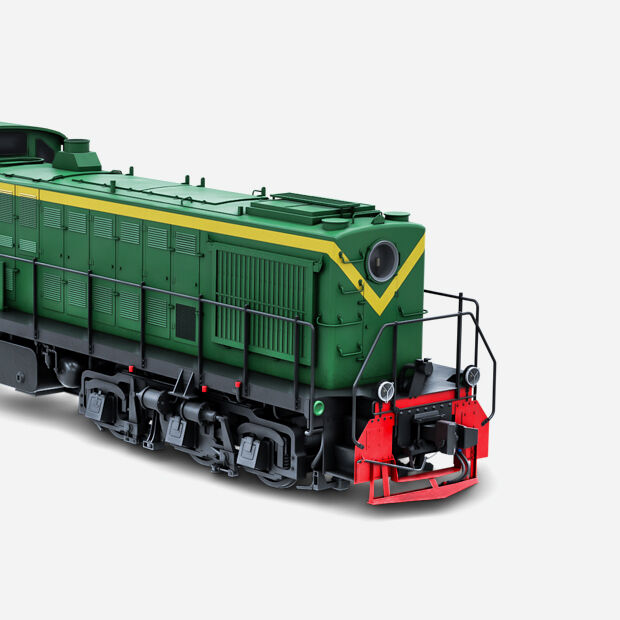
Diesel locomotive VME1-043

Foreign diesel locomotives

A new era of electric and diesel traction began in 1956. The 300 units of shunting diesel locomotives TE1-20 built in 1947–1950 were not enough. To gradually replace shunting steam locomotives, it was decided to order shunting diesel locomotives from the Hungarian People's Republic and the Czechoslovak Socialist Republic.

After testing and partial changes to the project, since 1958 diesel locomotives under the VME1 series began to be delivered to the Soviet Union. The first VME1 diesel locomotives arrived at the Leningrad railway junction for shunting work with passenger trains. Later, these locomotives worked on many roads of the USSR.

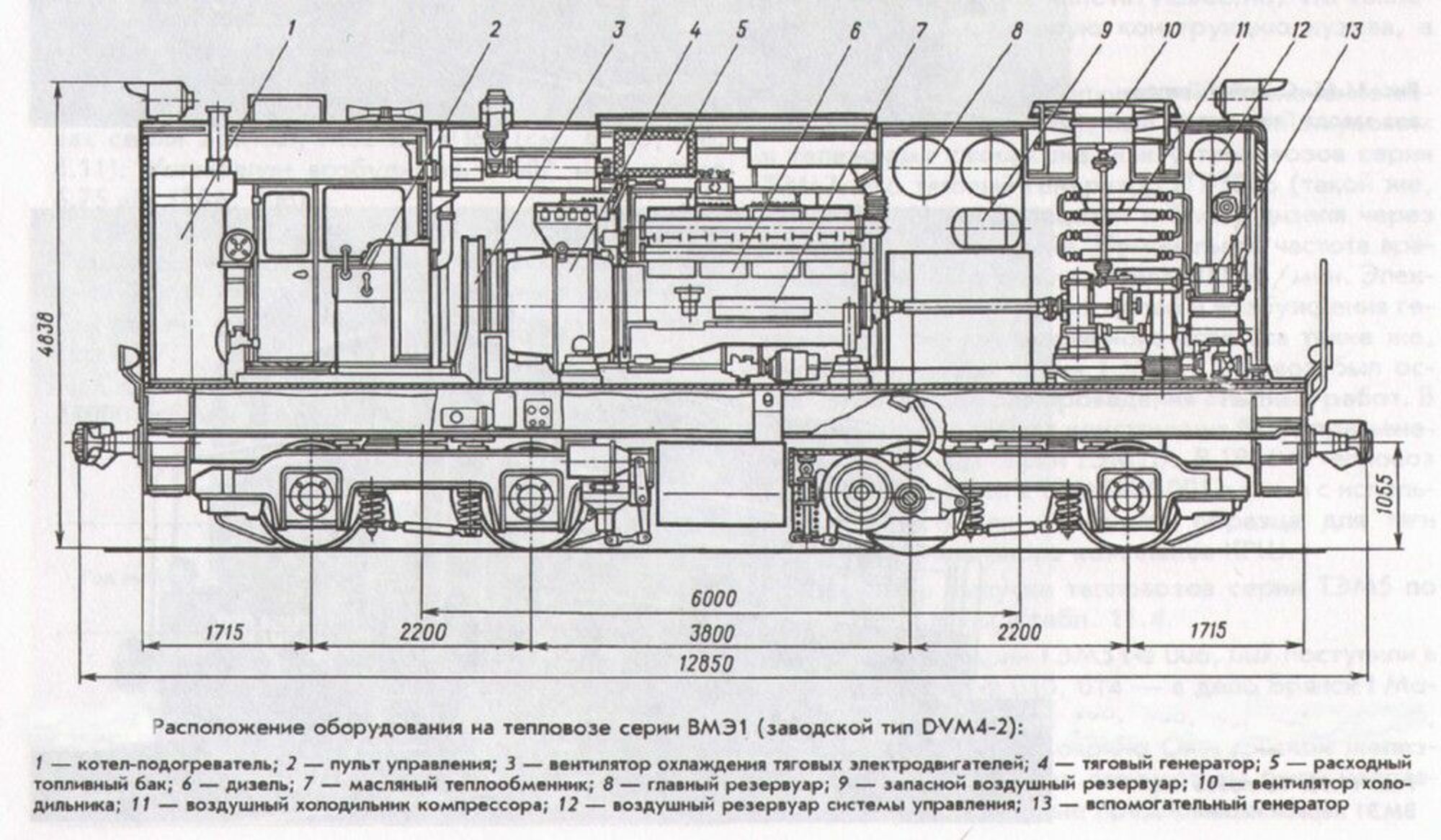
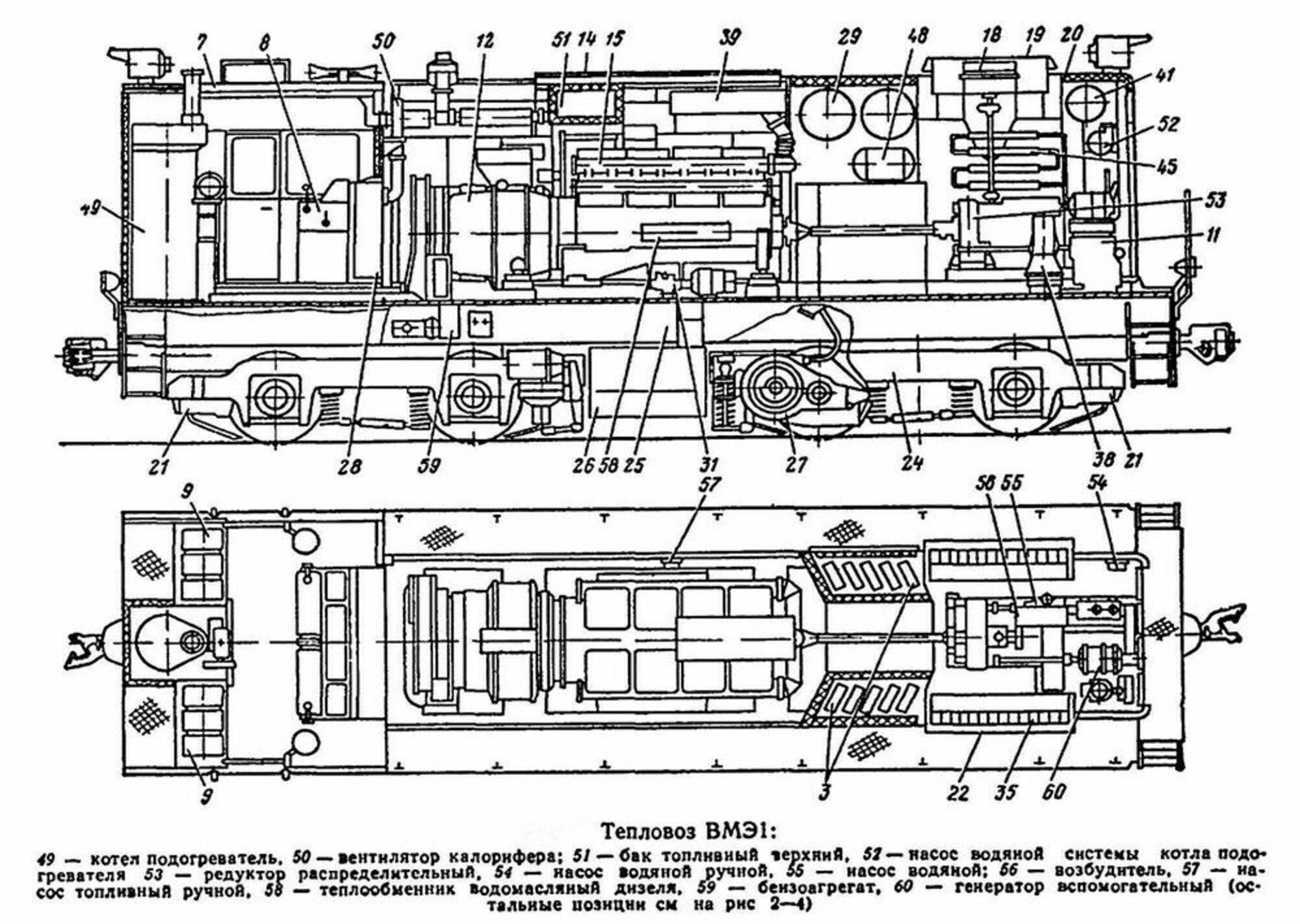
The locomotive body is of the bonnet type, the main frame of the body, welded from sheet steel, rested through sliding supports on two two-axle bogies. Traction and braking forces were transmitted through kingpins. Four electric motors had a support-axle suspension.

The locomotive is equipped with a 16-cylinder V-shaped four-stroke non-compressor diesel engine, developing 600 hp. s. The engine output shaft was connected to the shaft of a traction generator with a rated power of 370 kW. The weight of the locomotive in service condition was 73.6 tons. When starting from a standstill, the locomotive developed a traction force of 17,000 kgf. The speed reached 80 km/h.

After the delivery of the installation series, the plant made the necessary changes to the design. The diesel locomotives of the second series are equipped with boilers for heating water, fuel and oil, the water supply has been increased to 1,560 kg. The total weight has reached 74.5 tons.

The most significant changes were made starting with diesel locomotive No. 137. A new traction generator and traction electric motors were installed, the diesel power was increased to 640 hp. It became possible to operate diesel locomotives using a multiple unit system, transition platforms were made on the driver's cab side. The last diesel locomotives No. 276–310were manufactured in 1965.

In the museum

The majority of diesel locomotives of the VME1 series were excluded from the inventory in the period 1975–1985. It is most likely that the last VME1 was removed from service in Tallinn in 1993.

The diesel locomotive VME1-043 worked on the October Railway since 1960. It entered the Russian Railway Museum in 1990.

The first VME1 diesel locomotives arrived at the Leningrad railway junction for shunting work with passenger trains, since such locomotives were weak for freight trains. Later, these diesel locomotives worked on many roads of the USSR. On the Baltic railway, VME1 diesel locomotives were not only used for shunting work, but also serviced small commuter trains.

Parameters

Technical
specifications

Number of locomotive sections
1
Axle arrangement
2o-2o
Length, mm
12,850
Full wheelbase, mm
8,200
Service weight, t
72
Load from moving axle on rails, t
18
Fuel capacity, t
3.0
Diameter of moving wheels, mm
1,050
Design speed, km/h
80
Power, hp
420
Diesel
XVIJV 170/240
Number of strokes
4
Rated power (diesel engine)
750
Rated speed per minute (diesel engine)
1,400
Cylinder arrangement
V-shaped
Number of cylinders, pcs. (diesel engine)
16
Cylinder diameter, mm (diesel engine)
170
Piston stroke
240
Main generator
ЕВСс44/200
Rated power, V (main generator)
370
Maximum voltage (main generator)
485
Continuous current (main generator)
1,400
Auxiliary generator
EDH41/R4
Rated power (auxiliary generator)
4.2
Voltage, V (auxiliary generator)
60
Current, A (auxiliary generator)
70
Maximum speed per minute (auxiliary generator)
2,750
Traction motor type
ТС32 44/14
Quantity, pcs. (traction motor)
4
Rated power, kW (traction motor)
205
Current, A (traction motor)
282
Maximum voltage, V (traction motor)
815
Battery type
Alkaline
Brand (battery)
2 S31
Number of elements, pcs. (battery)
40
Capacity
310
Discharge time
4
Voltage, V (battery)
50
Maximum discharge current, A
3,000
Compressor type
MK135
Productivity
1.5
Number of revolutions per minute
1,100
Pressure
9
Number of stages, pcs.
2
Number of cylinders, pcs.
2
Cooling surface, m2
Water — 700; oil — 350
Pump feed, m3/hour
Water — 68; oil — 4.7
Maximum number of revolutions per minute (in summer)
960

Drawings
and diagrams

History

Chronology

  1. 1906 The Ganz & Co factory also supplied its products to pre-revolutionary Russia. Thus, in 1906, two four-axle steam locomotive cars were built by order of the then Petersburg-Warsaw (later North-Western) Railway. One was for suburban service, and the second was a "saloon car-motor", which received the designation M1 on the road. The latter was used for official trips of the railway management and the Ministry of Railways.
  2. 1945 In the post-war period, from 1945 to 1988, the factory supplied passenger diesel trains of various designs and compositions to the USSR, which were designated DP, D and D1.
  3. 1956 At the 20th Congress of the CPSU, it was decided to stop building steam locomotives in the Soviet Union. After that, in 1956, a new era of electric and diesel traction began. The production of domestic shunting diesel locomotives with electric transmission had just begun. The 300 units of TE1-20 shunting diesel locomotives built in 1947–1950 were not enough, and they were mostly used in train work. Therefore, in order to gradually replace shunting steam locomotives, shunting diesel locomotives were ordered from the Hungarian People's Republic and the Czechoslovak Socialist Republic.
  4. 1956 In 1956, a diesel locomotive from the Ganz MÁVAG plant was tested on the Moscow-Kursk-Donbass Railway. The design was partially changed, and in 1958 the plant began supplying these diesel locomotives to the Soviet Union. The factory type DVM4 is a modified DVM2, the VME1 series is Hungarian Shunting with Electric Transmission, type 1.
  5. 1960 The VME1-043 diesel locomotive worked on the October Railway since 1960. It was delivered to the museum from the Leningrad-Varshavsky depot in 1990.
  6. 1975–1985 The majority of VME-1 series diesel locomotives were excluded from the inventory between 1975 and 1985. Most likely, the last VME-1 was removed from service in Tallinn in 1993.