Today the museum is open from 10:00 to 18:00

Map

Exhibit description

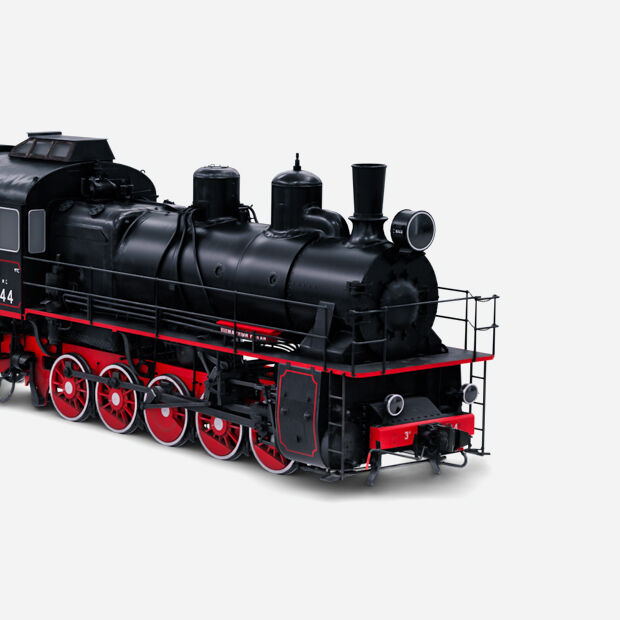
Passenger Steam Locomotive P36 0251

After the end of the Great Patriotic War, the Soviet Union’s passenger steam locomotive fleet was primarily composed of class SU steam locomotives type 1-3-1, with an axial load of about 18 t (more than 2,000 locomotives), and class IS locomotives type 1-4-2, with an axial load of 20 t (about 640 units). The use of class IS was limited to mainlines that had been reconstructed to support such heavy locomotives. After the war, there were few areas in the country that met these requirements.

By the mid-1940s, the SU steam locomotives were no longer able to cope with the increased passenger traffic. The weight of trains had increased, and on many sections of the railway served by the class SU, double traction was employed. In areas with steep gradients, freight locomotives like the classes SO and L, which were poorly suited for passenger transport, were sometimes used to haul passenger trains. This created a need for a more powerful and advanced passenger locomotive with an axial load not exceeding 18 t.

New Locomotive

As a result of an analysis of potential designs for the new locomotive (with options such as 2-3-2, 2-3-1, 1-4-1, and others considered), the decision was made to adopt the 2-4-2 wheel arrangement fo the new steam locomotive. The design work was assigned to the Kolomna Locomotive Works. It was conducted under the supervision of the plant’s Chief Designer L.S. Lebedyansky (1898–1968).

The experimental steam locomotive was completed by December 1949, and its official commissioning was timed to coincide with the 70th anniversary of Joseph Stalin, celebrated on 21st December 1949. Large signs placed on the smoke deflectors indicated that the locomotive was dedicated to the leader’s anniversary.

The commissioning of the experimental locomotive was dedicated to Stalin’s 70th birthday celebration.

The first 2-4-2 steam locomotive was equipped with a fan-driven exhaust system, which was replaced after a short time with a conventional blast pipe exhaust system. The P36 0001 steam locomotive, unlike all subsequent machines in this class, is equipped with a six-axle tender manufactured by the Bryansk Locomotive Works. The tender had a semi-cylindrical water tank. Similar tenders were also used on experimental freight locomotives of classes P34 and UU23. The locomotive is equipped with a mechanical stoker S-3.

After construction, the P36 0001 was tested on the closed-loop test track of the Central Research Institute of the Ministry of Railways at the Shcherbinka Station, as well as on the Oktyabrskaya and Moscow-Kursk-Donbas Railways. On 20th June 1951, during a test run at an average speed of 86.4 km/h, the maximum indicated power of the locomotive across all tests was achieved — 3,360 hp.

The test driver from the Oktyabrskaya Railway’s Moscow Depot, Hero of Socialist Labour N.A. Oshats, played a major role in the long-term testing of the new locomotive, its refinement to operational standards, and the improvement of its design. The test results were deemed positive, and a decision was made to build an experimental batch.

Mass Production

In 1953–1954, class P36 experimental (0002–0006) and pilot (0007–0036) batches were produced. In 1954, the Kolomna Locomotive Works finished the production of class L freight locomotives. From 1955 onward, the P36 locomotives became the sole type of mass-produced locomotive at the enterprise. In 1955–1956, the plant manufactured 215 class P36 steam locomotives, numbered 0037 to 0251.

Excellent Design

The new locomotives were distinguished by their exceptional design, featuring numerous innovations. The locomotive was equipped with an all-welded boiler and an extended smokebox (which, as noted in popular science publications of the time, could accommodate a Pobeda automobile), along with steam pipes that were maximally straightened and had enlarged gas passages. The firebox utilised cross circulation pipes.

The firebox doors and the doors leading from the cab to the tender vestibule, as well as the firebox grate’s air bleed mechanism, were all pneumatically operated. The locomotives also featured a mixing feedwater heater designed by the Bryansk Locomotive Works, which allowed for significant fuel savings. For the first time in the history of domestic steam locomotive production, all axle boxes, both on the locomotive and the tender, were equipped with roller bearings.

These locomotives were unmatched in terms of both comfort and ease of operation.

In terms of comfort and ease of operation for locomotive crews, these machines were unparalleled. Veterans from the Leningrad-Passazhirsky-Moskovsky Depot, who worked on the P36, half-jokingly remarked, “We could relax on these locomotives”. The drivers also praised the P36’s outstanding performance — its inexhaustible boiler, ease of starting from a standstill, incredibly smooth ride even at maximum speed, and excellent cornering ability.

Operation

The new P36 steam locomotives were delivered to the Oktyabrskaya, Moscow-Ryazan, Stalin, Kalinin, Belorusian, Kuybyshev, and Krasnoyarsk Railways, operating on routes such as Leningrad-Moscow, Moscow-Michurinsk, Krasnoyarsk-Tayshet, Moscow-Minsk, and others.

The mass transition to modern types of traction resulted in these steam locomotives being quickly replaced.

The mass transition to modern traction types in the USSR during the 1950s and 1960s led to the rapid displacement of P36 steam locomotives from mainlines in the European part of the country, relegating them to less busy and remote sections of the network. P36 locomotives began operating on the East Siberian, Transbaikal, Northern, Far Eastern, and Lviv Railways.

However, their service on these routes was relatively short-lived. The P36s operated the longest on the Transbaikal Railway, where they ran express trains, including No. 1 “Russia”, until 1973–1974. The P36 steam locomotives did not even reach half of their intended service life.

After their service ended, P36 steam locomotives were kept in reserve on the Belarusian, Northern, East Siberian, Transbaikal, and Far Eastern Railways. Their removal from inventory and transfer to industrial enterprises for use as stationary boiler houses began in 1982. At that time, the Ministry of Railways’ inventory fleet still included 247 P36 steam locomotives. Ten years later, in January 1992, only four locomotives of this class remained in inventory.

Today, 24 P36 locomotives remain in the post-Soviet space. Two more are preserved in Mongolia and Germany. Several class P36 locomotives are still in working order and are used for pulling retro trains, participating in events organised by Russian Railways, and performing economic tasks.

P36 0251 is the last passenger steam locomotive built in the USSR.

Passenger steam locomotive P36 0251 was built by the Kolomna Locomotive Works in 1956 under serial number 10420. P36 0251 is the last steam locomotive built by the Kolomna Locomotive Works and the last passenger steam locomotive built in the USSR.

Museum Exhibit

Steam locomotive P36 0251 served on the Kuybyshev, Northern, and Far Eastern Railways. Its last registered location was the Vyazemskaya Depot of the Far Eastern Railway, where it remained in operation until the early 1970s. In 1982, the locomotive was transferred from the Vyazemskaya Storage Depot to the Dalvodremmash Plant in Ussuriysk, where it was used as a stationary boiler house for about ten years.

The fate of this last passenger steam locomotive has long intrigued domestic railway history enthusiasts. Its location was well-known, correspondence was maintained with its owner, and enthusiasts occasionally “visited” the locomotive, documenting it through photographs. However, meaningful efforts to preserve it began only in the autumn of 1991, when the locomotive was purchased from its owner at scrap metal value by the Central Museum of the Oktyabrskaya Railway.

In June 1992, a unique operation was launched to transport the locomotive to St. Petersburg. It was organised and led by V.N. Voronin (1947–2011), head of the technology department at the Central Museum of the Oktyabrskaya Railway. Museum research associates S.L. Pogodin and I.K. Timofeev also participated in the expedition.

To remove the locomotive from the plant’s premises, it was required to detach it from technological steam pipes and metal structures, clear ten years’ worth of accumulated slag, prepare the running gear for movement to the nearest depot, and, most importantly, repair the 2.5 km-long access track, which had been unused for years. A major obstacle emerged about a kilometre from the locomotive, where pipeline support had been installed directly across the track, making dismantling impossible. A detour had to be constructed for this section of the route.

Despite these challenges, V.N. Voronin successfully overcame the difficulties, and the locomotive was delivered to the depot, where it was prepared for a journey of over 9,000 km.

In addition to technical issues, other hurdles also arose. Having received information that the locomotive was delivered from the plant to the depot, a Moscow-based commercial organisation under the Railway Research Institute of JSC Russian Railways of the Ministry of Railways attempted to claim it, using an administrative resource, and redirect P36 0251 to the test loop of the institute in Moscow. This effort was thwarted thanks to the intervention of  the Oktyabrskaya Railway’s management and the Deputy Minister of Railways.

Four additional exhibits, acquired from the Far Eastern Railway, were attached to the locomotive being prepared for dispatch to St.  Petersburg. Among these were the steam locomotive EA 2201, a Canadian-built boxcar, and an armoured platform.

Four additional exhibits, including the  EA 2201 steam locomotive, a Canadian-built boxcar, and an armoured platform, were attached to the locomotive itself.

The museum train was escorted to its destination by V.N. Voronin and the locomotive crew from the St.  Petersburg-Sortirovochny-Moskovsky Depot, led by the experienced driver V.A. Sergeev. During the journey, the train made a stop at the Magdagachi Depot of the Transbaikal Railway to dismantle spare parts from the P36 steam locomotives. These parts had to be removed in temperatures as low as −40°C.

In December, just before the New Year, the six-month expedition to save the unique steam locomotive concluded at the track of the museum site in Shushary.

Parameters

Technical
specifications

Plant
Kolomna Locomotive
Serial number
10420
Year
1956
Weight of the locomotive in working condition without tender, t
133.2
Weight of the locomotive in working condition with tender, t
230
Design speed, km/h
125
Maximum power at the wheel rim
3 077 л. с.
Axial formula
2 – 4 – 2
General data
Empty weight of a steam locomotive, t
120.4
Adhesive weight of a steam locomotive, t
72.4
Complete wheelbase of a steam locomotive with tender, mm
26,379
Length of a locomotive with tender along the axles of the automatic coupling, mm
29,805
Diameter of driving wheels, mm
1,850
Minimum radius of a passable curve, m
117
Tender type
Six-axle
Boiler
Steam pressure, kg/cm2
15
Firebox type
Radial
Grate area
6.75 m2
Total evaporating heating surface of the boiler (water)
243.2 m2
Heating surface of superheater pipes (gas)
132.1 m2
Number of smoke tubes, pcs.
66
Smoke tube diameter (outer), mm
57
Number of fire tubes, pcs.
50
Diameter of fire tubes (outer)152 мм, mm
152
Superheater type
Double-turn
Superheater tube diameter (outer), mm
38
Type of heating
Coal, mechanical
Car and crew
Number of cylinders, pcs.
2
Cylinder diameter, mm
575
Piston stroke, mm
800
Diameter of valves, mm
300
Frame type
Block
Frame thickness, mm
140
Steam distribution system, t
Walschaer
Tender
Empty weight, t
54.85
Weight with full supply of water and coal, t
123.45
Water supply, m3
45.6
Coal stock, t
23.5
Sidewalls of trolleys
Stamped, welded
Cross beams
Cast
Suspension
Double spring

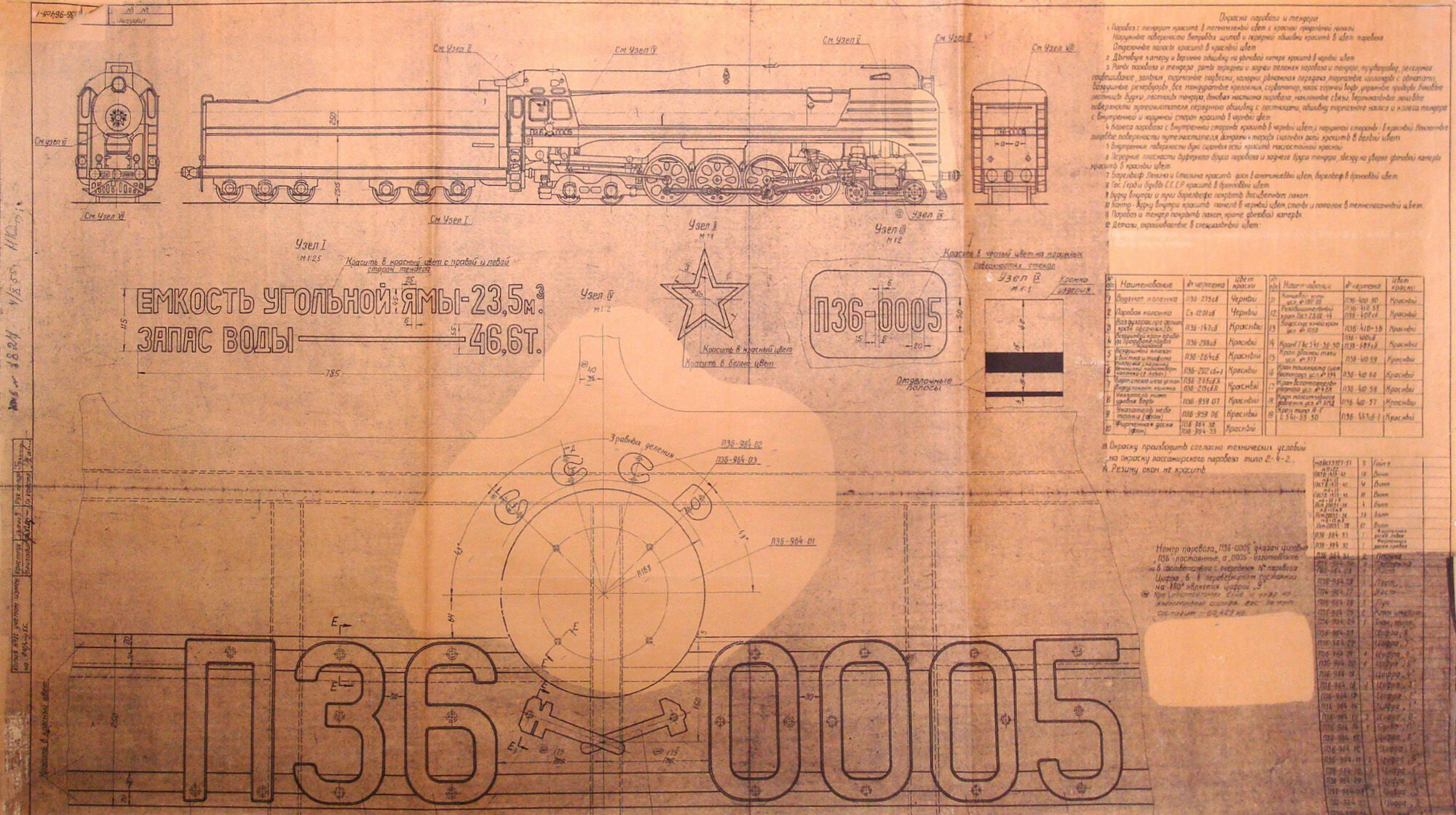
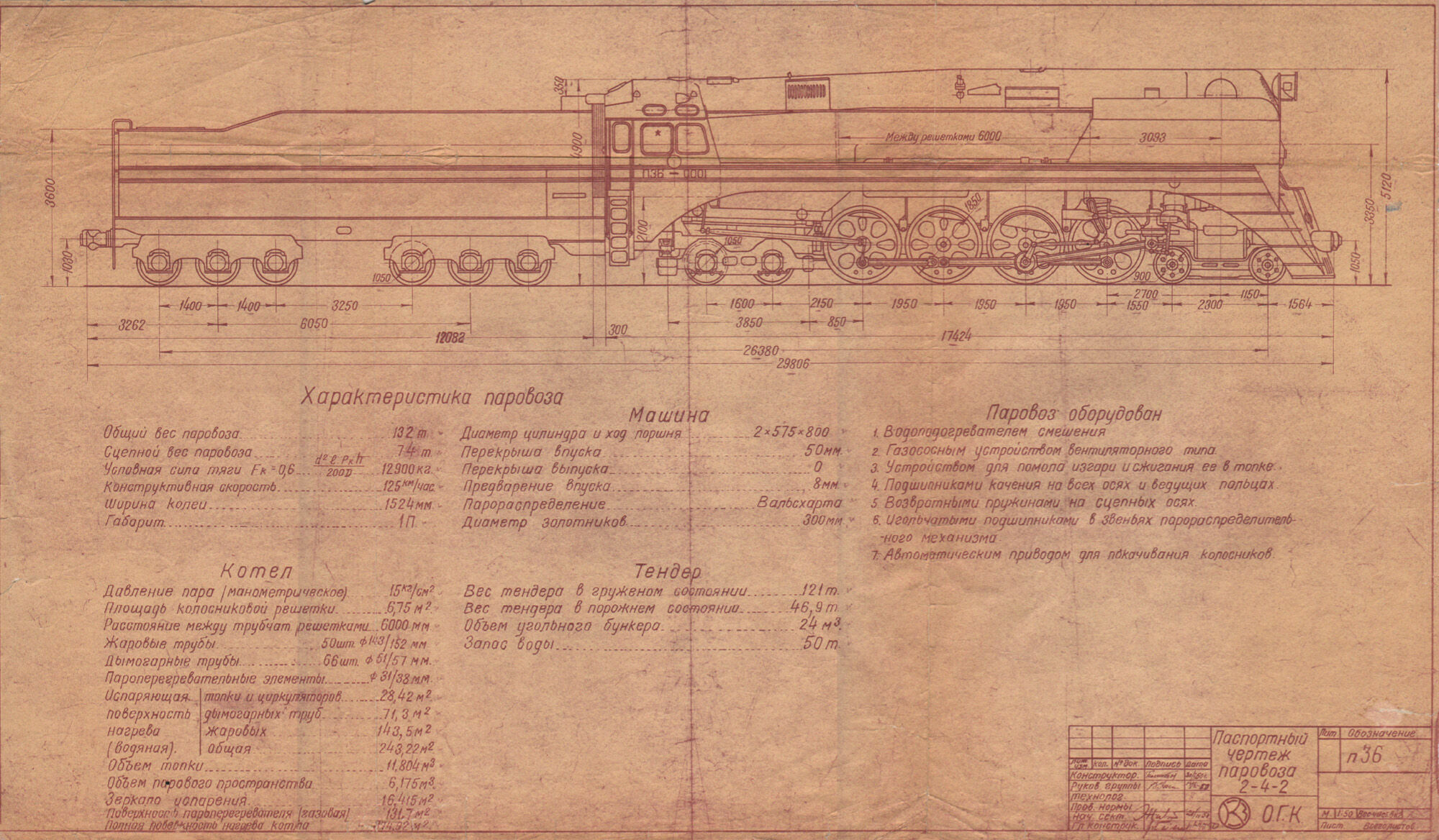
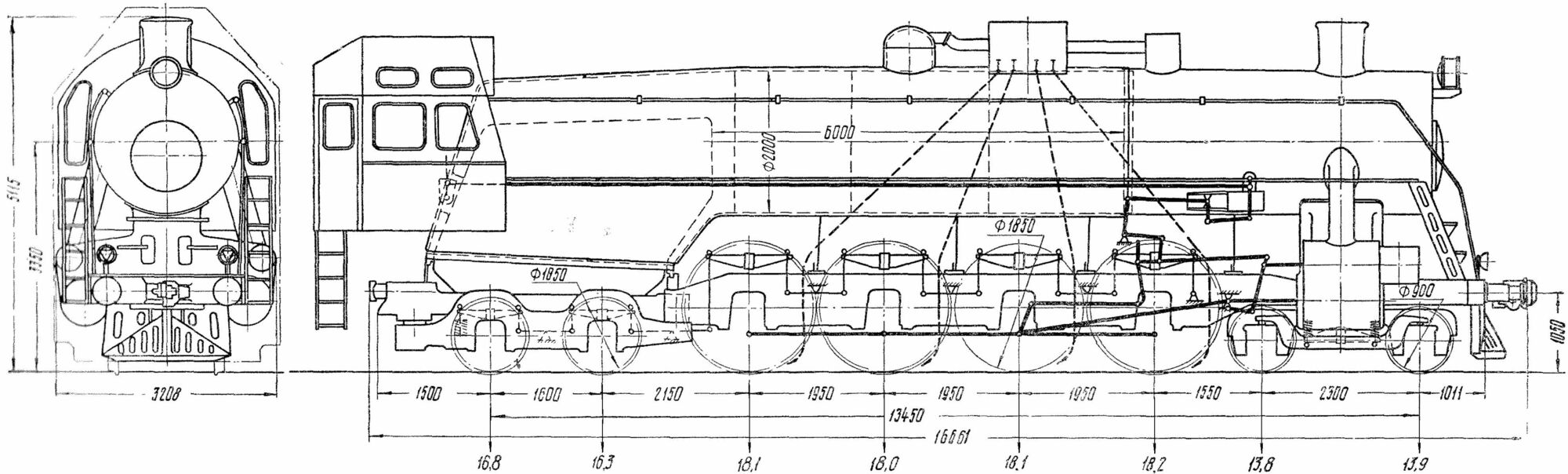
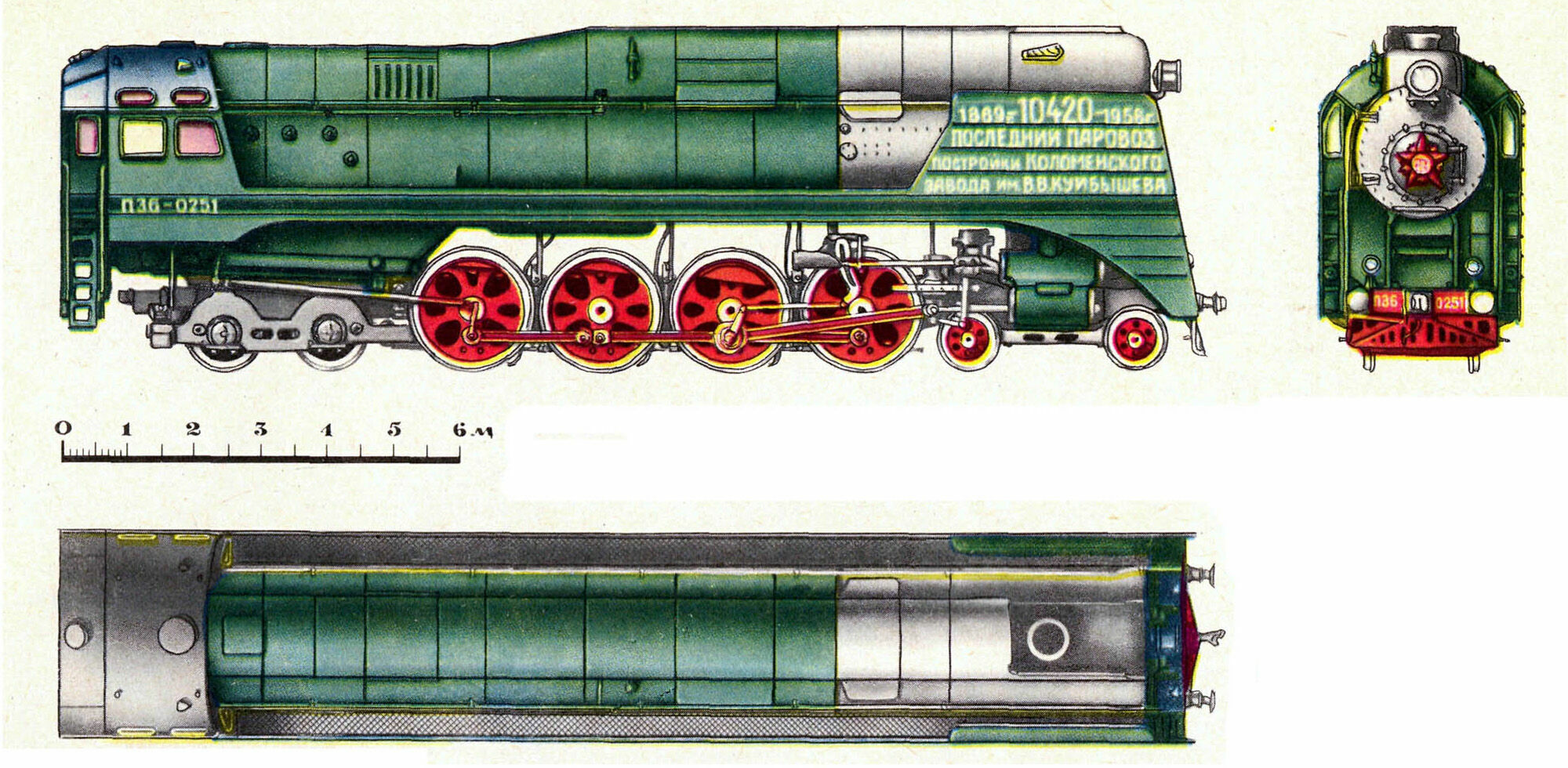
Drawings
and diagrams

History

Chronology

  1. December 1949 Commissioning of the first experimental steam locomotive, P36 0001, designed under the supervision of L.S. Lebedyansky, the chief designer of the Kolomna Locomotive Works.
  2. 20th June 1951 During the test run, at an average speed of 86.4 km/h, the maximum power of the locomotive is achieved — 3,360 hp.
  3. 1953–1954 The Kolomna Locomotive Works produces steam locomotives of the experimental (0002–0006) and pilot (0007–0036) batches of P36.
  4. 1955–1956 215 production steam locomotives P36 with numbers
    0037–0251 are built.
  5. 1956 The last steam locomotive P36 0251 is built at the Kolomna Locomotive Works.
  6. 1974 End of service of P36 steam locomotives on Soviet railways.
  7. 1982 Removal of steam locomotives from inventory and their transfer to industrial enterprises for use as boiler houses.
  8. 1982 Steam locomotive P36 0251 from the Vyazemskaya Storage Depot of the Far Eastern Railway is transferred to the Dalvodremmash Plant in Ussuriysk.
  9. Autumn 1991 Steam locomotive P36 0251 is purchased from its owner by the Central Museum of the Oktyabrskaya Railway at scrap metal value.
  10. June–December 1992 An operation is carried out to deliver the steam locomotive to the museum site in Shushary.