Today the museum is open from 10:00 to 18:00

Map

Exhibit description

Passenger Diesel Locomotive TEP10 163

The mid-1950s marked a major initiative in the USSR’s railway network to replace steam locomotives with innovative types of traction — diesel and electric. For train operations on sections and entire railway lines being converted to diesel traction, a large number of new, powerful diesel locomotives were needed to replace steam locomotives.

In the mid-1950s, the country faced a pressing need for a large number of new, powerful diesel locomotives capable of replacing steam locomotives.

For freight locomotives, this need was addressed by initiating the mass production of TE3 diesel locomotives, followed later by the 2TE10 class in various modifications. For passenger diesel locomotives, however, the challenge was more acute. Developing dedicated passenger locomotives required significant time, so to quickly expand the passenger fleet, modified versions of freight locomotives were created. The TE7 passenger locomotive, based on the TE3 freight locomotive, was one such adaptation. However, it saw limited use across the Ministry of Railways network.

New Class

The TEP10 diesel locomotives, developed at the turn of the 1950s and 1960s at the Kharkiv Locomotive Works, became much more widespread. The TEP10 (originally designated as the TE11) was a passenger version of the TE10 freight locomotive, which had been built at the same plant several years earlier.

This diesel locomotive was a single-section machine, with all its main components similar to those of the TE10: a ten-cylinder two-stroke diesel engine 10D100 with a capacity of 3,000 hp with counter-moving pistons, a traction generator MPT-120/49 (later GP-311), and traction engines EDT-340 with support-axial suspension.

The design speed of the TEP10 diesel locomotive increased to 140 km/h, and the diesel engine capacity was 3,000 hp.

The main difference from the TE10 freight locomotive was in the design of the traction gearbox: by reducing its gear ratio (63 : 20 = 3.15 instead of 69 : 14 = 4.93 on the TE10), the design speed of the TEP10 diesel locomotive increased to 140 km/h (100 km/h on the TE10), while the continuous tractive effort decreased to 17,200 kgf (27,000 kgf on the TE10). In addition, the passenger locomotive’s fuel capacity was slightly reduced (to 5 t, compared to 6.5 t on the TE10), and equipment for electro-pneumatic braking (EPB) was installed, along with a number of other design changes.

TEP10 passenger diesel locomotives were produced at the Kharkiv Locomotive Works in 1960–1968. A total of 335 locomotives of this class were built under Nos. 001–335.

A total of 335 TEP10 locomotives were built.

On the Railway of the USSR

The very first diesel locomotives of the TEP10 class were mainly delivered to the Oktyabrskaya Railway at the Leningrad-Passazhirsky-Moskovsky Depot, and somewhat later to the Kandalaksha Depot. These locomotives began servicing passenger trains along the entire northern route from Leningrad to Kandalaksha.

After the electrification of the Leningrad-Volkhovstroy section in 1965, some TEP10 diesel locomotives were transferred to the Leningrad-Finlyandsky and Leningrad-Sortirovochny-Moskovsky Depots to haul passenger trains to Vyborg and Elisenvaara. In the first half of the 1970s, after the Oktyabrskaya Railway received a significant number of TEP60 diesel locomotives, which were more suitable for passenger service and replaced the TEP10, the latter were transferred to other railways.

In addition to the Oktyabrskaya Railway, the TEP10 diesel locomotives were used on many other railways of the USSR Ministry of Railways network, including the Privolzhskaya Railway (Saratov, Volgograd Depots), the Southern Railway (Osnova, Poltava, Grebenka Depots), the Gorky Railway (Krasnoufimsk, Yudino, Agryz, Murom Depots), and the Central Asian Railway (Tashkent, Mary Depots).

Most locomotives of this class were retired and removed from the inventory in the 1980s. The last remaining TEP10 diesel locomotives in Russia operated at the Murom Depot of the Gorky Railway, where they hauled passenger trains until 2006.

Most locomotives in this class were retired and removed from inventory in the 1980s.

The TEP10-163, produced in 1965 and displayed in the museum, was sent to the Privolzhskaya Railway after its construction and transferred to the Gorky Railway in 1977.

Parameters

Technical
specifications

Years of production
1960–1968
Number of built, units
335
Diesel power, hp
3,000
Axial characteristic
3 0–3 0
Design speed, km/h
140
Service mass, t
129
Continuous thrust force, kgf
17,200
Traction generator type
GP-311
Traction motor type
ED-107
Suspension of the traction electric motor on the axle
Support-axial
Axial gear ratio
3,15
Battery type
46TPNZH-550
Brake compressor type
KT-7
Wheel diameter, mm
1050
Axle load on rails, ts
23
Continuous mode speed, km/h
36
Equipment fuel reserves, kg
5,000
Equipment stocks of sand, kg
520
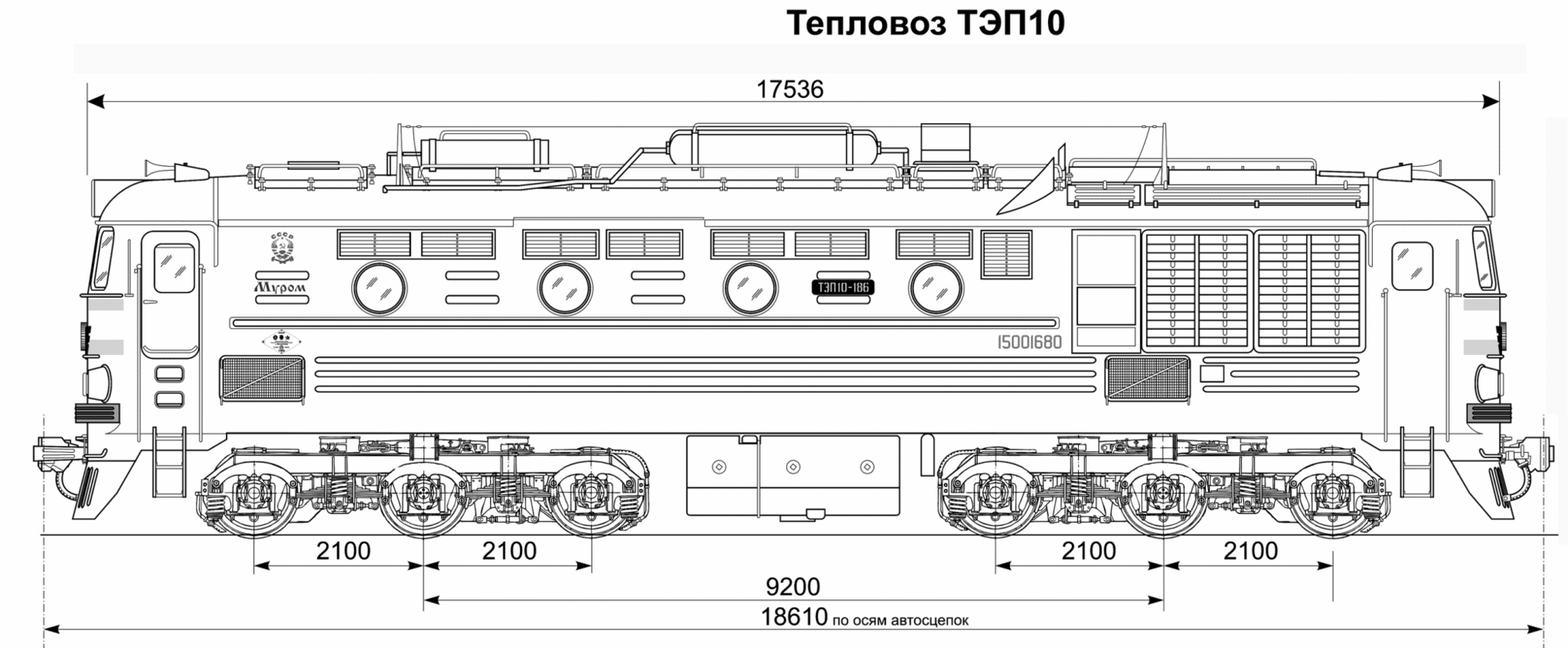
Length along the axles of automatic couplings, mm
18,610
Body width, mm
3 272
Body height, mm
5 124
Kingpin base, mm
9 200
Wheelbase of the bogie, mm
4 200
Minimum radius of passable curves, m
125
Current
Direct
Power transmission type
Electric
Diesel brand
10D100
Diesel
In-line
Fuel combustion cycle
Two-stroke
Diesel characteristics
Ten-cylinder
Piston
Counter-rotating

Drawings
and diagrams

History

Chronology

  1. 1965 The TEP10 diesel locomotive was built at the Kharkiv Locomotive Works.
  2. 1960–1968 TEP10 passenger diesel locomotives were produced at the Kharkiv Locomotive Works.
  3. 1960–1970 TEP10 locomotives were widely used on many railways of the USSR with passenger trains.
  4. 1980s Most of the TEP10 locomotives were retired and removed from inventory.
  5. 1991 The TEP10-163 diesel locomotive, produced in 1965 at the Kharkiv Locomotive Works, was delivered to the Russian Railway Museum in Saint Petersburg.