Today the museum is open from 10:00 to 18:00

Map

Exhibit description

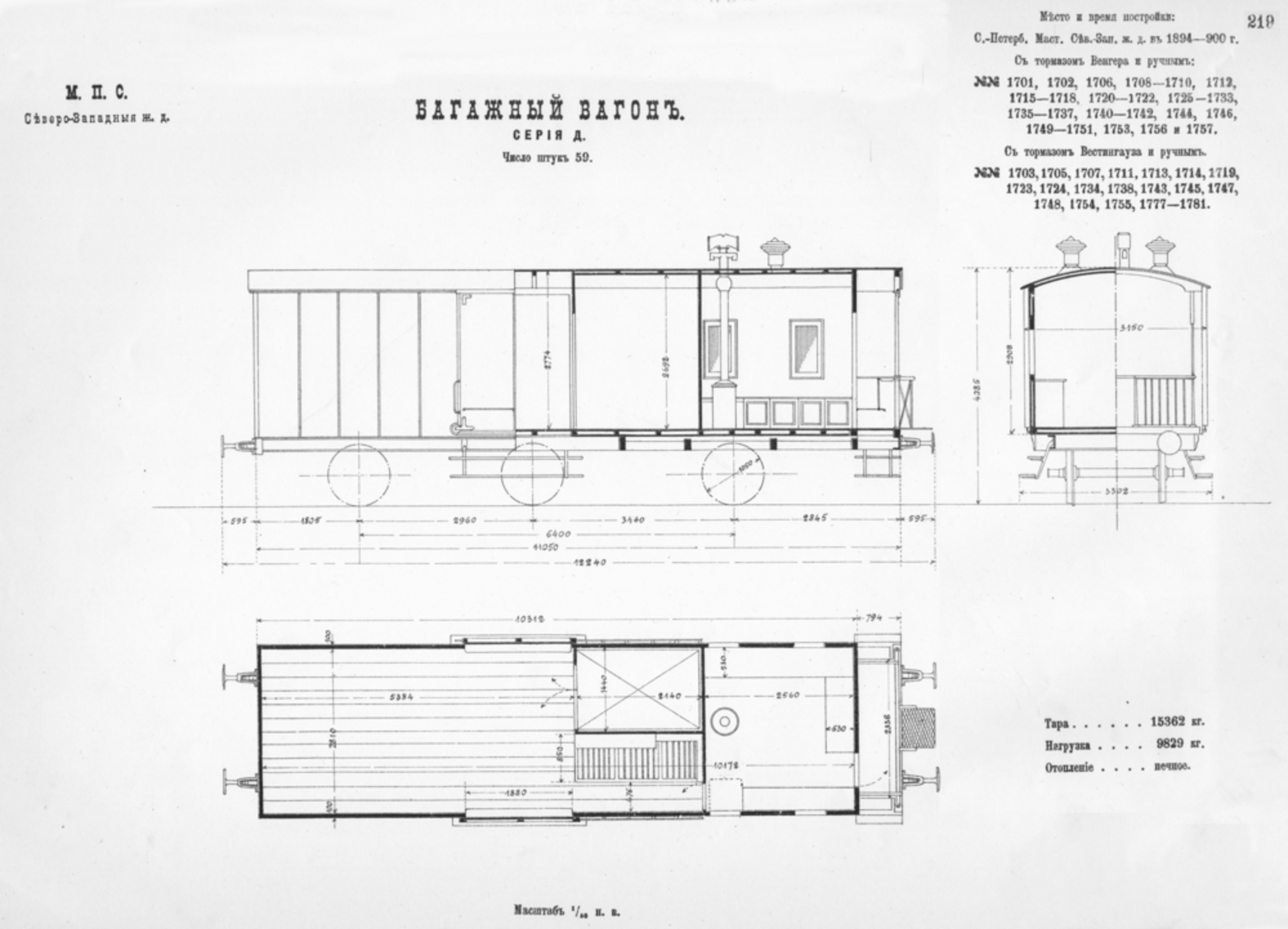
Baggage car No 1777 series D

The cars of this type were built by the St. Petersburg workshops of the St. Petersburg-Warsaw Railway between 1894 and 1900. Their distinctive feature was a compartment specifically designed for transporting oysters. About 60 of these cars were built.

On 1st January 1907, the St. Petersburg-Warsaw Railway was merged with the Baltic and Pskov-Riga Railways to form the North-Western Railways. In 1909, a unified type of three-axle baggage car was developed for state-owned railways. Apart from the standard models, there were specialised versions, including cars for the Southwestern Railways with cash chests and for the North-Western Railways with a compartment for oysters, similar to the earlier-built cars.

In 1909, a unified type of three-axle baggage car was developed for state-owned railways. But in addition to the standard models, there were also cars equipped with cash chests and a compartment for oysters.

Baggage cars on the St. Petersburg-Warsaw and North-Western Railways belonged to the class D.

The body of Anton Chekhov, who died in Germany, was brought to Russia in the same “oyster car”.

This same car, D 1734, was used to transport the body of Anton Chekhov in 1904 after he passed away at a resort in Germany. Aleksandr Kuprin described it as follows: “It felt like a dream, as I remember his funeral. Cold, grey Petersburg, confusion with telegrams, a small group of people at the station, the “oyster car”, the station authorities who had never heard of Chekhov and saw his body merely as railway cargo. Then, in contrast, Moscow — raw, elemental grief, thousands of seemingly orphaned people, tear-streaked faces. And finally, the grave at the Novodevichy Cemetery, all covered with flowers…”

Museum Exhibit

The car has been preserved because it was used for an extended period to store linen at the technical inspection station for long-distance passenger cars at the Leningrad-Passazhirsky-Finlyandsky Station. It was transferred from there to the museum in 1990.

Parameters

Technical
specifications

Car length by buffers, mm
12 240
Frame length, mm
10 040
External body width, mm
3 170
The height of the car from the level of the rail to the top of the roof, mm
4 085
Body height from floor to ceiling in luggage compartment, mm
2 774
Body height from floor to ceiling in service, mm
2 692
Wagon container, kg
15 362
Load capacity, kg
9 829
Car wheelbase, mm
2 690 + 3 440

Drawings
and diagrams

History

Chronology

  1. 1894–1900 The St. Petersburg workshops of the St. Petersburg-Warsaw Railway build baggage cars of the class D.
  2. 1907 The St. Petersburg-Warsaw Railway is merged with the Baltic and Pskov-Riga Railways.
  3. 1909 A single type of three-axle baggage car is created for state-owned roads.
  4. 1904 The class D car brings the body of Anton Chekhov, who died at a resort in Germany, to St. Petersburg.
  5. 1990 Class D car no. 1777, used for the storage of linen, is transferred to the museum.
  6. 2013–2014 Car no. 1777 is restored during repair work carried out by ARS-M LLC.