Today the museum is closed

Map

Exhibit description

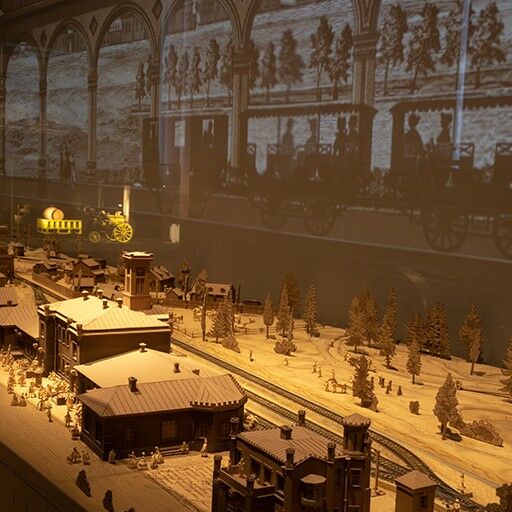
Museum display Pavlovsky railway station

An unprecedented project

Pavlovsky station — the terminal station of the first railway of the Russian empire — the Tsarskoye Selo Railway. Traffic on this section was opened on May 22 1838, and a day later the long-awaited event — the grand opening of Pavlovsky Station took place. There had never been a similar project in Russia: it became not only a meeting place for passengers, but also a magnificent concert building with a restaurant, around which a park was laid out.

In order to attract the public, Franz von Gerstner proposed to build a station building at the terminal point "for the shelter and pleasure of the public." In his report "On the Benefits of Building a Railway from St. Petersburg to Tsarskoye Selo and Pavlovsk," he wrote: "A new Tivoli is being built at the end of the road, a beautiful vauxhall: it will serve as a gathering place for the capital's residents in summer and winter; games and dances, refreshment in the fresh air and in a luxurious dining room will attract everyone there."

The concert building with a restaurant was built according to the design of the architect Andrei Stackenschneider. It was originally intended, as Franz von Gerstner had planned, that the station would function year-round. However, due to low winter attendance, from 1840 it was closed during the cold season, and only on occasions were concerts and balls held there.

Pavlovsky Station became the first permanent concert venue in Russia where symphony orchestras performed. In September 1838 the gypsies performed there, followed by the symphony orchestra conducted by Joseph Hermann at the beginning of the following year, and from 1856 Johann Strauss Jr. performed for ten seasons. Outstanding musicians conducted at the station: Alexander Glazunov, Reinhold Glière, Anatoly Lyadov, Leonid Sobinov, Anastasia Vyaltseva and others performed. Anna Pavlova gave one of her last performances in Russia at Pavlovsky Station.

Pavlovsk I

January 3 1844 there was a fire. The station was restored and opened May 13 of the same year, and then in 1860, 1871 and 1884 it was rebuilt and expanded. In 1875 the Pavlovsk Theater was built nearby according to the design of the architect Nikolai Benois. In 1900 Pavlovsk station came under the jurisdiction of the Moscow-Window-Rybinsk Railway. In 1904 during the construction of the Vitebsk line, a new station was built outside the park, and the old one was named Pavlovsk I.

After 1918 the Pavlovsk Music Station and the theater formed a complex in which a symphony orchestra of 80 musicians performed. During the summer season, it gave twenty concerts. Conductor Nikolai Malko acted as the director. The great Feodor Chaliapin sang here, and the first Great Russian orchestra of folk instruments in Russia performed under the direction of Vasily Andreyev.

During the war, the station building and the section were destroyed. After the Victory they were not restored, although the railway line Tsarskoye Selo - Tyarlevo - Pavlovsk I was indicated on maps until 1952. In Pavlovsk Park, a lantern, a fountain bowl and a station kitchen building have been preserved from the train station ensemble.