Today the museum is open from 10:00 to 18:00

Map

Exhibit description

Coal-loading crane Coal loading crane type "Zhuravl"

Steam locomotive power

The era filled with the smells of smoke, steam and ash is gone, and with it entire landscapes and mechanisms. Among the latest — coal loading cranes. With their help, railroad workers poured fuel, that is, coal, into a tender — wagon where fuel and water were transported.

Tender — is a U-shaped water tank mounted on a frame, on top of which fuel is placed. The height from ground level to the top of the tank reached 3.5 m, so cranes were used to load coal.

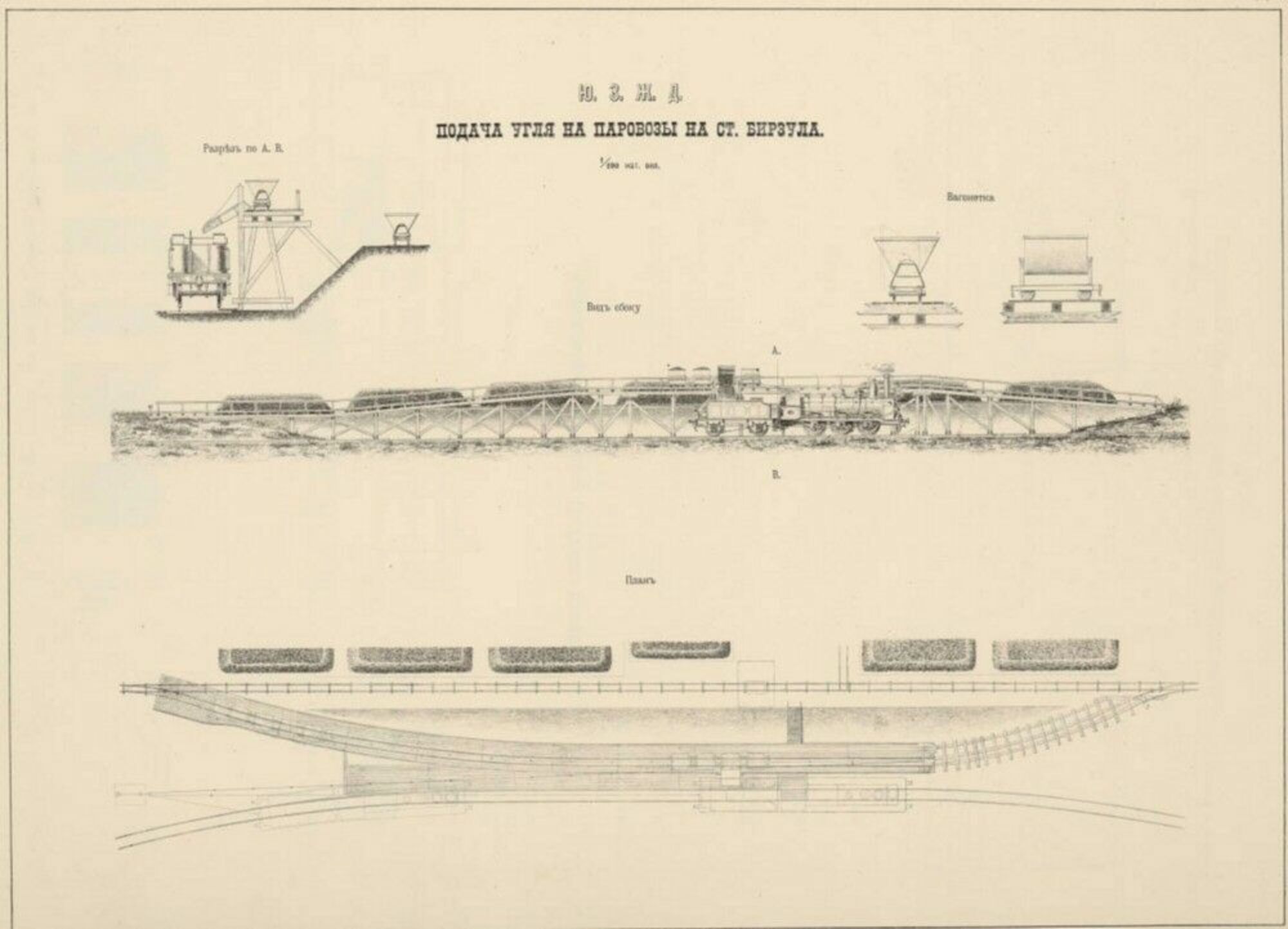
Various devices were used to load coal. The simplest were wooden trestles, onto which a cart with coal was rolled and its contents were tipped into a tender box. In addition to them, there were coal-lifting cranes called "Zhuravels".

The design of this crane was adopted from well cranes, with the only difference being that the beam of the coal-lifting "Zhuravels" rotated around the axis of the vertical support by 360 degrees.

"Zhuravel" at work

The "Zhuravel" crane was a beam on a vertical support. At one end of the beam there was a counterweight, and at the other a bucket for loading coal. The counterweight was designed so that after loading the bucket with coal, it could outweigh it by lifting it up. To lower the empty bucket, a rope was used or a loader jumped into it.

To transport large volumes of coal, where gravity was insufficient, a mechanical or steam drive was built. The steam for the operation of the "Zhuravel" was taken from the steam locomotive.

In the 1930s up to two-thirds of the coal mined in the USSR, i.e. millions of tons, was burned in the fireboxes of steam locomotives. Time passed, and locomotives powered by fire and firebox were used less and less, until they became museum exhibits.

The museum displays a "Zhuravel" with a mechanical winch, presumably manufactured between 1908 and 1920 It is unique in its riveted construction and elegant design. It was rolled along a special section of track by hand to unload coal evenly. It was hard and dirty work, but there was no alternative to trains.

The crane came to the museum from the Borovichi station, where small steam locomotives were used for rare trips. It could handle a small load and has survived to this day.

Steam locomotives required water and fuel for their operation, the main types of which were coal, peat, firewood and oil.

All steam locomotives had to have a supply of fuel and water. To work on main lines, special wagons were constantly attached to the locomotives, which contained supplies of water and fuel. These wagons were called tenders. Some locomotives, which were used for shunting or short branches, did not have tenders and carried the entire supply on themselves. Such locomotives were called tank locomotives. The volume of fuel varied from several hundred kilograms to 30 tons.

A tender is a U-shaped water tank mounted on a frame, on top of which fuel is placed. The height from ground level to the top of the tank reached 3.5 m. Special mechanisms were needed to load such a volume of fuel. For small volumes and in exceptional cases, fuel was loaded manually with buckets.

Different devices were used to load coal. The simplest were wooden trestles, onto which a cart or trolley with coal was rolled and their contents were tipped into a tender box.

Less capital structures were coal-lifting cranes, the so-called "cranes". Their design was adopted from well "cranes". The "crane" was a beam on a vertical support. Unlike a well "crane", the beam could rotate around the support axis by 360 degrees. At one end of the beam there was a counterweight, and at the other - a bucket into which coal was loaded. The counterweight was designed so that after loading the bucket with coal, it could outweigh this bucket, that is, lift it up. To lower the empty bucket, a rope was used or a loader jumped into it.

To deliver a large volume of coal, where there was not enough gravity, a mechanical or steam drive was built. The steam for the operation of such "cranes" was taken from the steam locomotive.

Parameters

Technical
specifications

Drawings
and diagrams

History

Chronology

  1. 1980s The last "crane", no longer in use, was preserved until the end of the 1980s at the narrow-gauge station Ryazan-Shumash. Unfortunately, no one saved even the iron parts from it to restore it later. The wheel, which played the role of a counterweight, was transferred to the museum car at the Moscow-Leningradskaya station in 1986.