Today the museum is closed

Map

Exhibit description

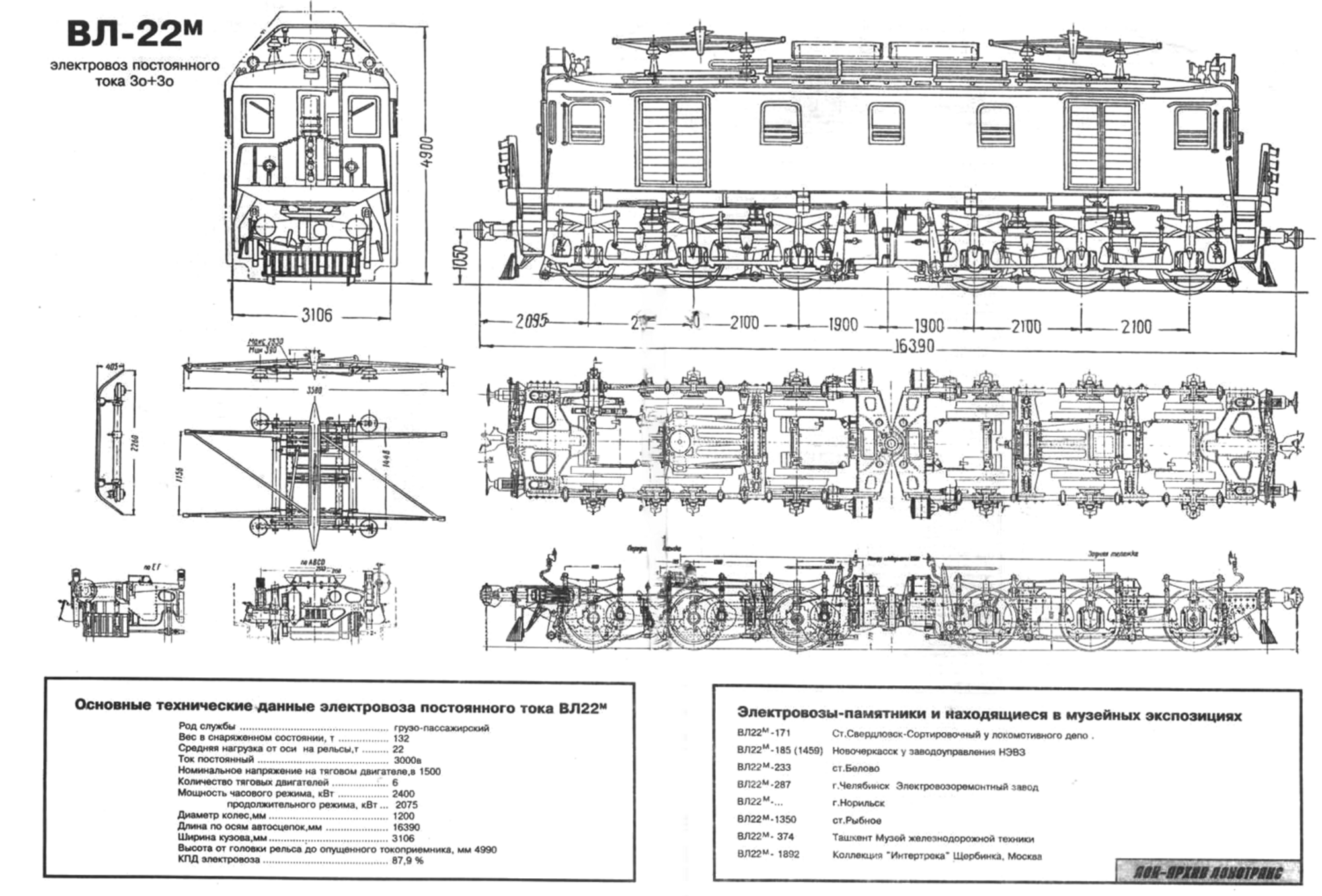
Direct Current Electric Locomotive VL22M 1729

Shortly after the end of the Great Patriotic War, in anticipation of the planned conversion of many of the railway lines to electric traction, the USSR began to restore electric locomotive construction as an industry. Production was established at the Novocherkassk Electric Locomotive Plant, at the site of the steam locomotive construction plant destroyed in the war. In the late 1940s, serial production of the VL22M direct current mainline electric locomotive began here.

In the late 1940s, serial production of the class VL22M direct current mainline electric locomotive began at the Novocherkassk Electric Locomotive Plant.

Vehicle Class

VL22 locomotives were developed before the war and were a further development of the design of the first Soviet electric locomotives, S S and VL19. In 1938–1941, the Kolomna Locomotive Works and the Dynamo Plant together produced 37 VL22 electric locomotives; production was then stopped due to the outbreak of war. In the post-war period, when organising the production of electric locomotives at the Novocherkassk Electric Locomotive Plant, the VL22 was selected as the starting point for the creation of a new locomotive. A number of improvements were made to its design (more powerful DPE-400 electric traction engines installed, new types of some of the electrical apparatus and machines used), resulting in the modernised VL22M.

In April 1947, the Novocherkassk Electric Locomotive Plant built its first electric locomotive, VL22M 185 (numbering continued from the 184 VL19 and VL22 locomotives built before the war). The plant then began series production of the electric locomotives up until 1958. In total, over the course of a decade, 1,541 VL22M units were built (no.  185, 186, 188, 200–580, 681–700, 801–830, 931–2037).

This class of electric locomotive was produced in three main variants, which were not distinguished by index.

Firstly, most of the locomotives produced (716 units) were intended for use with freight traffic, had a design speed of 75 km/h (axial gear ratio of 4.45 or 4.56) and were equipped with electric (regenerative) braking.

Next, less than half of the remaining number of VL22Ms built (581 units) differed from the above-mentioned only in that they did not have regenerative braking. These machines were intended for use with freight trains mains running on sections with a flat track profile, where there was no particular need for regenerative brakes.

Class VL22M electric locomotives were produced in three main variants: freight, freight with a flat track profile, and passenger.

Finally, due to the severe shortage of passenger electric locomotives on Soviet railways in the early 1950s, some batches of VL22Ms (244 units in total) were built with a design speed of 90 km/h (axial gear ratio of 3.74, 3.76 or 2.76) and, as a rule, without regenerative brakes to allow for this use. The VL22M 1729 on display belongs to the latter variant.

VL22M-class electric locomotives were widely used on Soviet railways. In the late 1950s, they were in operation on the East Siberian, South Caucasus, Kalinin, Kuybyshev, Lviv, Moscow-Kursk-Donbas, Moscow-Ryazan, Oktyabrskaya, Omsk, Sverdlovsk, Northern, North Caucasus, Stalin, Tomsk, Ufa, Southern and South Ural railways.

Until the mid-1960s, VL22Ms were the most common direct current electric locomotives on the network. Later, after the arrival of the newer VL8, VL23 and ChS2 electric locomotives on Soviet railways, most VL22M electric locomotives were concentrated on the Sverdlovsk, Prydnipro and South Caucasus Railways. These locomotives were especially widespread on the Sverdlovsk Railway, where they were used in large numbers for all types of traffic until the mid-1990s. The last of these vehicles were decommissioned in the early 21st century. On most other railways, VL22Ms were removed from service and decommissioned earlier, in the 1970s–80s.

As well as on the railways of the USSR’s Ministry of Railways, class VL22M electric locomotives were also used in industry, on in-house electrified lines at some large enterprises — for example, Apatit (Murmansk Oblast), Azovstal (Mariupol), the Chelyabinsk Metallurgical Plant, and so on.

Until the mid-1960s, VL22M electric locomotives were the most common direct current electric locomotives.

The electric locomotive VL22M 1729 displayed in the museum was built in 1957 and operated on the Ufa and Kuybyshev railways.

Parameters

Technical
specifications

Plant
Novocherkassk Electric Locomotive
The factory number
Unknown
Years of production
1946–1958
Number of built units
1,541
Nominal voltage of the contact network, V
3000
Axial characteristic
30+30
Continuous Power, kW
1,860
Continuous thrust force, kgf
14,800
Design speed, km/h
90
Service mass, t
132
Type of current, t
Constan
Electric brake
Absent
Axial gear ratio
3,74
Brake compressor type
E-500
Type of pantograph
J-5K
Wheel diameter, mm
1 200
Axle load on rails, ts
22
Clock mode power, kW
2,400
Clock mode speed, km/h
42,9
Hourly mode thrust force, kgf
19,800
Continuous mode speed, km/h
45,3
Length along the axles of automatic couplings, mm
16,442
Body width, mm
3 106
Body height, mm
4,900
Wheelbase of the bogie, mm
4 200
Minimum radius of passable curves, m
75
Traction motor type
DPE-400A

Drawings
and diagrams

History

Chronology

  1. Late 1940s The Novocherkassk Electric Locomotive Plant begins serial production of the class VL22M of direct current mainline electric locomotives.
  2. April 1947 The plant builds the first VL22M 185 electric locomotive and goes on to begin series production of these electric locomotives.
  3. 1947–1958 Series production of the VL22M electric locomotive begins.
  4. 1957 Electric locomotive VL22M 1729 is built.
  5. 1970–1980s Gradual decommissioning of VL22M electric locomotives from service on the railways.
  6. 1996 Electric locomotive VL22M 1729 arrives at the Russian Railway Museum from the Ruzayevka Locomotive Depot on the Kuybyshev Railway.