Today the museum is open from 10:00 to 18:00

Map

Exhibit description

Diesel locomotive TGM3-021

Simpler and more reliable

Research on power transmission from an internal combustion engine to the driving wheel pairs was conducted back in the 1930s. They showed the extreme unreliability of mechanical transmission and the impossibility of using electric transmission for low-power diesel locomotives due to complex manufacturing and high cost. To create a new diesel locomotive to replace the industrial steam locomotive, a hydromechanical transmission was chosen. Its development took place during the Second World War.

In Germany, V36 shunting locomotives were produced since 1937. After the war, one of them ended up in the USSR, where in 1949 it was tested. They revealed sufficient reliability and convenience of hydromechanical transmission for low-power diesel locomotives.

At the end of 1956 the Murom Plant named after F.E. Dzerzhinsky. built the first two three-axle shunting locomotives with hydraulic transmission of the TGM1 series. The series turned out to be unsuccessful. The construction of a new one was entrusted to the Lyudinovo Diesel Locomotive Plant.

Under the supervision of the chief designer of the Lyudinovo Plant, Alexander Khrychikov, the locomotive was redesigned. This is how the TGM3 series appeared, that is, "diesel locomotive with hydromechanical transmission, shunting, type 3". The plant produced the first five locomotives in 1959

From 1959 to 1977 less than 4,000 TGM3 of all modifications were built. About 1,200 worked on the railways of the Ministry of Railways. 75 machines were exported to Bulgaria, Iran, Turkey, Egypt and China. In Poland from 1963 to 1966 the SM15 series was built according to Soviet designs.

Exhibit history

The museum displays the shunting diesel locomotive TGM1 575, built at the Lyudinovo Plant named after Dzerzhinsky in 1960.

The TGM1 575 was added to the museum's collection in 1997. Before that, it was located in the Velikiye Luki depot of the October Railway.

Outwardly, the diesel locomotive was more reminiscent of industrial electric locomotives. It had a highly raised driver's cab located almost in the center, and hoods at the front and back were slanted to the outside.

After testing, it turned out that the locomotive had a short wheelbase, which led to its rocking while moving. The units were located too compactly, which made them difficult to access for repair and dismantling. The large slopes of the cabin walls impeded visibility, and the refrigerator elements were located too far from the diesel engine.

Parameters

Technical
specifications

Service type
Industrial shunting
Gauge, mm
1 524
Power, hp
750
Transmission
Hydromechanical
Operation mode
Shunting and train
Axles, pcs
4
Axial formula
20 – 20
Coupling weight, t
68
Fuel stock, kg
2800
Cooling system water, l
430
Oil in hydraulic transmission, l
300
Min. curve radius, m
40
Length at automatic coupling axes, mm
12 600
Pivot base, mm
6 000
Height from crown of rail, mm
4 600
Width at protruding parts, mm
3 150
Wheel diameter, mm
1 050
Trolley base, mm
2 100
Design speed, km/h
Shunting mode 30 / train mode 60

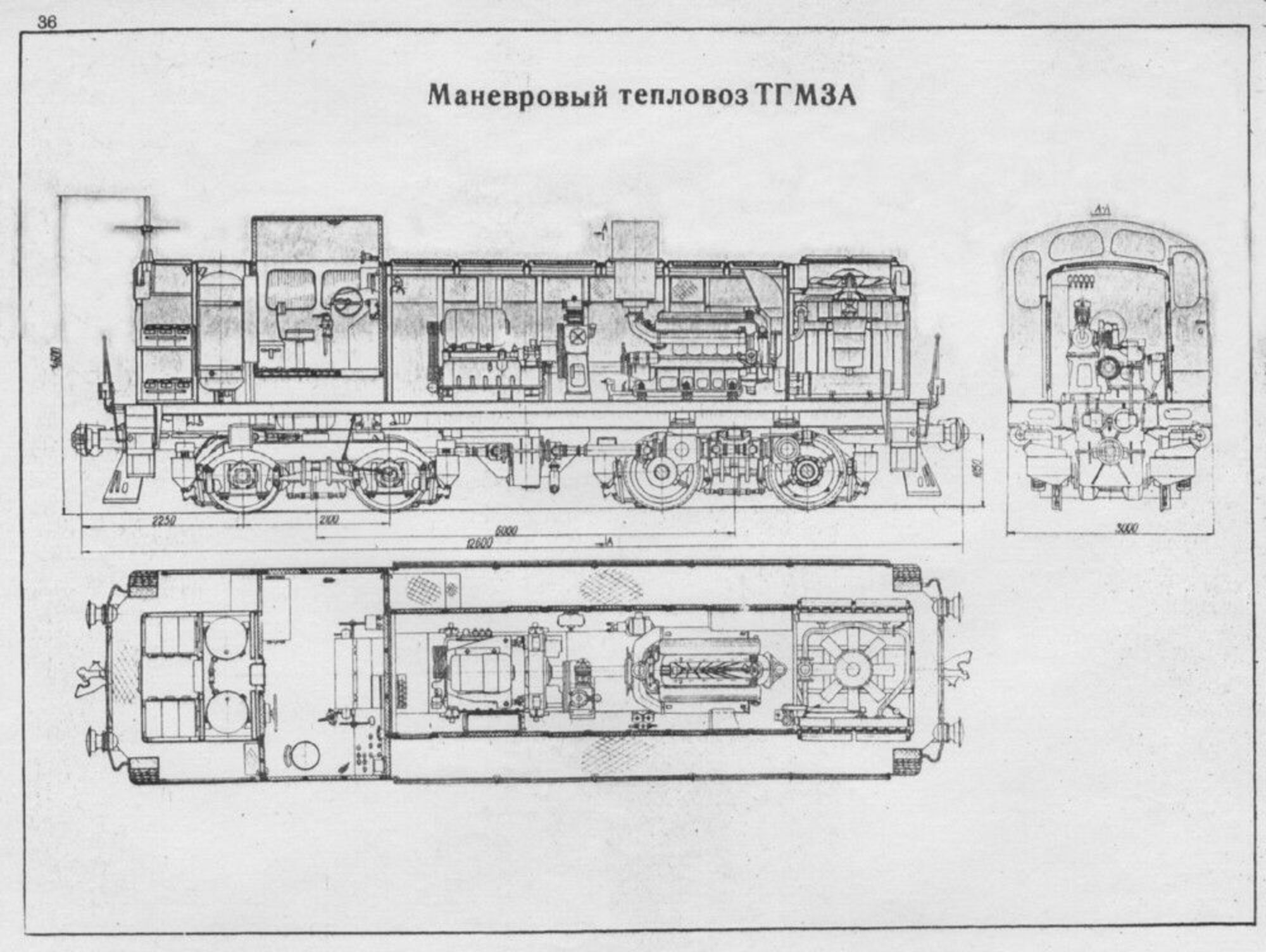
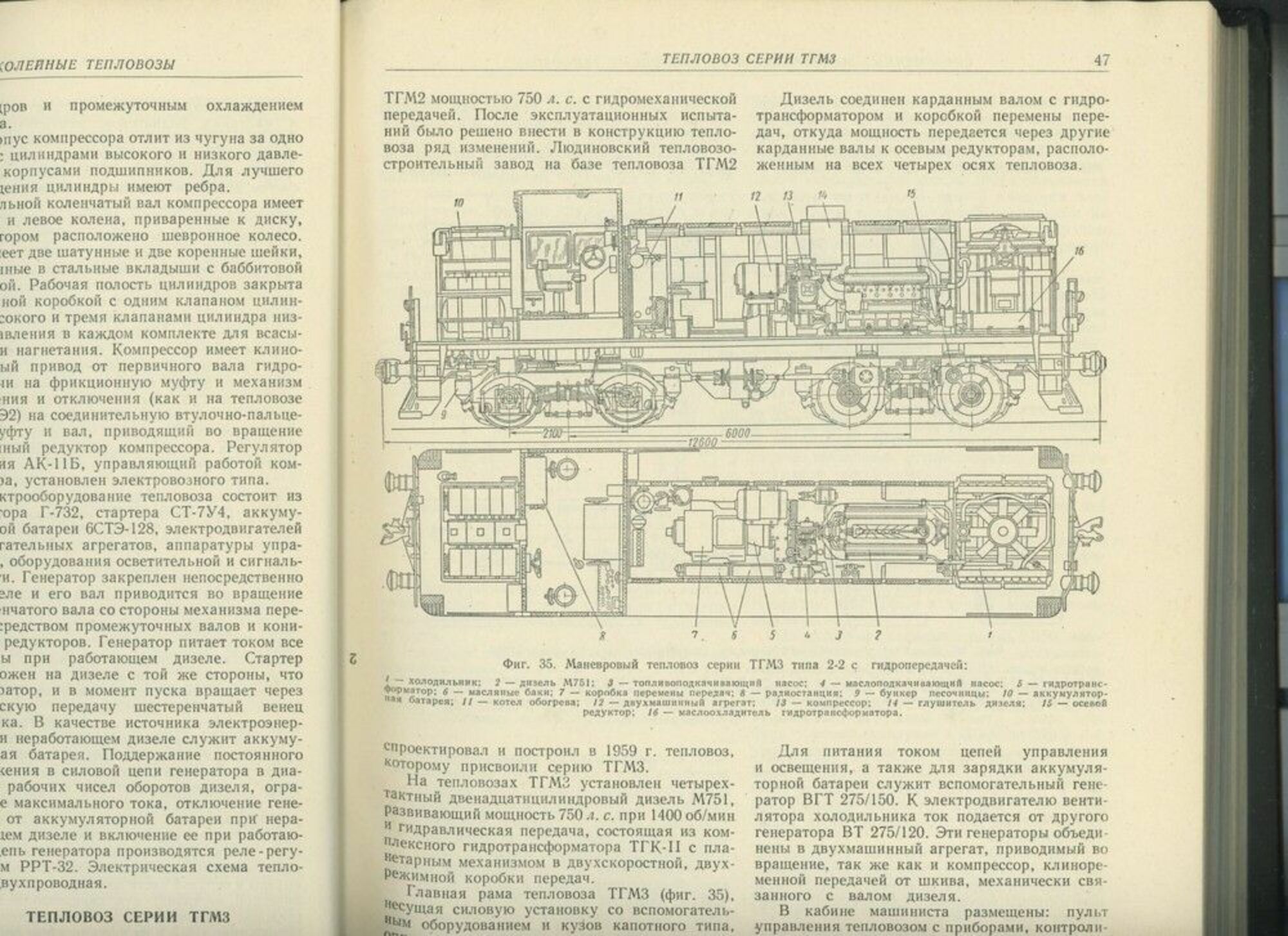
Drawings
and diagrams

History

Chronology

  1. 1956 The creation of shunting diesel locomotives with hydraulic transmission was first entrusted to the Lyudinovsky and then to the Voroshilovgrad Diesel Locomotive Plant named after the October Revolution (VZOR). At the end of 1956, it built the first, and at the beginning of 1957 - the second similar diesel locomotive, which was initially designated TGV. Then the name was changed to TGM2.
  2. 1958 As a result, the construction was transferred to the Lyudinovo Diesel Locomotive Plant, which was resuming locomotive construction, which had ceased in pre-revolutionary times. Having produced three locomotives of this design according to the drawings of the Voroshilovgrad plant in 1958 and 1959, it was decided to redesign the locomotive.
  3. 1959 Under the leadership of the chief designer of the Lyudinovo plant A. M. Khrychikov, the locomotive was significantly redesigned. The new locomotive received the TGM3 series: a locomotive with hydromechanical transmission, shunting, type 3. The plant produced the first five TGM3 locomotives in 1959.
  4. 1959 In total, from 1959 to 1977, slightly less than 4 thousand TGM3 locomotives of all modifications were produced. About 1,200 of them worked on the railways of the Ministry of Railways. 75 locomotives were exported to Bulgaria, Iran, Turkey, Egypt and China.
  5. 1960 The diesel locomotive in the museum was built by the Lyudinovo Diesel Locomotive Plant in 1960. It was used on the tracks of industrial enterprises. It was transferred to the museum from the Tsarskoye Selo Track Machine Repair Plant in 1996.
  6. 1963 In the Polish People's Republic, according to Soviet documentation, diesel locomotives were produced from 1963 to 1966, which were designated as SM15.