Today the museum is open from 10:00 to 18:00

Map

Exhibit description

Hand-powered trolley Manual trolley-rocking

Types of trolleys

Trolleys are the first type of special self-propelled rolling stock to appear. This type of equipment appeared in the 19th century and was initially driven exclusively by human muscle power, being divided into hand-held and bicycle trolleys.

Trolleys were used for track inspection, access to artificial structures (bridges, pipes, overpasses), monitoring communication lines, and as a means of communication during track repairs. More advanced trolleys with comfortable benches for inspection of tracks and structures were also built. This type of machine was named after its inventor, Karl von Drais.

Exhibit equipment

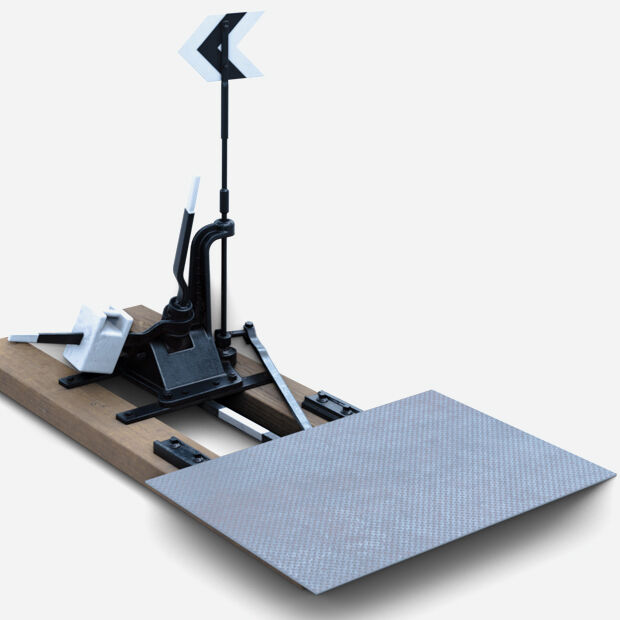
The rocking trolley presented in the exposition of the Museum of Railways of Russia is a typical example of such equipment. It has a wooden frame about 1.8 m long and 1.7 m wide. The type of brake is manual band on the rear axle. The trolley is equipped with two axles with wheels adapted for movement on railway rails. A lever mechanism with long handles is connected to the drive wheels.

It is interesting that rocking trolleys often became heroes of various stories and jokes among railway workers. For example, there were cases when track workers had to quickly remove a trolley from the tracks when a train suddenly appeared. That is why one of the important design requirements was the ability to quickly remove the trolley from the rails with the help of two or three people.

The hand-operated rocking trolley was transferred to the Russian Railway Museum in 1997

Hand-operated trolleys provided mobility for service personnel for several decades. They were widely used until the middle of the 20th century, when they began to be replaced by more advanced motor trolleys with internal combustion engines. However, in some remote areas, hand-operated trolleys continued to be used for a long time. In some places, they can still be found today.

There were many different designs of handcars with a muscle drive: "rockers", "twirlers", bicycle-type with a foot drive. When internal combustion engines appeared, they began to equip handcars. On narrow-gauge railways, motorized handcars are called "pioneers". In many European countries, there are clubs of handcar enthusiasts; they periodically organize meetings to which they bring handcars from different countries. Most often, handcars are replicas built according to original drawings of past years.

Handcars were used to inspect the track, access artificial structures (bridges, pipes, overpasses), control communication lines and as a means of communication during track repairs. More solid handcars with comfortable benches for inspection of the track and structures were also built. The handcar got its name from the inventor Karl von Drais.

The most famous trolley among railway workers is the TD-5 with an M72 engine. It could carry up to two TP-type trailers, designed for the transportation of repair materials and tools. It was also produced in a narrow-gauge version (TD-5U).

Lighter detachable motor trolleys for the transportation of four people of the ID-1 and SM-4 types were also built. Such trolleys were used for dispatching repair crews to repair the track, communications, and signaling.

Parameters

Technical
specifications

Year of construction
Unknown
Number of axles
2
Drive
Manual
Transmission
Mechanical: toothed on rear axle
Frame
Wooden
Length, mm
1,762
Width along outer edge of wheels, mm
1,700
Height from rail head with upper lever position, mm
1,100
Base, mm
1,080
Brake type
Manual band on rear axle

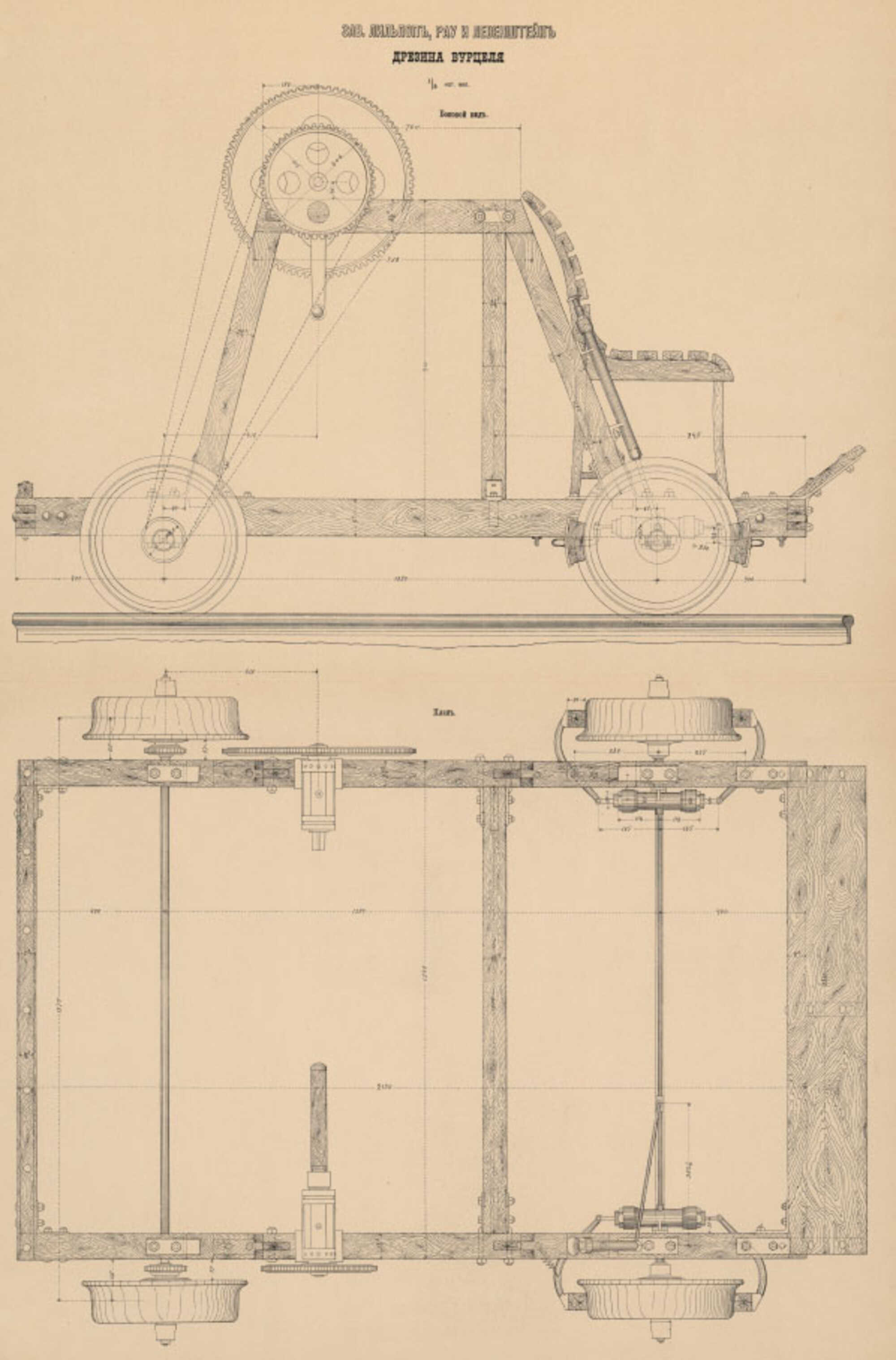
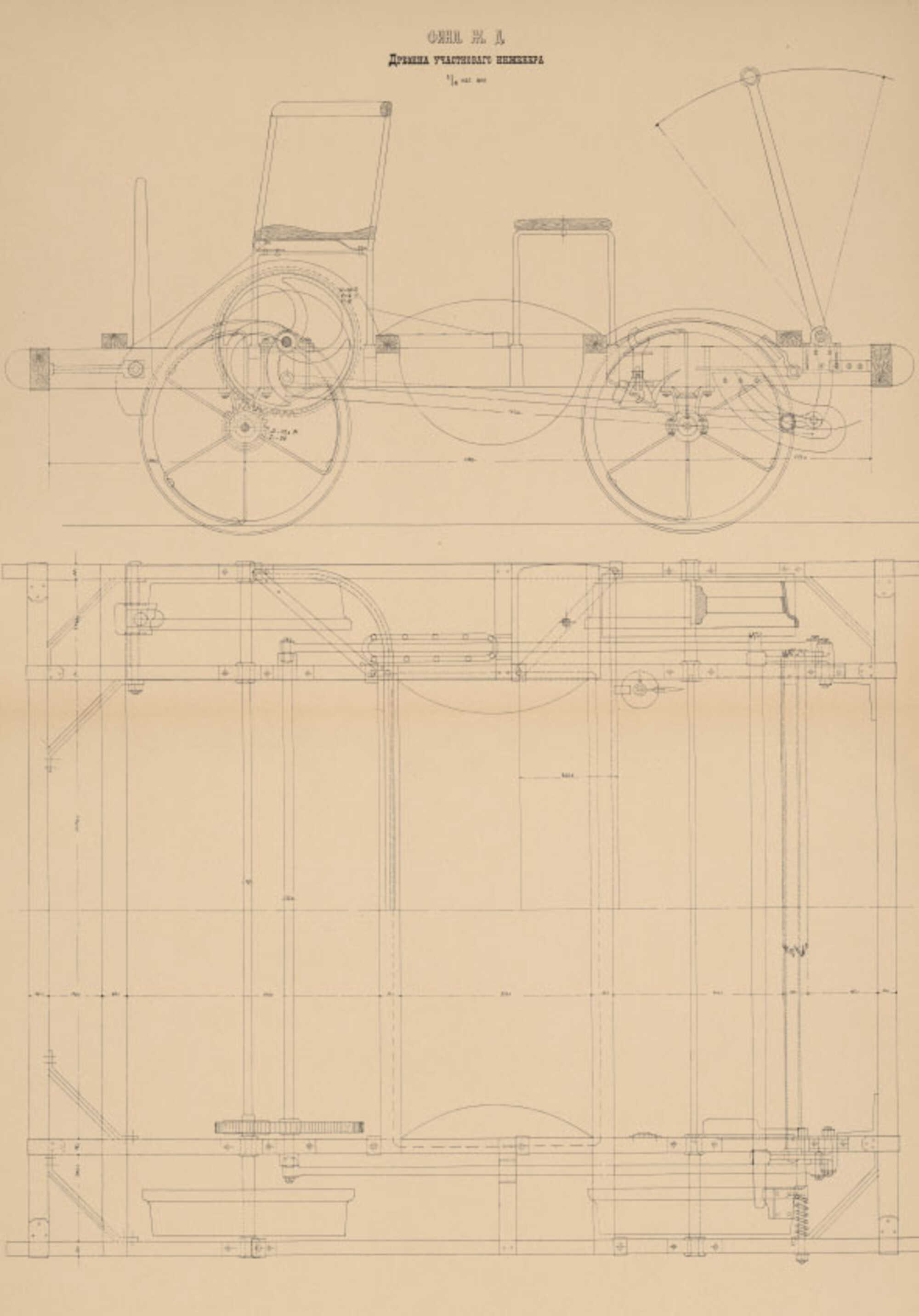
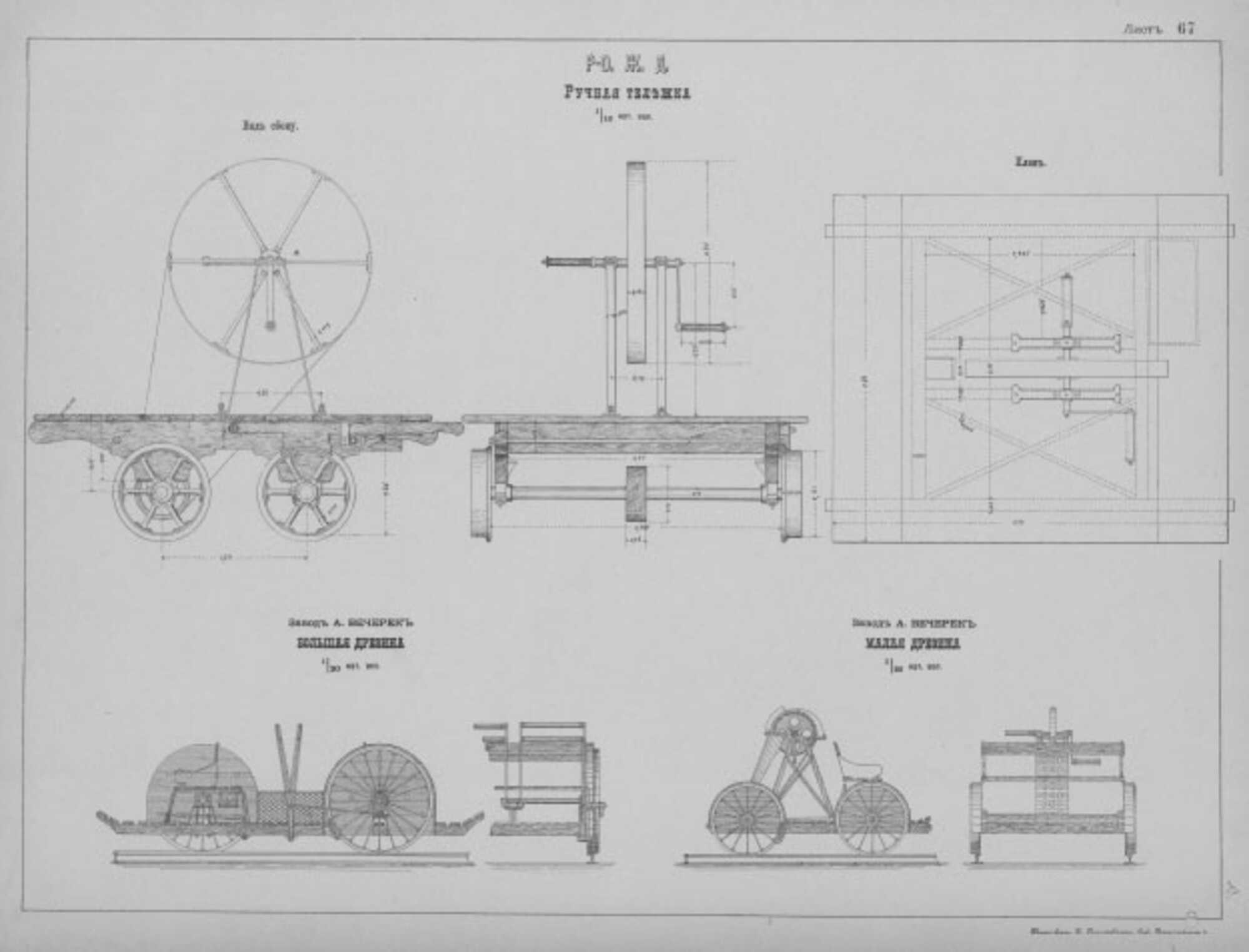
Drawings
and diagrams

History

Chronology

  1. 1929 For the serial production of detachable motor trolleys, from October 1, 1929, the former Main Railway Workshops of the Syzran-Vyazemskaya Railway were transformed into the Locomotive Car Repair and Automobile Railroad Railroad Construction Plant. Later, the plant was renamed the Kaluga Machine-Building Plant TsUMZ. This plant launched the production of motorcycle engines for detachable trolleys. Their construction in the post-war period was continued by the same Kaluga plant.
  2. 1997 This trolley was transferred to the museum by the Maksatikh track section of the Bologovsky branch of the October Railway in 1997.