Today the museum is open from 10:00 to 18:00

Map

Exhibit description

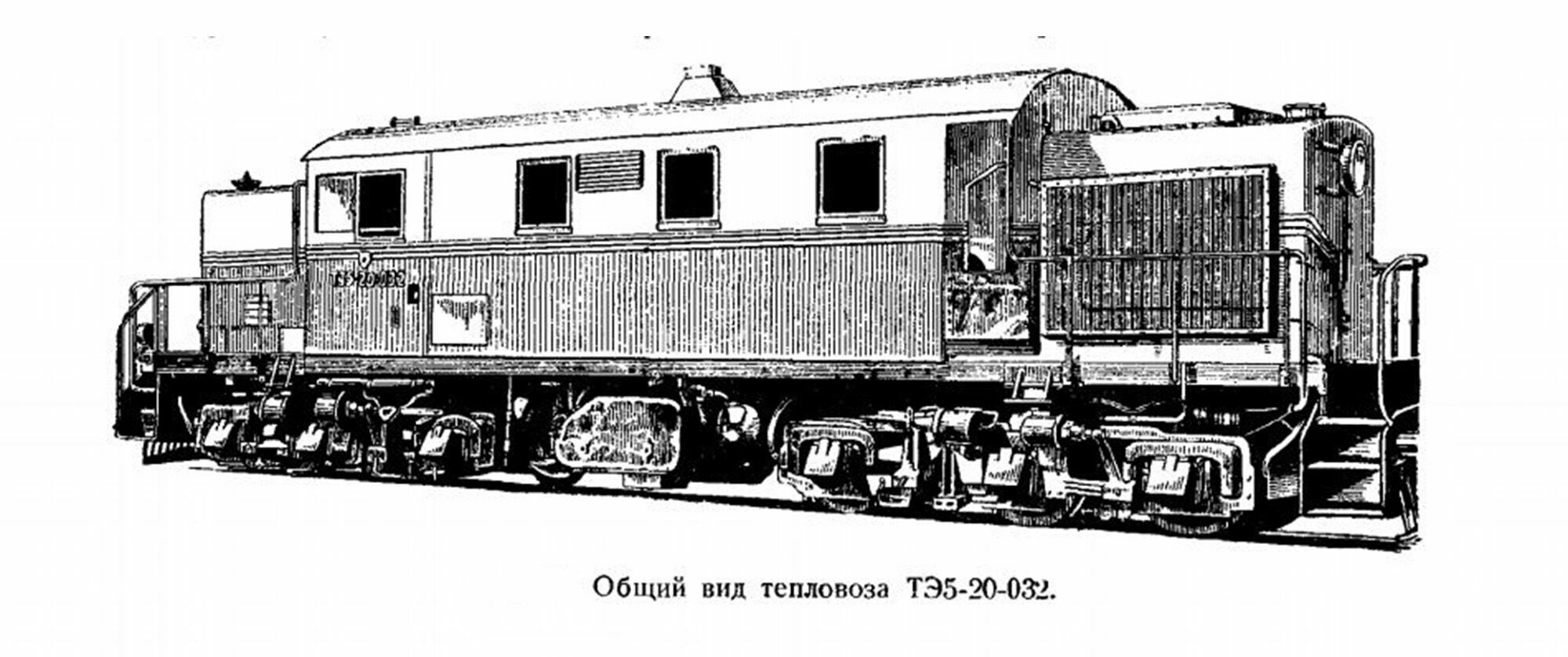
Experimental Diesel Locomotive TE5-20 032

In the second half of the 1940s, the Kharkiv Locomotive Works (also known as Plant No. 75) in the USSR began mass production of the first domestic post-war diesel locomotives of the class TE1. They were created through so-called “reverse engineering”, where an existing product — the American-made DA20 diesel locomotive supplied to the USSR under Lend-Lease — was used as a basis to develop a domestic version without independent design work, which was then mass-produced.

The class TE1 was developed through “reverse engineering” by copying and adapting the American DA20 diesel locomotive to Soviet realities.

The main changes compared to the class DA involved converting inch-based dimensions to metric and, in some cases, replacing materials and equipment to align with the capabilities of the Soviet industry. TE1 diesel locomotives were equipped with D50 diesel engines producing 1,000 hp, MPT-84/39 DC traction generators, and DK-304B traction motors with a support-axle suspension.

Class TE1-20

In March 1947, the very first TE1-20 001 diesel locomotive was produced (with “20” indicating the axial load in tonne-forces). Between 1947 and 1950, the Kharkiv Locomotive Works manufactured a total of 300 TE1 diesel locomotives (no. 001–300).

Of the three hundred TE1 diesel locomotives produced, two were significantly different: they were adapted for operation in extreme climate conditions.

Among these 300 locomotives, two significantly differed in design from the standard TE1 models. These were experimental diesel locomotives no. 031 and 032, designed for operation in extreme climate conditions. They were designated as the class TE5.

Unlike the production TE1 diesel locomotives, which had a hood-type body, the TE5 featured a so-called “car-style” body, meaning it had a fully enclosed design. Additionally, unlike the TE1, the front of the diesel locomotive was positioned on the side of the battery compartments rather than the diesel engine side. The design also included steam boilers to heat the engine room and control cab when the diesel engine was not running.

All other major components (the diesel generator, traction motors, and locomotive underframe) were similar to those used in the class TE1. Accordingly, the TE1 and TE5 had identical traction and thermal characteristics.

Both TE5 diesel locomotives (no. 031 and no. 032) were initially tested and operated for a short period  he Moscow-Passazhirskaya Depot of the Moscow-Kursk Railway. They were soon transferred to the Nyandoma Depot of the Northern Railway, where they were tested during the winter of 1948–1949 in the extreme climate conditions for which they had been designed. Then both vehicles were transferred to the Turkestan-Siberia Railway.

The TE5 locomotives were never mass-produced, with only two units built, as the class TE1 was discontinued in 1950.

The production of the TE5, the  “northern” modification of the TE1, was limited to just two units, as the class TE1 production ceased in 1950. After that, no locomotives specifically designed for extreme climate conditions were produced in the USSR until the 1980s. Then, in connection with the commissioning of the Baikal-Amur Mainline, small batches of the 2TE10S and 4TE10S diesel locomotives were built in a “northern” version. It seems that diesel locomotives with a car-type body (TE2, TE3, etc.) were already considered suitable for operating in extreme climate conditions.

The TE5-20 031 diesel locomotive, originally operating on   urkestan-Siberia Railway, was transferred to the Moscow-Ryazan Railway in 1958. Later that same year, it was moved to the Kirov Railway, which, in the summer of 1959, became part of the Oktyabrskaya Railway. In 1963, by special instruction from the Central Committee of the Ministry of Railways, the locomotive’s class was changed to TE1-20 140 to eliminate inconsistencies in the fleet’s class designations. In 1984, this locomotive was removed from the inventory of the Oktyabrskaya Railway.

The TE5-20 032 diesel locomotive from the Turkestan-Siberia Railway, which is displayed in the museum, was transferred to the Orenburgtransstroy Trust in February 1962, in accordance with the Ministry of Railways’ Order No. M-33161, dated 28th November 1961.

Parameters

Technical
specifications

Plant
Kharkov Transport Engineering
Year
1948
The factory number
Unknown
Diesel power, hp
1,000
Axial characteristic
30 –30
Design speed, km/h
93
Service mass, t
123.9
Continuous traction force, kgf
16,000
Diesel type
D50
Diesel
In-line
Traction generator type
MPT-84/39
Traction motor type
DK-304B
Axial gear ratio
75:16=4,69
Battery type
32TN-550
Brake compressor type, CT
1
Wheel diameter, mm
1,050
Axle load on rails, t
20.7
Continuous mode speed, km/h
12
Equipment fuel reserves, t
5 150
Equipment stocks of sand, t
1,200
Length along the axles of automatic couplings, mm
16,892
Body width, mm
3 121
Body height, mm
4 251
Kingpin base, mm
9,449
Wheelbase of the bogie, mm
3,430
Minimum radius of passable curves, m
125
Diesel characteristics
Six-cylinder
Fuel combustion cycle
Four-stroke
Power transmission type
Electric
Current
Direct

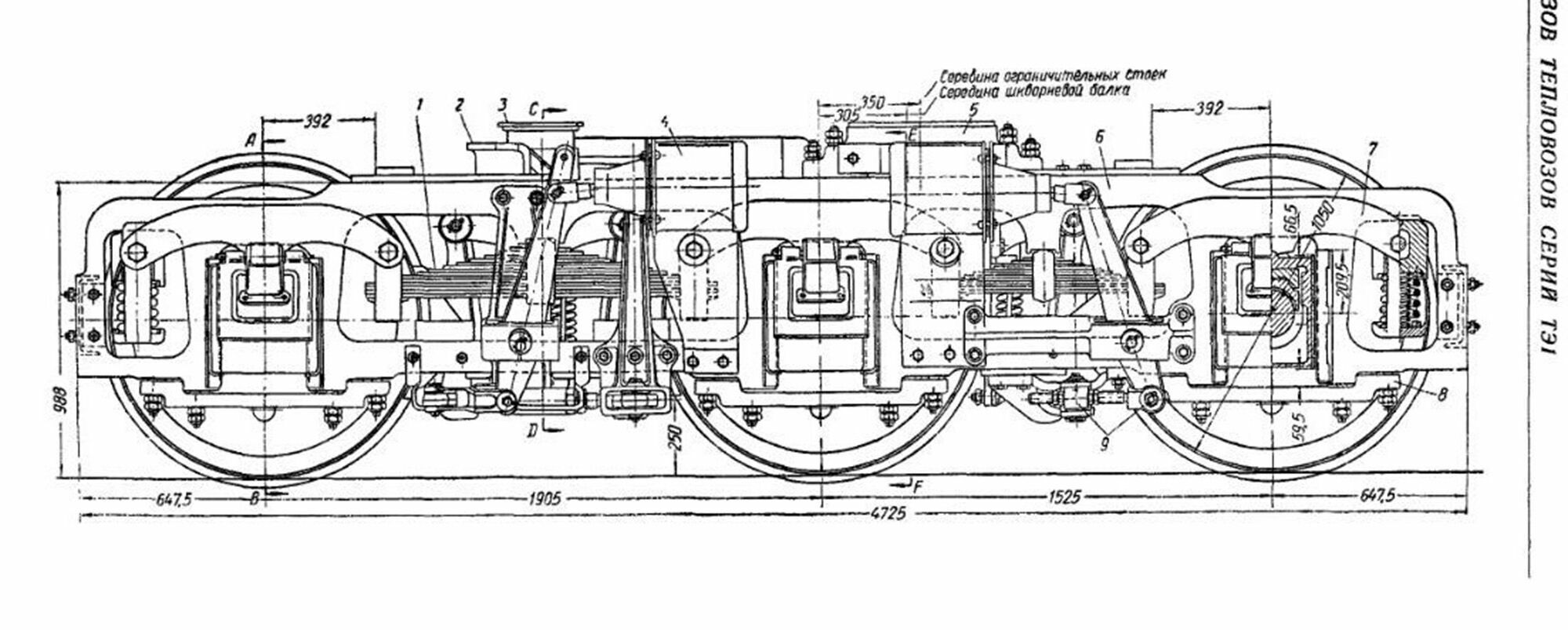
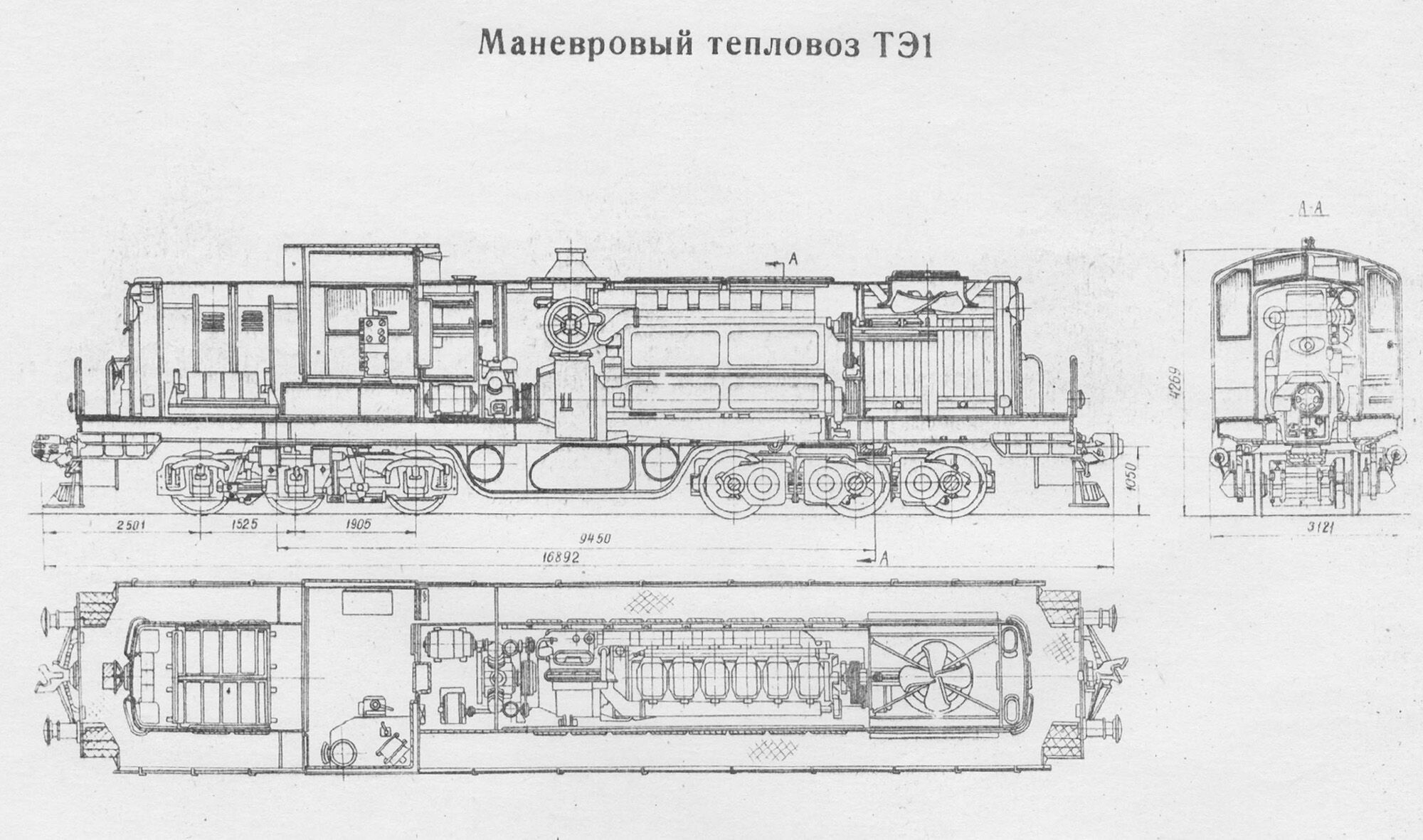
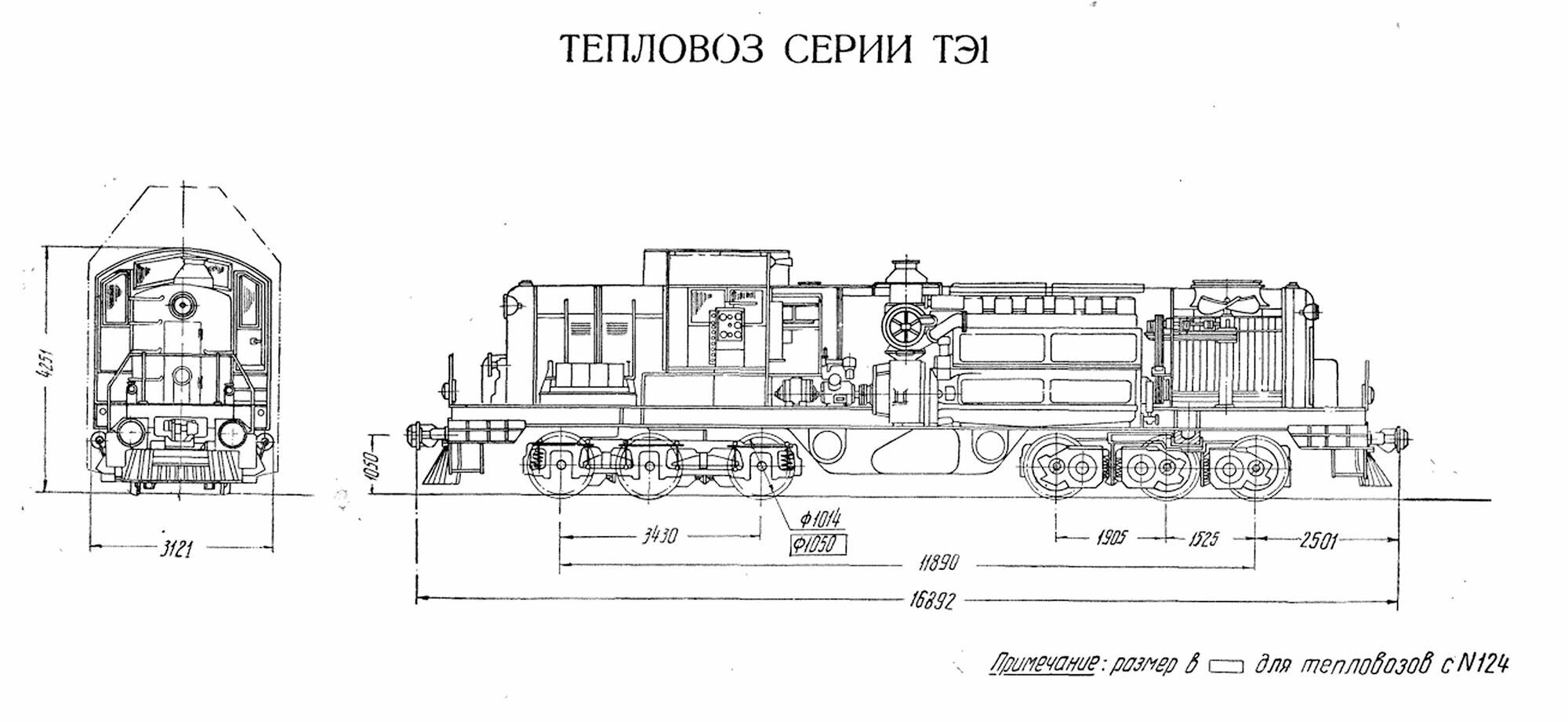
Drawings
and diagrams

History

Chronology

  1. March 1947 The first diesel locomotive TE1-20 001 is produced.
  2. 1947–1950 The Kharkiv Locomotive Works produces 300 TE1 locomotives.
  3. 1948 The TE5-20 031 diesel locomotive is built at the Kharkiv Locomotive Works.
  4. Winter 1948–1949 Diesel locomotives TE5 no. 031 and no. 032 are transferred to the Nyandoma Depot of the Northern Railway.
  5. 1950 The production of the class TE1 is discontinued.
  6. 1958 The TE5-20 031 diesel locomotive is transferred from the Turkestan-Siberia Railway to the Moscow-Ryazan Railway.
  7. 1984 The TE5-20 031 diesel locomotive is removed from inventory.
  8. 1992 The TE5-20 032 diesel locomotive is purchased by the Central Museum of the Oktyabrskaya Railway and delivered from Chelyabinsk to St. Petersburg.