Today the museum is closed

Map

Exhibit description

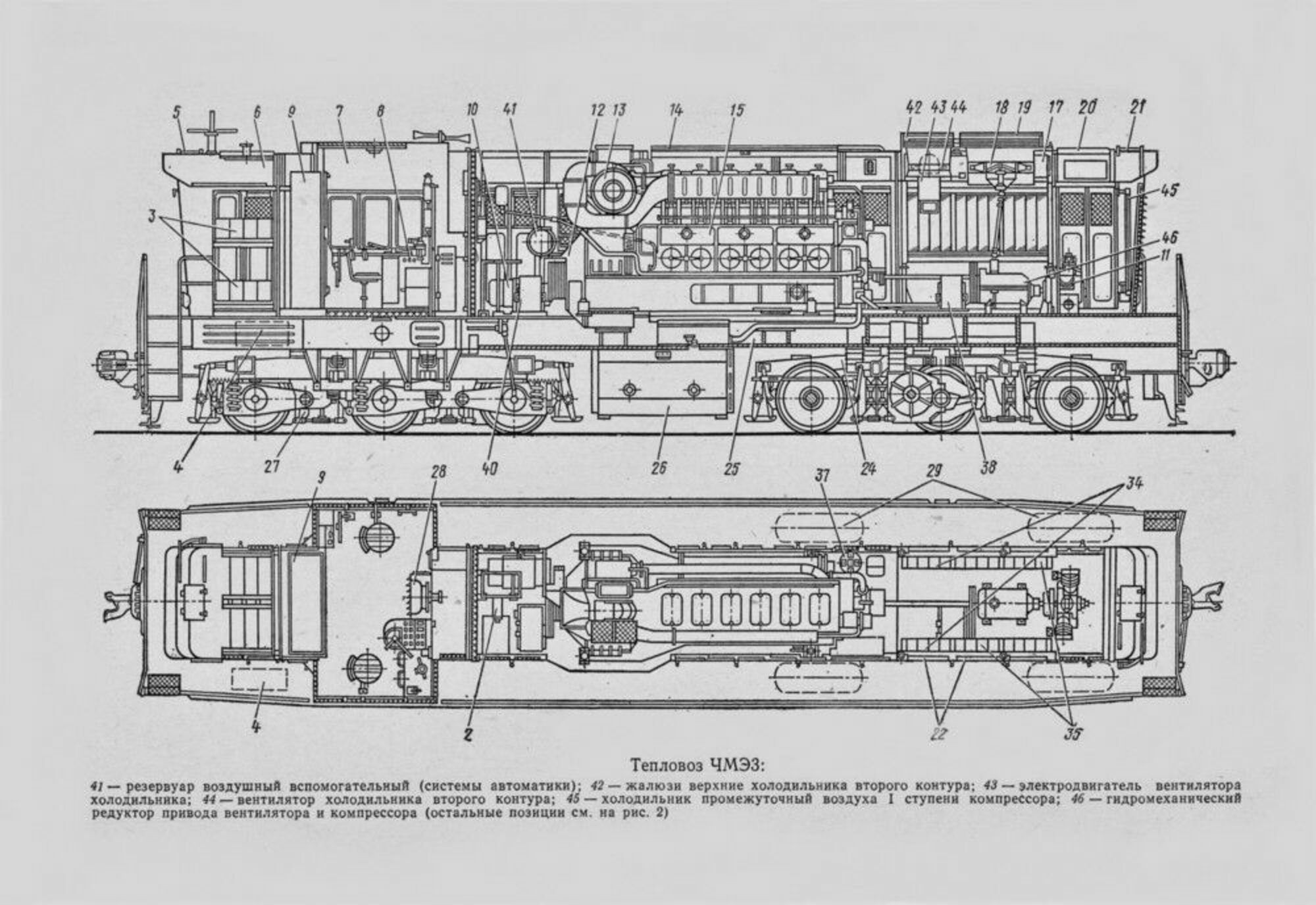
Shunting diesel locomotive ChME3-0001

Shunting locomotives

The abrupt cessation of steam locomotive production from mid-1956 required not so much the creation of new locomotive designs as their mass production.

Within the framework of the Council for Mutual Economic Assistance (CMEA), created in January 1949, a division of production was carried out. In particular, in Czechoslovakia, at the ČKD-Sokolovo plant in Prague, it was decided to produce shunting locomotives and passenger electric locomotives for the CMEA countries.

Design of ЧМЭ-2

Locomotives built in Czechoslovakia were designated ЧМЭ — Czechoslovak shunting locomotive with electric transmission. From 1958 to 1965 the plant supplied the USSR with four-axle shunting locomotives ЧМЭ-2 in three series, with a total of 522 units.

For the ЧМЭ-3 locomotive, a six-cylinder diesel engine from the ЧМЭ-2 6S310DR type was selected, on which supercharging was used, which resulted in an increase in power to 1,350 hp. Based on the results of the tests, a number of proposals were made to the design, which were taken into account when the first batch of locomotives № 003–012 was released in 1964. Starting from 1965, the plant produced them in series.

In the first half of the 1970s production was in full swing and more than 200 locomotives were produced per year. In the second half of the 1970s locomotives were produced in regular series of three hundred units, mostly for the USSR. In the early 1980s for the Soviet Union, each series of deliveries already included about 360 locomotives.

Then the diesel locomotive underwent various modernizations and received the designations ЧМЭ3т (with rheostatic brake) and ЧМЭ3э (with electronic control). In total, 7,459 locomotives of this type were built for the USSR and after 1991 for the former USSR countries.

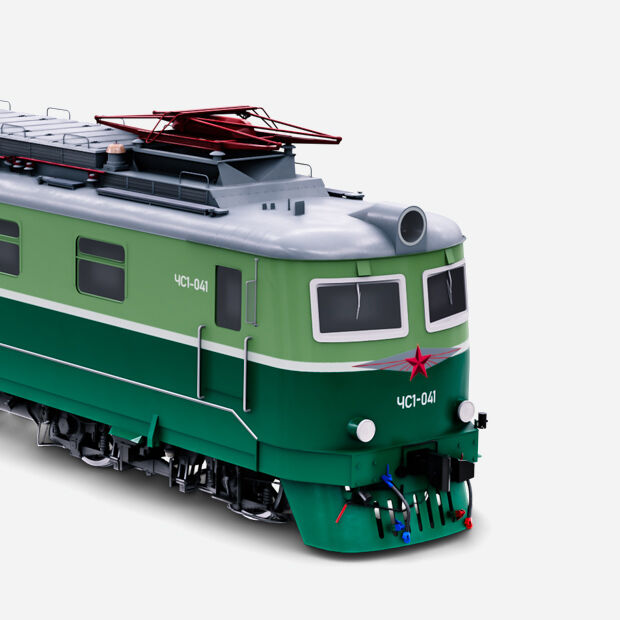
The first locomotive was painted blue, typical for Czech Railways locomotives of that time. Starting with No. 002, the machines were painted green. On approximately the first 800 locomotives, the arrow on the side hoods at the front of the locomotive was painted, which gave it a dynamic look typical for that entire period of its life. A small red star was displayed on the front of the hood.

The shunting locomotive ЧМЭ3-0001 entered the Museum of Russian Railways in 1999

The diesel locomotives built in Czechoslovakia were designated ČME - Czechoslovak shunting with electric transmission. Diesel locomotives were built for the USSR by the ČKD-Sokolovo plant in Prague (Czech-Moravian Kolben-Danek).

It was designated ChME3 — Czechoslovak shunting with electric transmission, type 3.

Parameters

Technical
specifications

Length, mm
17,220
Height, mm
5,235
Width, mm
3,120
Full wheelbase, mm
12,600
Service weight, t
123
Load from moving axle on rails
20.5
Fuel capacity, kg
560
Diameter of moving wheels
1,050
Design speed, km/h
95
Power, hp
1,350
Engine brand
K6S310DR (6ЧН31/36)
Rotation speed
750 nom. 350 min.
Number of cylinders
6
Cylinder diameter
310
Piston stroke
360
Pressure
9.937
Battery type
Acid
Battery brand (battery)
Nife-HI-15
Number of battery cells
75
Total battery voltage
115
Total battery capacity
150
Battery weight
1,125
Type of auxiliary generator
DT-701-4
Power
12–14.5
Nominal voltage, V
115
Nominal current, A
104–125
Rotation speed of the anchor shaft
1,120–2,400
Compressor brand (auxiliary generator)
K2
Power
26±2
Working pressure
9.0
Number of braking axles
6/2
Number of main tanks
4
Capacity
1 000
Type
DC with independent excitation and self-ventilation
Traction generator brand (auxiliary generator)
TD-802
Power
885
Current (auxiliary generator)
2,350–1,565
Voltage (auxiliary generator)
377–565
Rotation frequency of the anchor shaft
750

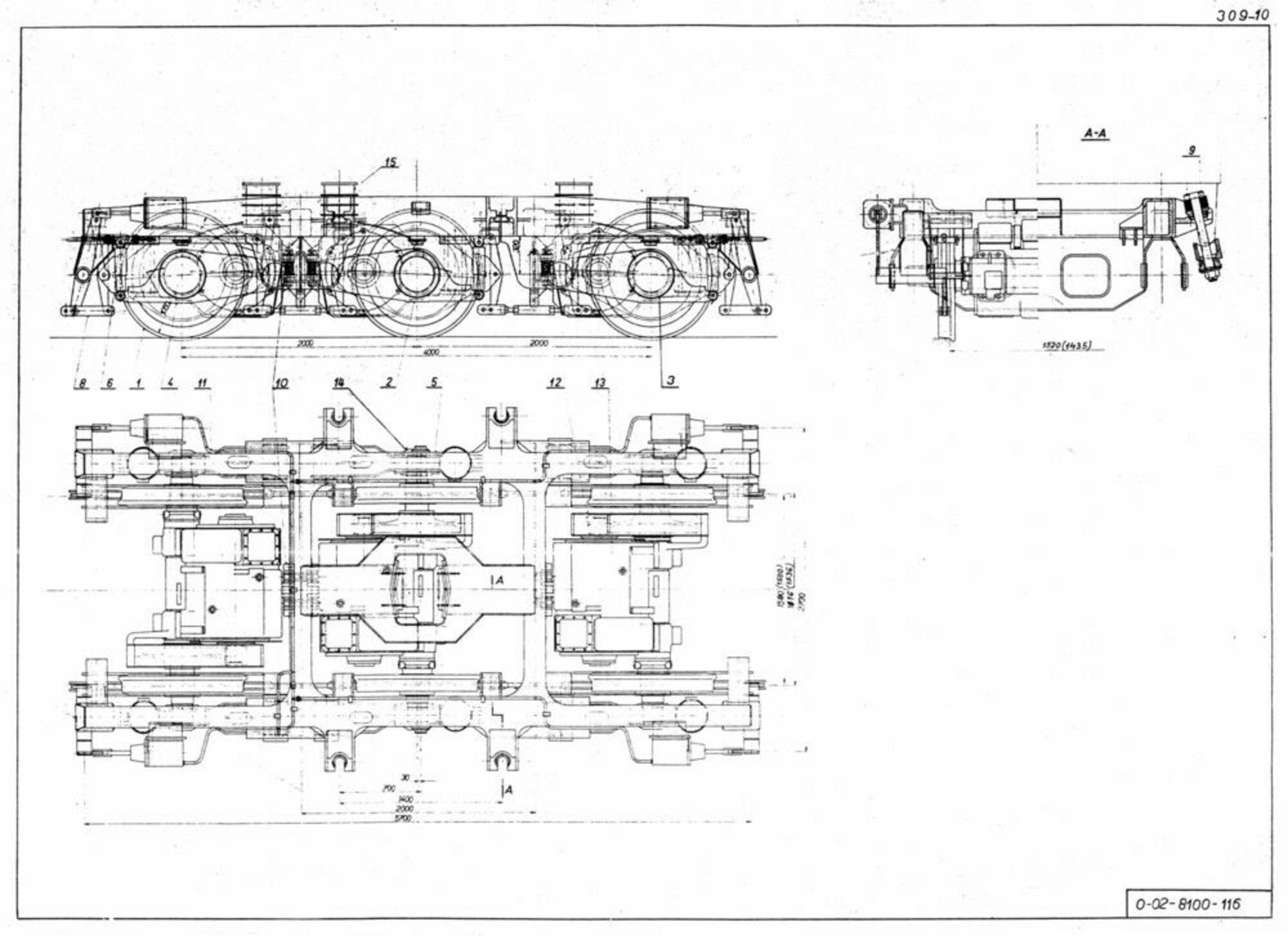
Drawings
and diagrams

History

Chronology

  1. 1954 The design of the T698.0 diesel locomotives began back in 1954. They were equipped with a 2,000 hp diesel engine, which was excessive for a shunting locomotive. Therefore, they chose another six-cylinder diesel engine from the ChME2 diesel locomotives, type 6S310DR, which was supercharged and, as a result, increased power from 750 to 1,350 hp.
  2. 1956 Since mid-1956, the production of steam locomotives has abruptly ceased. This required not so much the creation of new locomotive designs as their mass production. In January 1949, the CMEA (Council for Mutual Economic Assistance) was created, within the framework of which the division of production was carried out. It included the countries of Eastern Europe, and later in 1970 the GDR, Mongolia, Cuba and Vietnam joined. In particular, shunting diesel locomotives and passenger electric locomotives were to be produced in Czechoslovakia for the CMEA countries.
  3. 1958–1959 At the stage of delivery of the ChME2 diesel locomotives, it was decided that six-axle shunting locomotives would be needed for delivery to the USSR. During the design, the ChKD-Sokolovo plant used the experience of building and operating three six-axle T698.0 series diesel locomotives in 1958–1959, which were designed for Argentina.
  4. 1963 At the end of 1963, the plant built three locomotives of this type: ChME3-001 and ChME3-002 for 1,524 mm gauge for the Soviet Union, and T669.0001 for 1,435 mm gauge for Czechoslovakia.
  5. 1964 Tests in the USSR were carried out by employees of VNIIZhT (All-Union Scientific Research Institute of Railway Transport) and workers of the Lyublino depot of the Moscow Railway. Based on the results of the tests, a number of proposals were made to the design, which were taken into account when releasing the first batch of locomotives No. 003–012 in 1964. Since 1965, the plant began to produce them serially.
  6. 1970s In the first half of the 1970s, production was in full swing: more than 200 locomotives were manufactured per year.
  7. 1991 Then the locomotive underwent various upgrades and received new designations: ЧМЭ3Т (with rheostatic brake) and ЧМЭ3Э (with electronic control). A total of 7,459 locomotives of this type were built for the USSR and, after 1991, the countries of the former USSR. The last two ЧМЭ3Т-7458 and 7459 locomotives from the batch ordered by Ukraine in 1995 were sold only in 2001. This marked the end of the 38-year history of production of this locomotive, intended for heavy shunting and haulage service.