Today the museum is closed

Map

Exhibit description

Alternating Current Passenger Electric Locomotive CHS4 012

By the end of the 1950s and the early 1960s, the length of railway lines electrified with alternating current in the USSR had increased significantly. At the same time, a problem that had emerged a few years earlier during the expansion of the DC electric traction loops continued to grow. Specifically, there was a pressing need for passenger electric locomotives, with no domestically produced designs that had been successfully mastered in production.

There was a shortage of passenger electric locomotives running on alternating current in the USSR. The Czechoslovakian Škoda Plant was called upon to address this issue.

In the case of DC passenger electric locomotives, a decision was made — due to both technical and political reasons — to order locomotives from the Czechoslovakian Škoda Plant. Several years later, the shortage of AC passenger electric locomotives was addressed in a similar manner.

New Model

In the early 1960s, the Škoda Plant developed a new design for an AC electric locomotive, which was designated ChS4 in the USSR. In 1963, a prototype was created — a six-axle experimental electric locomotive, S699.001, factory type 32E0, which underwent various tests in the Czechoslovak Socialist Republic. In 1964, based on the experience gained from developing this locomotive, the ChS4 001 electric locomotive of factory type 52E0 was built. After being delivered from Czechoslovakia, it was tested on the North Caucasus Railway in 1965–1966.

Later, the Škoda Plant began mass production of the ChS4 electric locomotives, which continued until 1972. A total of 230 locomotives of this class (Nos. 001–160 and 162–231) were manufactured and delivered to Soviet railways. The batches of electric locomotives belonged to the factory types 52Е1 (002–011), 52Е2 (012–061), 52Е3 (062–160), 52Е4 (162–211), and 52Е5 (212–231), which had minor differences in design.

The design of the ChS4 electric locomotives, made in Czechoslovakia, featured many technical solutions that were completely uncharacteristic of Soviet electric locomotive construction. Many components and assemblies differed significantly from the corresponding design elements found in domestic electric locomotives. An interesting feature of the ChS4 electric locomotive was its body, which was made of fiberglass. Large windshields, the outlines of the headlight and buffer lamps, and the smooth shape of the body gave this locomotive a very unique and memorable appearance (the exterior design was created by Czech designer Otakar Diblik).

Czech designer Otakar Diblik developed a very unique design for an electric locomotive: large windshields, the outlines of the headlight and buffer lamps, and the smooth shape of the body.

The power circuit of the electric locomotive uses a so-called “high-voltage regulation” system, which involves regulating the voltage of the traction electric motors on the primary (high) winding of the traction transformer. This approach, typical for European electric locomotive construction of that time, simplified the electrical circuit of the locomotive. However, it required very advanced technology for the manufacture of switching equipment, which was not typical for Soviet AC electric locomotives. In contrast, Soviet locomotives like the VL60 and VL80 employed “low-voltage regulation”, where the voltage was regulated on the secondary winding of the transformer.

In addition, the first batches of ChS4 electric locomotives (Nos. 001–011) had an electric (rheostatic) brake. Although this approach was abandoned in later-produced locomotives due to design imperfections, the idea was revisited during the creation of the new ChS4T electric locomotives.

The ChS4 electric locomotives have proven reliable in operation on Soviet railways. They were used in passenger service across several regions, including the North Caucasian (Kavkazskaya Depot), Southwestern (Kyiv Depot), Moscow (Bryansk-2 Depot), Gorky (Kirov Depot), Privolzhskaya (Saratov Depot), and South-Eastern (Balashov Depot) Railways.

In Russia, these electric locomotives operated until 2006.

Regular operation of these locomotives on the Russian Railways network ended at the Balashov Depot in 2005–2006. In Ukraine, however, where a significant number o ChS4 locomotives (105 units) underwent major repairs and extensive modernisation at the Zaporizhzhia Electric Locomotive Repair Plant from 1999 to 2013, these locomotives continue to operate successfully to this day.

The ChS4 012 electric locomotive displayed in the museum was built in 1967 and was used on the Southwestern and Privolzhskaya Railways.

Parameters

Technical
specifications

Plant
Škoda, Czechoslovakia
Factory type
52E2
Factory number
5444
Years of production
1965–1972
Number of built, units
230
Nominal voltage of the contact network, V
25,000
Axial characteristic
30–30
Continuous Power, kW
4 920
Continuous thrust force, kgf
16,800
Design speed, km/h
160
Service mass, t
123
Type of current
Variable
Electric brake available
No
Traction motor type
AL-4442nP
Type of suspension of the traction electric motor on the axle
Support frame
Axial gear ratio
2.64
Type of pantograph
2SLS1
Wheel diameter, mm
1 250
Axle load on rails, tc
20.5
Clock mode power, kW
5 100
Clock mode speed, km/h
107.1
Hourly mode thrust force, kgf
17,400
Continuous mode speed, km/h
109.1
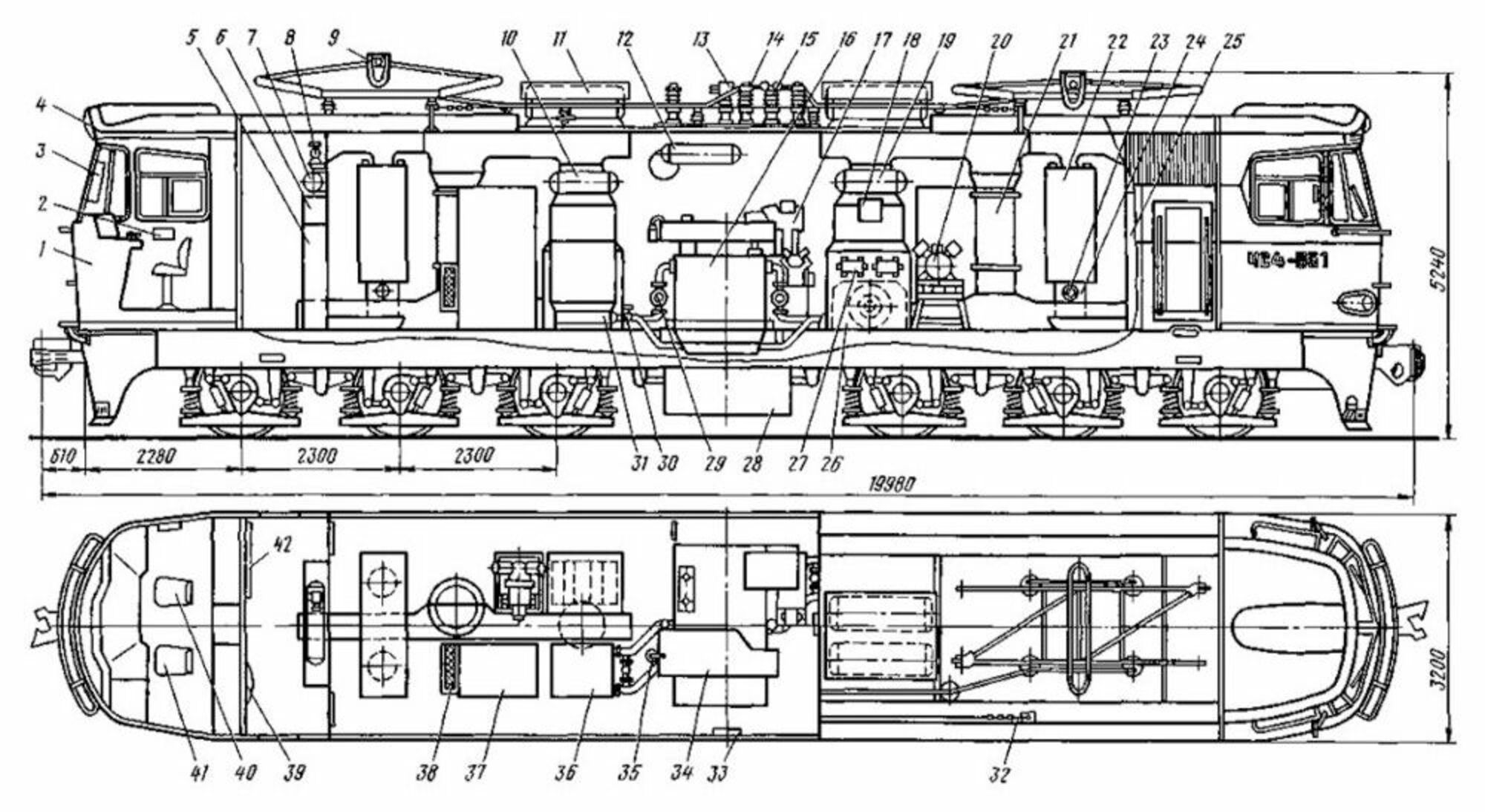
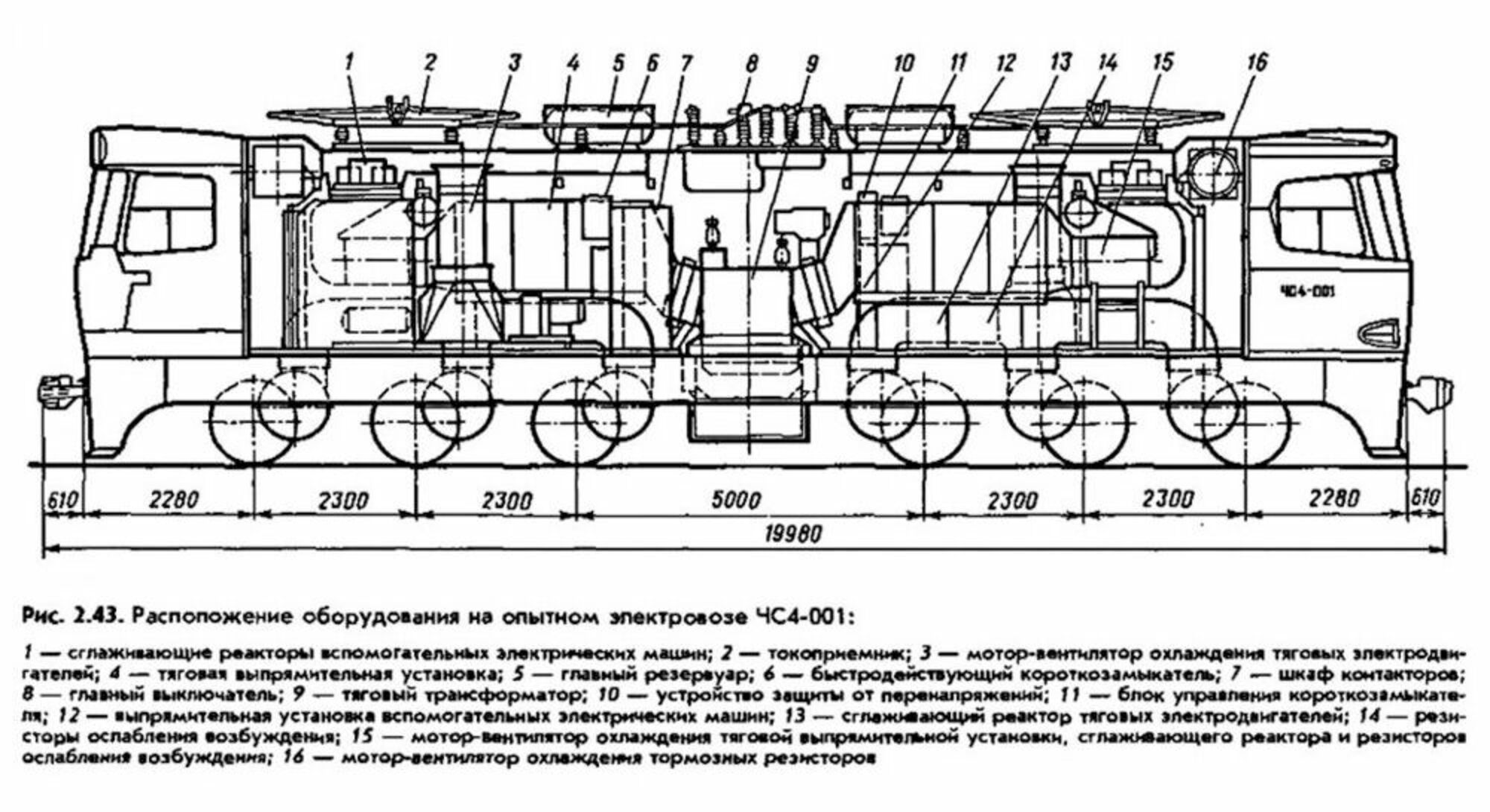
Length along the axles of automatic couplings, mm
19,980
Body width, mm
3 200
Body height, mm
4 650
Wheelbase of the bogie, mm
4 600
Minimum radius of passable curves, m
125

Drawings
and diagrams

History

Chronology

  1. 1965 Start of production of ChS4 electric locomotives in Czechoslovakia.
  2. 1967 The ChS4 012 electric locomotive was built in Czechoslovakia.
  3. 1972 Discontinuation of production of ChS4 electric locomotives.
  4. 2005 ChS4 012 electric locomotive was transferred to the Russian Railway Museum in Saint Petersburg.
  5. 2006 ChS4 electric locomotives were withdrawn from service.