Today the museum is open from 10:00 to 18:00

Map

Exhibit description

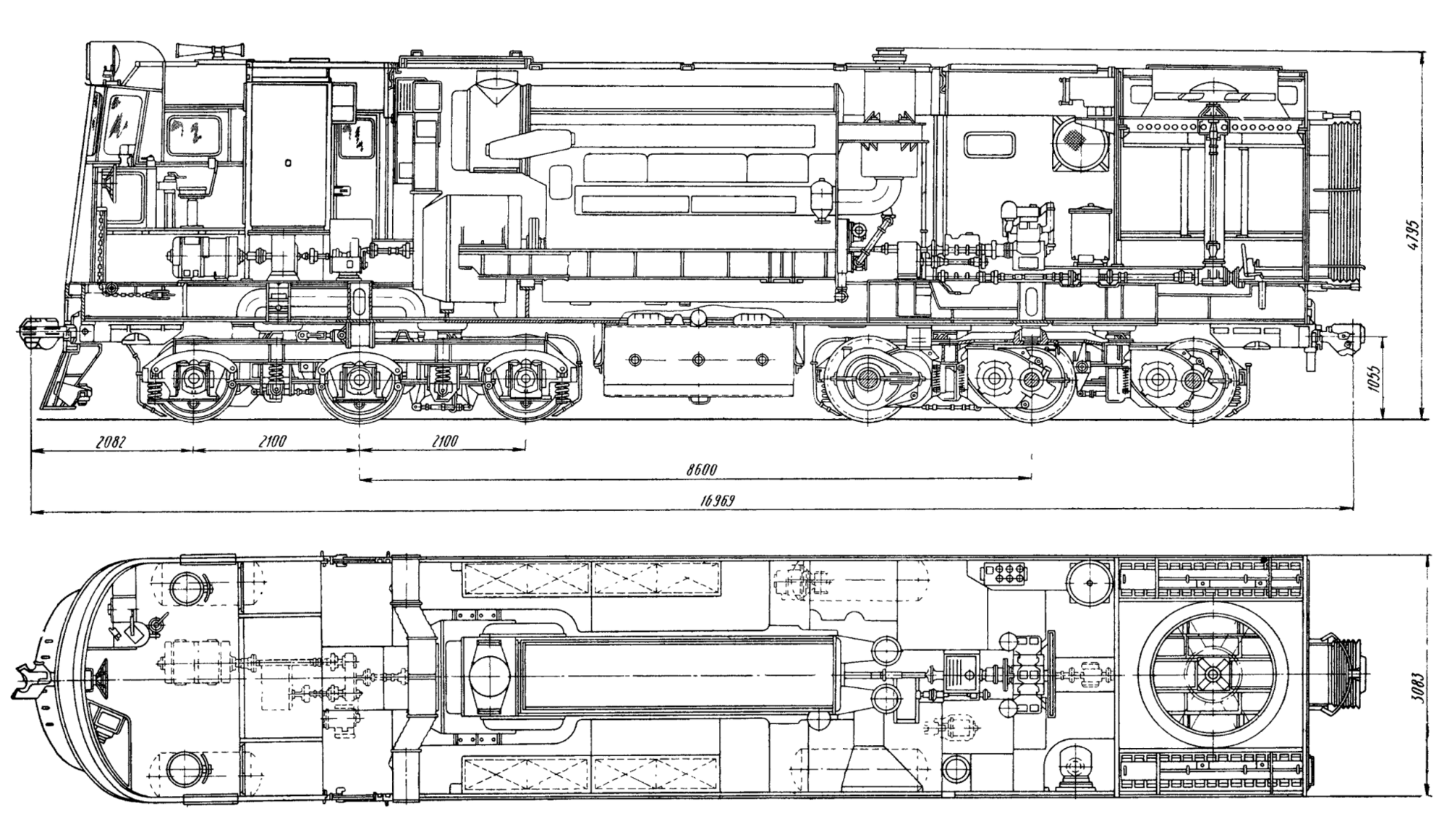
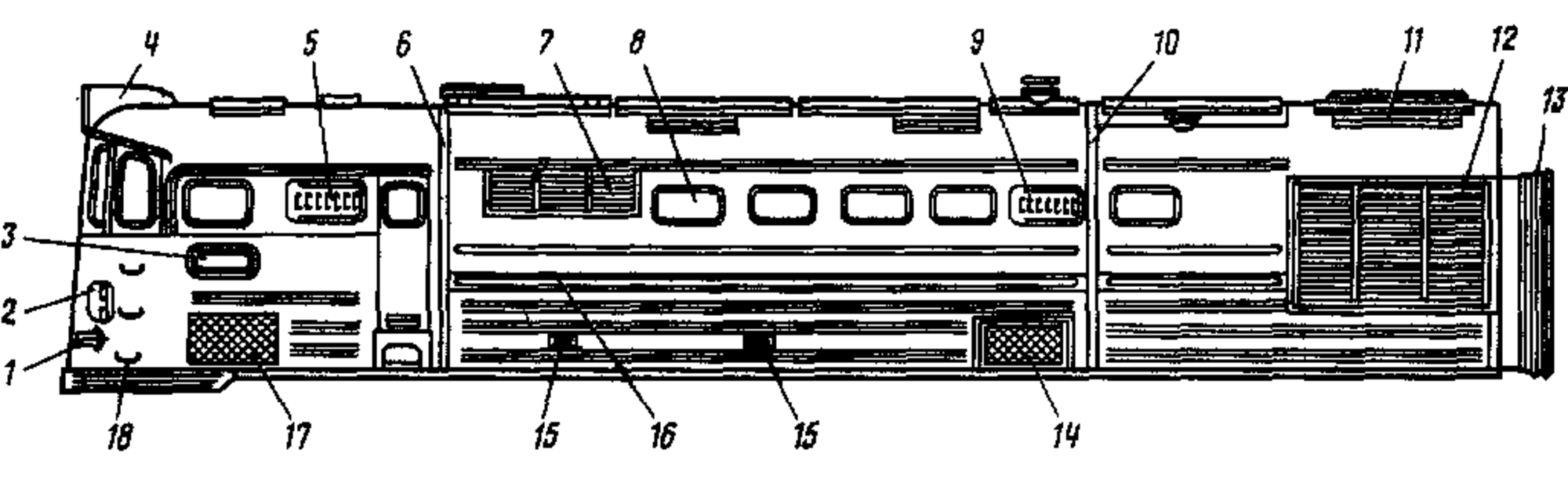
Passenger Two-Section Diesel Locomotive TE7 013

The mid-1950s marked a major initiative in the USSR’s railway network to replace steam locomotives with innovative types of traction — diesel and electric. For train operations on sections and entire railway lines being converted to diesel traction, a large number of new, powerful diesel locomotives were needed to replace steam locomotives.

To meet this need, mass production of the class TE3 freight diesel locomotives was quickly initiated, with large-scale manufacturing starting in 1955 at three plants at once. These locomotives were successfully used not only for freight but also for passenger services on many railways. However, the TE3 diesel locomotives were unsuitable for passenger trains on major railway routes, mainly due to their speed limitations.

Upgraded Design

The simplest solution to this issue was the production of passenger locomotives based on the TE3 diesel locomotives, adapted for this type of service with appropriate design modifications. These locomotives were built at the Kharkiv Locomotive Works and were designated as the class TE7.

The TE7 diesel locomotive was a two-section machine, with all its main components similar to those of the TE3, including a ten-cylinder, two-stroke 2D100 diesel engine with a capacity of 2,000 hp and opposed pistons, a MPT-99/47 traction generator, and an EDT-200 traction engines with support-axle suspension.

The main difference was in the design of the traction gearbox: by reducing the gear ratio, the speed of the TE7 diesel locomotive increased to 140 km/h.

The main difference was in the design of the traction gearbox: by reducing its gear ratio (66:26 = 2.54 instead of 75:17 = 4.41 on TE3), the design speed of TE7 increased to 140 km/h (TE3 reached the speed of 100 km/h), while the continuous tractive effort decreased to 23,200 kgf (40,400 kgf on the TE3). In addition, the TE7 featured a new control cab design with taller windshields, a feature that was later introduced on the TE3.

Class TE7 passenger diesel locomotives no. 001–028 were produced at the Kharkiv Locomotive Works (the Malyshev Factory) from 1956 to 1962, and no. 029–113 at the Luhansk (Voroshilovgrad) Locomotive Works from 1963 to 1964. In total, the two plants built 113 locomotives of this class.

A total of 113 class TE7 locomotives were built.

The very first TE7s were delivered to the Oktyabrskaya Railway, where, starting in 1956, they operated trains on the Leningrad-Moscow line, replacing the P36 steam locomotives. Since 1960, these locomotives operated daytime express trains, completing the 650-kilometre journey between Leningrad and Moscow in 6 hours and 20 minutes. On the main line of the Oktyabrskaya Railway (the Leningrad-Passazhirsky-Moskovsky Depot), TE7s remained in service until the line’s full electrification in 1962.

In addition to the Oktyabrskaya Railway, TE7 diesel locomotives were also deployed on the Moscow Railway (Smolensk, Bryansk, Uzlovaya, and Tula Depots), the Northern Railway (Vologda, Kuloy, and Ivanovo Depots), the Southwestern Railway (Kyiv, Zhmerynka, and Korosten Depots), and the Lviv Railway (the Lviv-West Depot). Most locomotives of this class were retired and removed from inventory during the 1980s. The last remaining TE7s in Russia operated at the Ivanovo Depot of the Northern Railway, where they continued to haul passenger trains until 1997–1998.

Most TE7 locomotives were retired and removed from inventory in the 1980s.

The TE7 013 diesel locomotive on display in the museum, manufactured in 1960 at Malyshev Factory in Kharkiv, was initially delivered to the Leningrad-Passazhirsky-Moskovsky Depot of the Oktyabrskaya Railway. It was later transferred to the Southwestern Railway in 1963 and to the Northern Railway in 1968.

Parameters

Technical
specifications

Plant
Kharkov
Years of production
1956–1964
The serial number of the locomotive
Unknown
Diesel kind
In-line
Number built, units
113
Diesel power, hp
2 × 2,000
Power transmission type
Electric
Axle characteristic
2 (3O – 3O)
Design speed, km/h
140
Service weight, t
252
Continuous traction force, kgf
23,200
Diesel type
2D100
Traction generator type
МПТ 99/47
Traction motor type
ЭДТ-200А
Axle reducer ratio
66:26 = 2.54
Battery type
32ТН-450
Brake compressor type
КТ-6
Wheel diameter, mm
1,050
Axle load on rails, t
21,5
Continuous speed, km/h
35
Equipment reserves (per section) of fuel, kg
5,440
Equipment reserves (per section) of sand, kg
400
Length over coupler axles (buffers), mm
33,948
Body width, mm
3,270
Body height, mm
5,020
Kingpin base, mm
8,600
Truck wheelbase, mm
4,200
Smallest radius of passable curves, m
125
Fuel combustion cycle
Two-stroke
Diesel characteristic
Ten-cylinder
Pistons
Counter-moving
Current
Direct

Drawings
and diagrams

History

Chronology

  1. Mid-1950s A major initiative takes place in the USSR’s railway network to replace steam locomotives with innovative types of traction — diesel and electric.
  2. 1955 Mass production of TE3 diesel locomotives is started at three plants at once.
  3. 1956 The first class TE7 diesel locomotives are delivered to the Oktyabrskaya Railway, where they operate trains on the Leningrad-Moscow line, replacing the P36 steam locomotives.
  4. 1956–1962 Class TE7 passenger diesel locomotives are produced at the Kharkiv Locomotive Works (the Malyshev Factory) (no. 001–028).
  5. 1960 Class TE7 locomotives start operating daytime express trains, completing the journey between Leningrad and Moscow in 6 hours and 20 minutes. Malyshev Factory produces the TE7 013 diesel locomotive.
  6. 1963–1964 Class TE7 passenger diesel locomotives are produced at the Luhansk Locomotive Works (no. 029–113).
  7. 1980s Most class TE7 locomotives are retired and removed from inventory.
  8. 1997 The diesel locomotive TE7 013 is brought to the Russian Railway Museum.
  9. 1997–1998 Operation of the last TE7 diesel locomotive in Russia at the Ivanovo Depot of the Northern Railway.