Today the museum is closed

Map

Exhibit description

Railway car № 951386

Industrial boom

The development of industry in the 1930s required the creation of high-capacity wagons for the transportation and automated unloading of overburden, coal, ore, soil, sand, crushed stone etc. Construction sites, factories, quarries, and mines were in dire need of them. We are talking about a dump wagon, which has a second name, a dumpcar, from the English words "dump" — to dump and "car" — wagon.

The first Soviet dump cars were developed based on American documentation at the Krasnoye Sormovo plant in 1931. The following year, the cars began to be produced in series. The first of them had a carrying capacity of 40 tons. They were supplied for the construction of the Dnieper Hydroelectric Station and Magnitka, the Bakal mines and other large-scale construction projects.

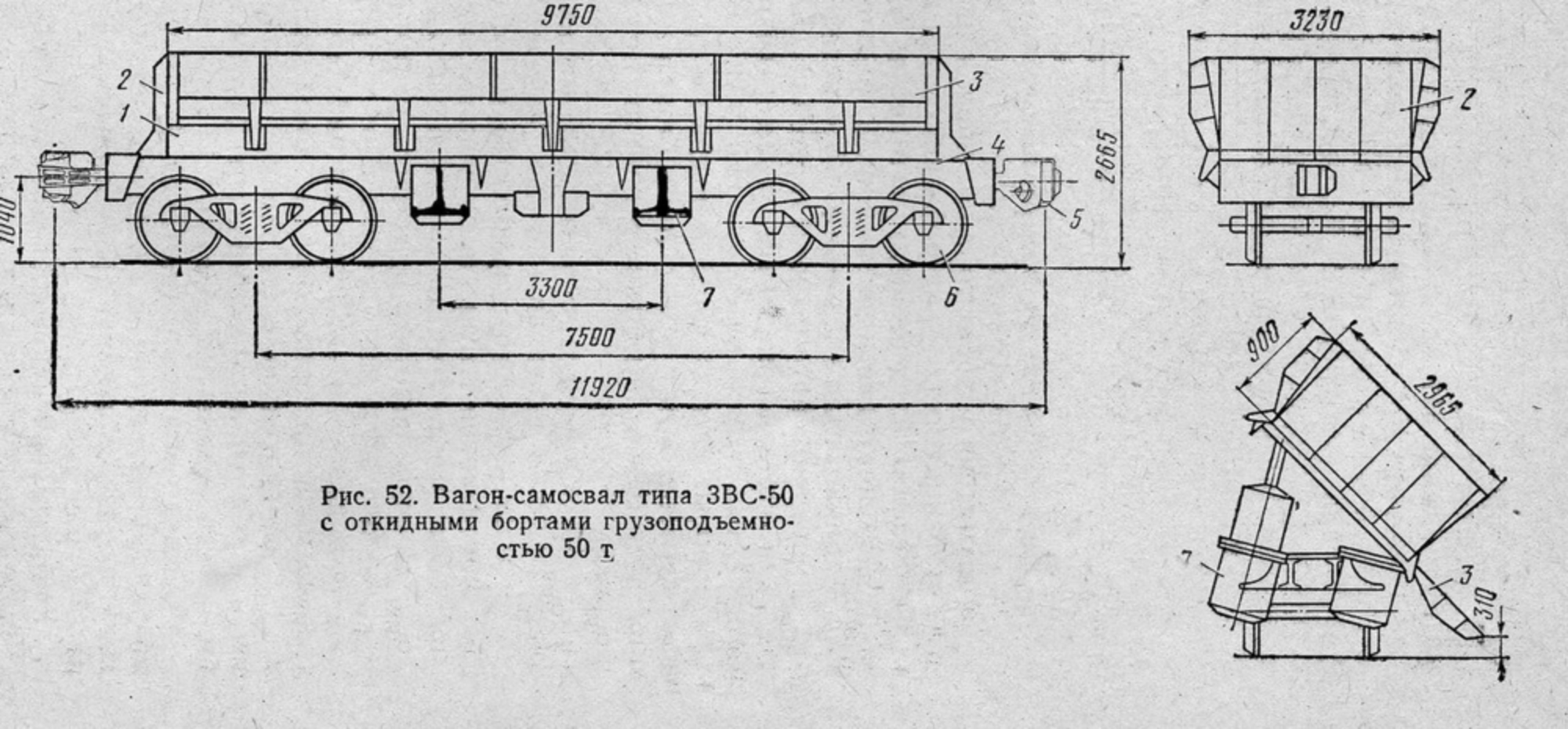
In 1943–1944 dump cars were built by the Kalinin plant, and from 1946 — by the Kaliningrad plant, which later became the main base for the construction of dump cars. 40-ton cars were also produced immediately after the war in Germany at the Görlitz plant. In 1947 the Kaliningrad plant began building dump cars with a load capacity of 50 tons of the BC-50 type. The modified design was designated 3BC-50 (the third model, BC — dump car, 50 tons).

Such cars were built in Czechoslovakia at the Vagonka Tatra Studenka plant in 1949–1951. This plant later produced six-axle dump cars. Most Soviet citizens knew it for its production of ACh-2 railcars in 1984–1990.

The dump car body tilted during unloading, and the sides folded back when the body tilted. The sides could be folded up or down depending on the design of the car. After unloading, the body lowered to its original position under its own weight. One of the important design features of these cars was the multi-layer floor, which cushioned the weight of the falling load. Some dump cars could withstand the weight of falling boulders weighing up to 2 tons.

A solid "Hungarian"

Dump car № 951386, located in the museum, was built at the Vagonka Tatra Studenka enterprise in 1950 It was received by the museum from the Leningrad-Sortirovochny-Vitebsky locomotive depot of the October Railway in 1996

Dump car or dumpster. The name comes from the English words: "dump" - to dump, "car" - car.

The development of industry and new industrial constructions required cars with a large carrying capacity. They were needed for the transportation and automated unloading of overburden, coal, ore, soil, sand, crushed stone and the like.

Parameters

Technical
specifications

Load capacity, t
50
Tara, t
32
Tare coefficient
0.64
Body volume, m³
24.5
Number of axles
4
Length by coupling axles of automatic couplings, mm
12,220
Car base, mm
7,500
Body width (inside), mm
Top — 2,965, bottom — 2,580
Body length (inside), mm
Top — 9,750, bottom — 9,750
Side height, mm
900
Car width, mm
3,230
Body slope angle
45
Number of unloading cylinders
4
Rail load
20.5
Overall dimensions
1-T

Drawings
and diagrams

History

Chronology

  1. 1931 The first dump cars were developed based on American documentation at the Krasnoye Sormovo plant in 1931. Since 1932, the cars have been mass-produced. The first cars had a carrying capacity of 40 tons, a car tare of 24 tons, a body volume of 16 m³, a body tilt during unloading of 35 degrees. They were urgently needed by construction sites, factories, quarries, mines. The first cars were supplied for the construction of the Dnieper Hydroelectric Station (Dneprostroy) and Magnitka (Magnitstroy), the Bakal mines, and the construction of railways (Nizhzheldorstroy).
  2. 1943–1944 In 1943–1944, dump cars were built by the Kalinin plant, and from 1946 by the Kaliningrad plant, which later became the main base for the construction of dump cars. 40-ton cars were also built immediately after the war in Germany at the Gorlitz plant.
  3. 1947 In 1947, the Kaliningrad plant began building cars with a load capacity of 50 tons, type VS-50. The sides of this car folded upward, the car was installed on belt bogies of the Diamond type.
  4. 1950 The dump car presented in the museum was built in 1950 at the Tatra-Studenka national enterprise in Czechoslovakia. It was received by the museum from the Leningrad-Sortirovochny-Vitebsky locomotive depot of the October Railway in 1996.
  5. 1951 The modified design of the car was designated 3ВС-50: the third model, ВС — dump car, 50 — load capacity in tons. These cars were also built at the Czechoslovakian Tatra-Studenka plant from 1949 to 1951. Later, this plant also produced six-axle dump cars. Many people know this plant for producing ACh-2 railcars from 1984 to 1990.