Turning circles were used to turn steam locomotives, since the design of such a locomotive was supposed to move with the pipe forward. In most cases, the turning circle was built at fan depots and also served to drive steam locomotives into the stalls.
By their design, there were two types of circles: balanced and unbalanced.
The balanced circle is an older type. To turn around, a steam locomotive drove onto it, it was balanced by moving along the track, like on a swinging beam, which made it possible to turn it later using the physical strength of people. For this purpose, waggons were installed at the ends of the turning truss. Using this type of circle was quite difficult, since the tender of the steam locomotive could be filled with water and fuel completely or partially. This affected its position on the circle during balancing. The steam locomotive itself could be cold and without water in the boiler. This required longer circles - longer than the full wheelbase of the locomotive and tender. If the tender was not fully loaded, the circle had to be an additional 1.5-2 m longer than the wheelbase of the entire locomotive.
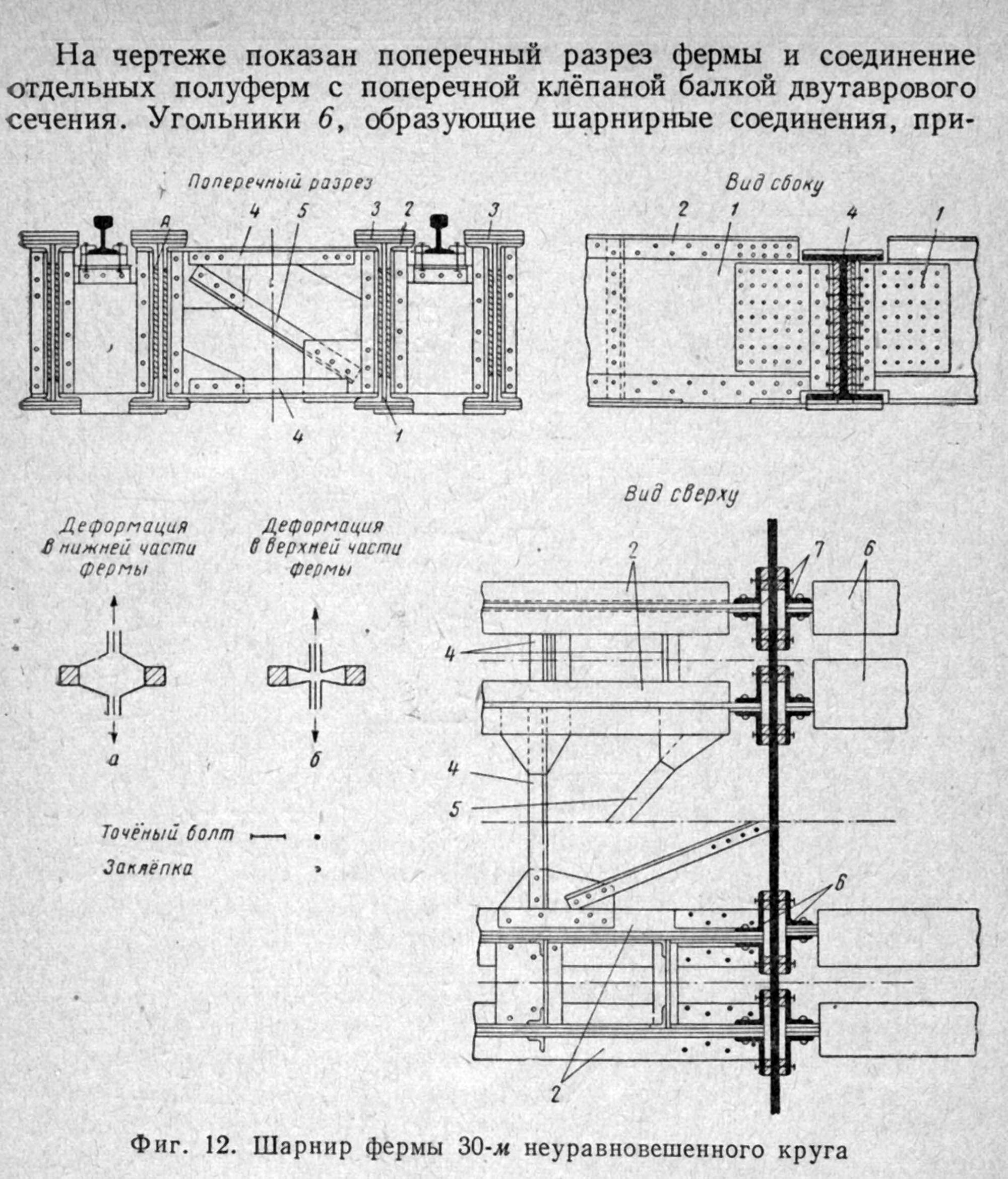
The increase in the weight and length of the locomotives also required a change in design. This led to the appearance of unbalanced split turntables. With this design, the turning beam rested on both the central support and the end wheels, which, in turn, rested on the ring rail when turning. The beam consisted of two parts connected in the center. In this case, the ride was carried out on top of the beam. Hence the name "with top riding" - similar to bridges.
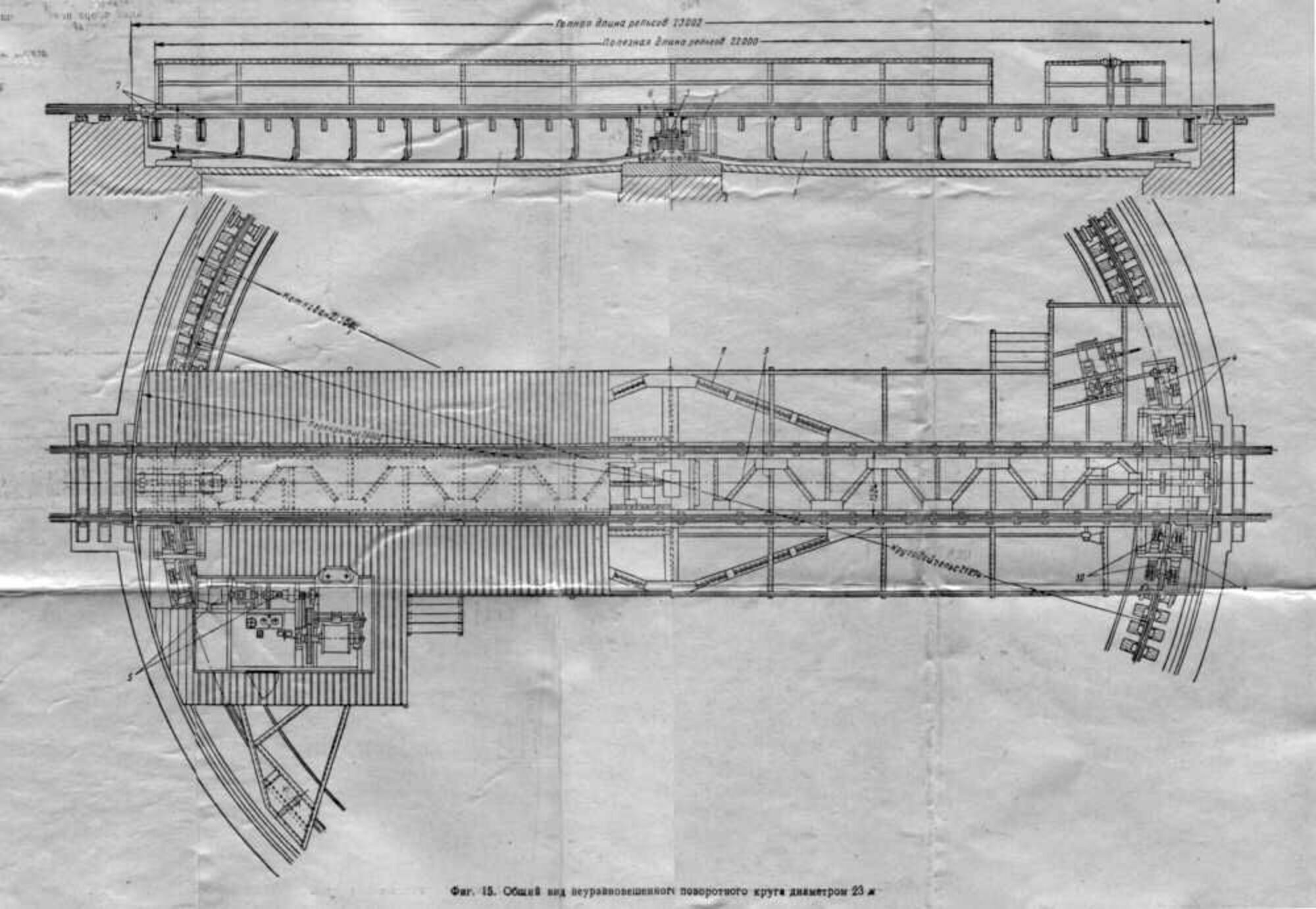
The advantage of such circles was that the truss for turning could be shorter, since it was enough for all the wheels of the locomotive and tender to fit on it. This significantly reduced the time for installing and turning the locomotive. The truss was smaller in weight and height, but its rotation required twice as much power, which clearly required the installation of a turner.
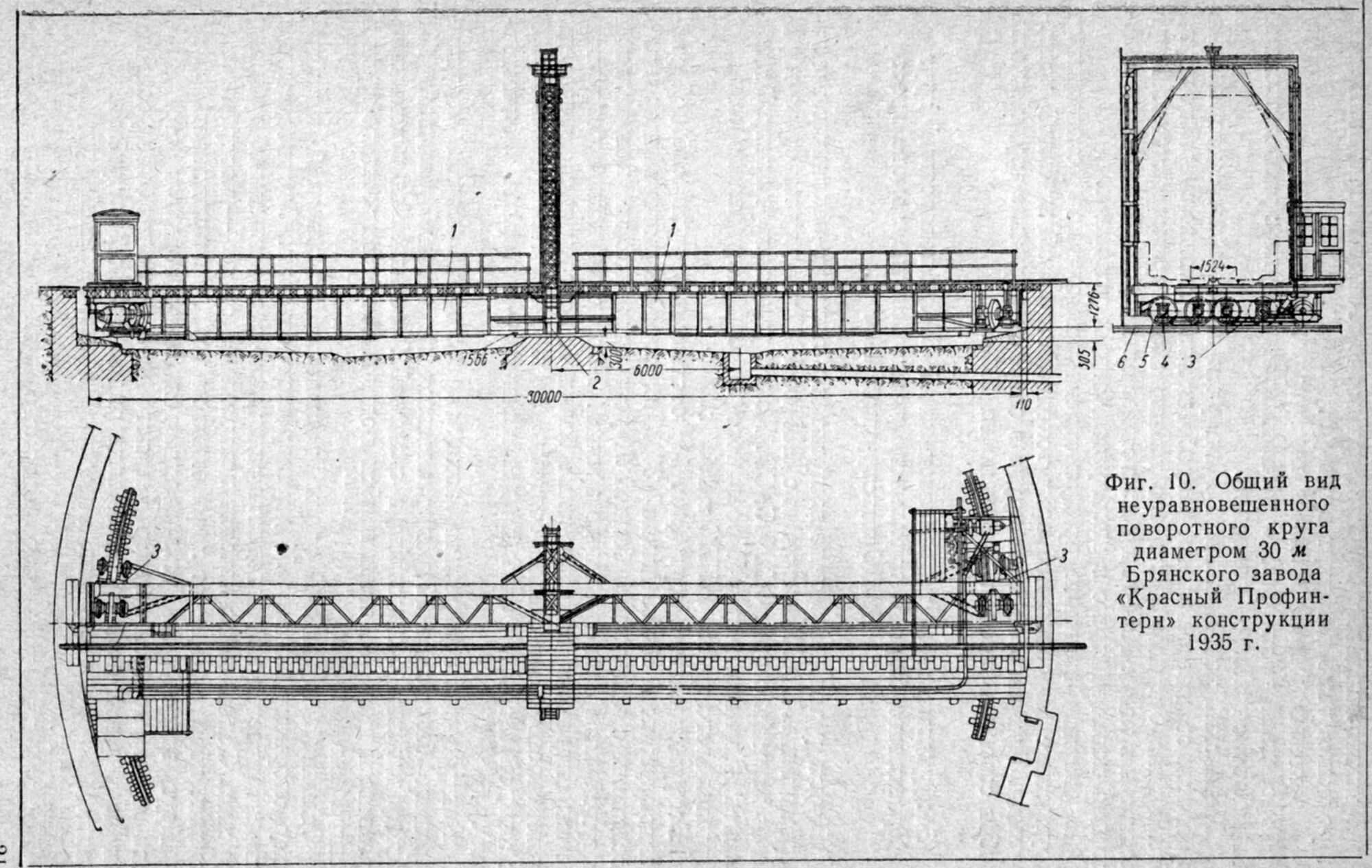
Unbalanced circles with a diameter of 23, 25 and 30 m were manufactured in the USSR. 25- and 30-meter foundationless circles were manufactured for installation in places with high groundwater levels. Large circles were necessary for turning new powerful locomotives of the SO, IS, FD, L, LV and P36 series. The circles were manufactured by the Bryansk plant "Red Profintern", the Lublin Foundry and Mechanical Plant of the NKPS named after L. M. Kaganovich, the Kirov Plant of the MPS named after 1 May and others.
Maximum load capacity is 300 t, span length is 30 m.