Today the museum is open from 10:00 to 18:00

Map

Exhibit description

Diesel Locomotive ShchEL1

At the end of the 19th century, fully functional designs of internal combustion engines of various systems were developed, including the compression ignition engine, created in 1897 by Rudolf Diesel, which later bore his name. These designs soon began to be widely adopted across various technical fields, including transportation: cars, motorcycles, tractors, aeroplanes, and ships.

At the beginning of the 20th century, internal combustion engines were already widely used in transportation, but their application in locomotives faced significant challenges.

In terms of their application to locomotives, significant technical challenges arose. The inherent characteristics of the internal combustion engine were not well-suited to the specific demands of locomotives as traction machines. This required the development of an intermediate power transmission system to adapt the diesel engine for locomotive operations.

In the early 20th century, many experimental diesel locomotive designs with various types of transmissions, primarily mechanical, were created. However, these designs proved to be either too low-powered and unsuitable for train operations, or completely unworkable. It was not until years of trial and error that it was determined that electric and hydraulic power transmissions were the most effective solutions for diesel locomotives.

First Domestic Locomotive

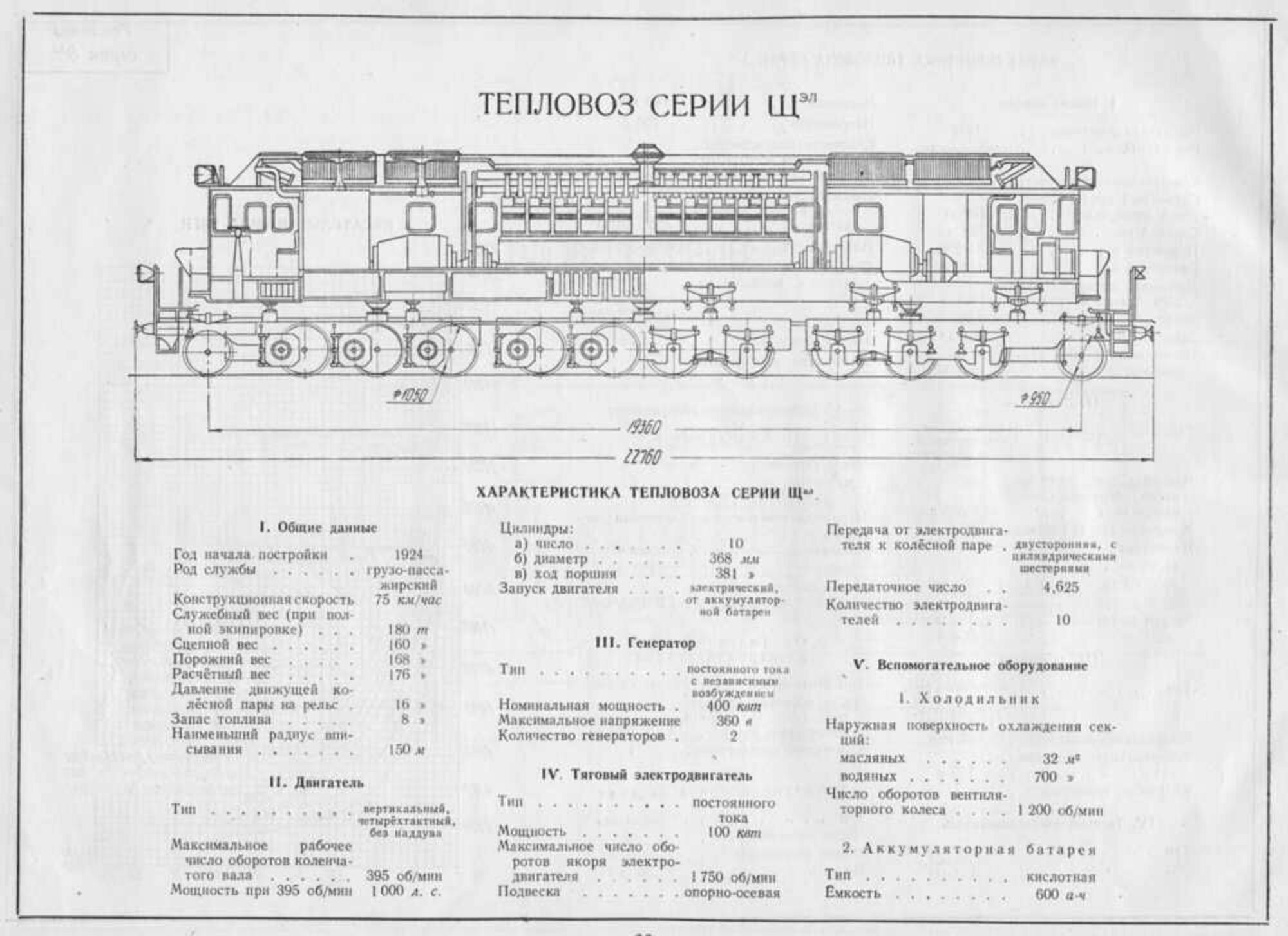
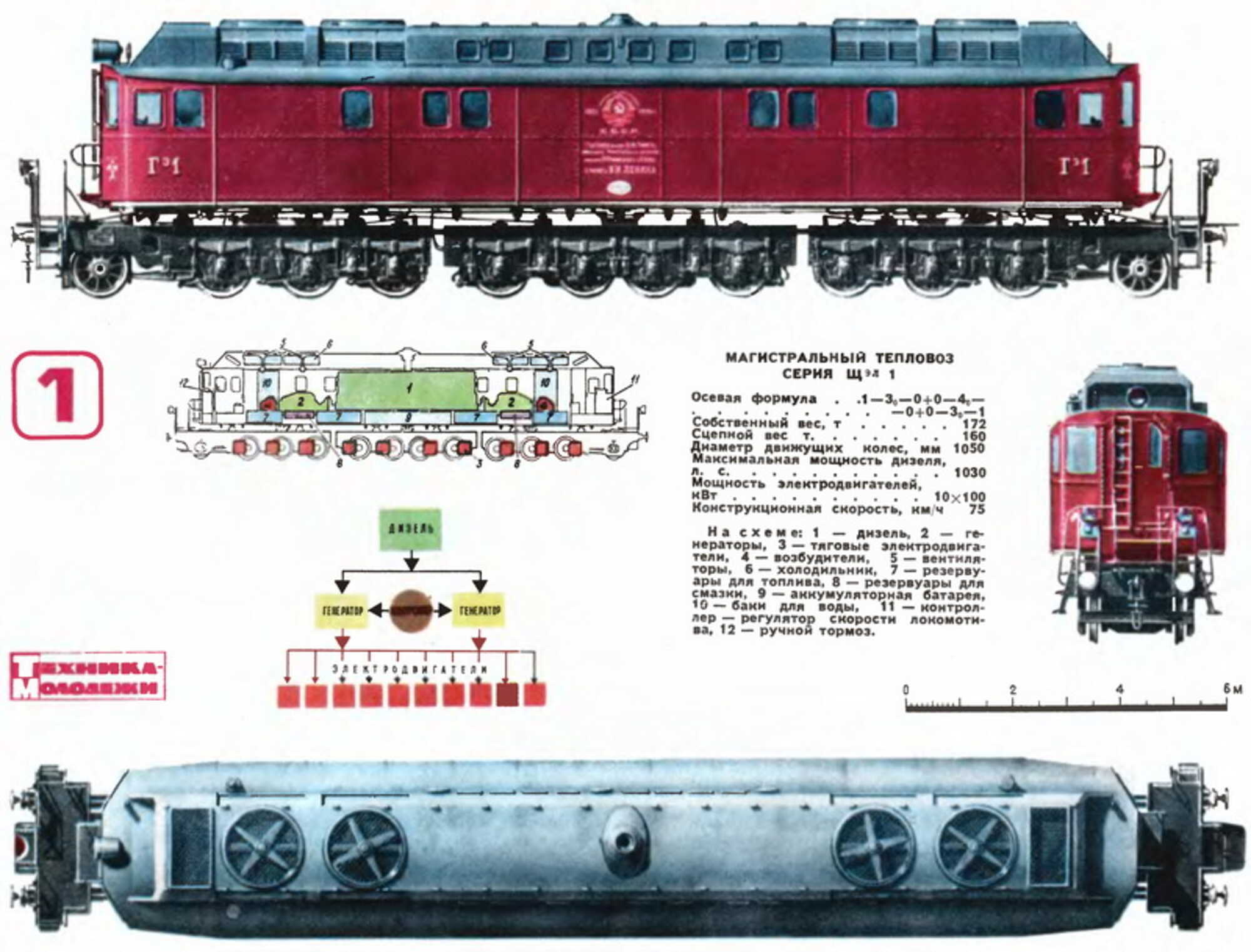
GE1 is the very first domestically built diesel locomotive and one of the first operational mainline locomotives in the world with an internal combustion engine (diesel). It was built in Petrograd between 1922 and 1924 according to the design of Engineer Yakov Gakkel through the joint efforts of three plants: the Baltic Shipyard (installation of the diesel engine and general assembly of the locomotive), the Krasny Putilovets Plant (production of the body and running gear), and the Elektrik Plant (production of traction electric motors).

The first Russian diesel locomotive was equipped with an engine originally intended for a submarine, which was never built due to the revolution.

The locomotive was equipped with a ten-cylinder, four-stroke diesel engine with a capacity of 1,000 hp, produced back in 1916 by the English Vickers Plant for the Russian submarine Lebed (“Swan”), which was unfinished due to the events of 1917. The locomotive had an electric power transmission. Two direct current traction generators were produced by the Volta Plant (Riga) and were also originally intended for use on submarines.

Ten PT-100 traction electric motors with a capacity of 100 kW each, mounted on the guiding axles, with support-axle suspension, were specially designed for this locomotive under the supervision of Engineer A.E. Alekseev. The underframe of the diesel locomotive consisted of a body and three four-axle trucks. The body had a main frame which was supported on each truck by four bearing springs and sliding supports.

The assembly of the diesel locomotive was largely completed at the Baltic Shipyard by mid-1924. While the work was originally planned to be finished by October 1924, severe flooding in Leningrad in September 1924 inundated the Baltic Shipyard, delaying the project. As a result, the diesel locomotive was finally ready a month later. On 7th November 1924, it made its first independent trip along the tracks of the Oktyabrskaya Railway. In January 1925, the locomotive travelled under its own power with a train to Moscow and was subsequently used on the Moscow-Kursk Railway in 1926–1927.

At different times, this diesel locomotive had several designations: initially, the locomotive was named YaG No.  1, after its creator Yakov Gakkel. It was later re-designated as YuE002 (the letter “Yu” was unused in the system for the Russian steam locomotive classes at the time), then as GE1 (where “E” indicated the type of transmission — electric), and later ShchEL1 (“Shch” signified that the diesel locomotive’s power was equivalent to that of the common Shch class steam locomotive).

The ShchEL1 remained an experimental model, but the experience gained from its creation had a profound impact on the development of domestic diesel locomotive construction.

The ShchEL1 diesel locomotive remained an experimental model produced in a single copy. Later, more advanced diesel locomotives were built in the USSR. Nonetheless, the experience gained from creating the ShchEL1 had a profound impact on the development of domestic diesel locomotive construction.

Since the late 1920s, the diesel locomotive was no longer in use. Before the war, it was sent to the test loop of the Railway Research Institute in Shcherbinka, and in 1972, it was installed as a monument at the Khovrino Locomotive Depot of the Oktyabrskaya Railway.

Parameters

Technical
specifications

Year of construction
1924
Locomotive type
Cargo-passenger
Number of locomotive sections
1
Locomotive length by buffers in mm
22 760
Wheelbase in mm
19 500
Service weight in t
180
Hitch weight in t
160
Rail axle load in t
16
Diameter of driving wheels in mm
1 050
Design speed in km/h
75
Diesel power in l. With.
1 000
Diesel
Vickers
Rated power in kW
800
Diesel speed per minute
395
Minimum radius of a traversable curve in m
150

Drawings
and diagrams

History

Chronology

  1. 1916 A diesel engine is built at the Vickers Plant for the Russian submarine Lebed, which is later used in the ShchEL1 diesel locomotive.
  2. 1921 Professor Yakov Gakkel proposes the first design for a diesel locomotive and presents it to the Supreme Technical Committee of the People’s Commissariat of Communication Routes.
  3. September 1921 Yakov Gakkel presents a design of a diesel-electric locomotive with a 1,000 hp engine.
  4. February 1922 The design, together with the estimate, is submitted to the State Planning Committee.
  5. Mid-1924 The assembly of the diesel locomotive is largely completed at the Baltic Shipyard.
  6. 5th August 1924 The first test run of the diesel locomotive on the tracks of the Baltic Shipyard.
  7. September 1924 The severe flooding of the Baltic Shipyard delays the completion of work on the diesel locomotive.
  8. October 1924 The planned completion of work on the diesel locomotive.
  9. 7th November 1924 The diesel locomotive is fully assembled and makes its first independent trip along the tracks of the Oktyabrskaya Railway.
  10. 30th December 1925 The diesel locomotive is accepted by the committee of the People’s Commissariat of Communication Routes and begins operating with freight trains
    on the Lyublino-Kursk section of the Moscow-Kursk Railway.
  11. December 1927 The diesel locomotive is removed from service with a mileage of only 40,000 km.
  12. 1940 Professor Ya.M. Gakkel and Engineer V.A. Rakov put forward two options for redesigning the diesel locomotive.
  13. 1941 With the onset of the war, plans to redesign the diesel locomotive are postponed, and it is sent to the test loop of the Railway Research Institute.
  14. 1972 Thanks to the efforts of a group of enthusiasts, the diesel locomotive is delivered to the Khovrino Depot and installed as a monument.
  15. 1997 The diesel locomotive is transported to St. Petersburg for the celebration of the 160th anniversary of Russian railways.
  16. 2017 The diesel locomotive is delivered to the Russian Railway Museum.