Today the museum is open from 10:00 to 18:00

Map

Exhibit description

Car of the Aurora express train Aurora

High-speed train

In 1963 there was a need to establish a high-speed rail connection between Moscow and Leningrad. This is how the high-speed train "Aurora" was created. The main goal of its creation was to reduce the travel time between the two capitals to 5.5 hours. To achieve this, the new project went through several stages of modernization.

Initially, carriages manufactured by the Ammendorf plant in the GDR were adapted for the "Aurora", which were strengthened for high speeds. Electric generators were dismantled to reduce air resistance. The design speed was 160 km/h.

Later, the "Aurora" consisted of a Czechoslovakian electric locomotive ChS2, nine passenger cars with "airplane" seats and a power station car. With the transition to ChS2T locomotives, the number of cars increased to 12, and with ChS6 and ChS200 — to 15 passenger and a restaurant car.

The first trip of the "Aurora" took place on June 12 1963 It covered the distance from Leningrad to Moscow in 5 hours 27 minutes. However, during experiments in 1965 the locomotive reduced the time to 4 hours 59 minutes.

As the number of cars in the train increased, the speed of the "Aurora" decreased, and the travel time increased to seven hours. This figure was improved to 5.5 hours with the advent of the ChS6 electric locomotives.

Initially, the cars had a different corporate livery. They were painted dark red with a wide cream stripe along the window line. The inscription "Aurora" was made in overhead letters.

Trains of subsequent years of operation received a fast corporate paint job of gray-blue color with a dark blue stripe along the bottom of the car body and a red inscription "Aurora". In 2009 the "Aurora" was replaced by the high-speed express "Sapsan".

"Aurora" today

Car №003 12249, presented in the Museum of Russian Railways, was built at the "Görlitz" plant in the GDR in October 1988. It is an all-metal car with air conditioning, combined heating and a radio compartment.

After it arrived at the October Railway, the carriage was modernized. The upper berths were removed, leaving only seats. This allowed for an increase in passenger capacity. However, it turned out to be uncomfortable to travel in a sitting position for 5.5 hours.

The train consisted of a Czechoslovak-made ChS2 electric locomotive, 9 interregional passenger carriages (with aircraft-type seats) built by the Kalinin Carriage Works (KVZ), and a power station carriage for centralized power supply of passenger carriages. The transition to ChS2T type locomotives made it possible to increase the number of carriages in the train to 12 units, and for ChS6/ChS200 types - up to 15 passenger carriages and a restaurant carriage.

Initially, the carriages had a different corporate livery. They were painted dark red with a wide cream stripe along the window line. The inscription "Aurora" was made with overhead letters. Trains of subsequent years of operation were painted gray and blue with a dark blue stripe along the bottom of the body and a red inscription "Aurora".

Parameters

Technical
specifications

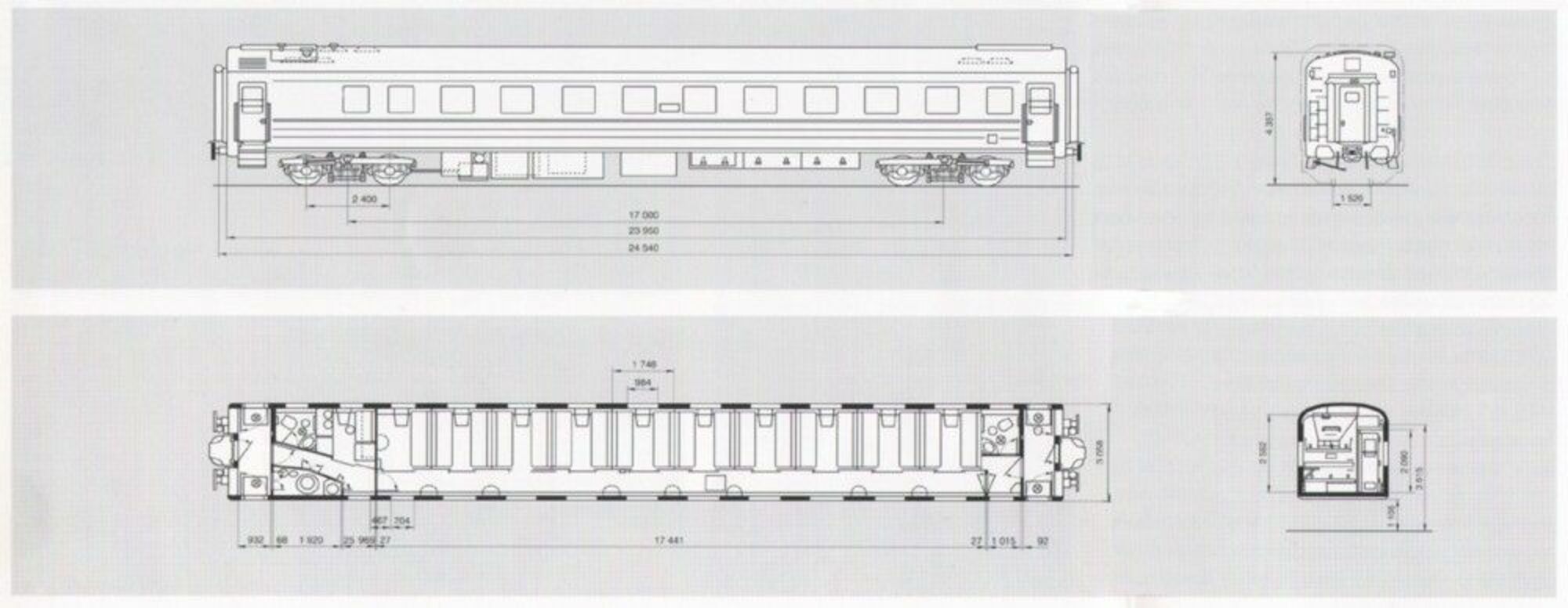
Length along coupling axes, mm
24,540
Wagon body length, mm
23,950
Maximum car width, mm
3,134
Car height from rail head to roof top, mm
4,357
Car base, mm
17,000
Base of bogies, mm
2,400
Wheel pair tread diameter, mm
950
Height from rail heads to automatic coupler center, mm
1,060 +/- 20
Number of seats
54
Smallest curve radius allowed for uncoupled car passage, m
80
Power supply
From power station car
Travel speed, km/h
160
Temperature range, degrees Celsius
+/- 50
Car tare, t
53
Water capacity, l
1,120

Drawings
and diagrams

History

Chronology

  1. 1963 The high-speed branded train "Aurora" No. 159A/160A on the Moscow-Leningrad route of the October Railway ran between the two capitals from June 12, 1963 to April 4, 2010. At the end of 2009, it was replaced by the high-speed express "Sapsan".
  2. 1963 The first trip of the high-speed express "Aurora" was made on June 12, 1963. The train was pulled by the electric locomotive ChS2-078 under the control of the engineer E. P. Sakharov and assistant A. I. Zakharov. The journey from Leningrad to Moscow was completed in 5 hours 27 minutes. In 1965, test trips of the "Aurora" took place, during which the minimum travel time of 4 hours 59 minutes was achieved. In the second half of the 1970s, as the number of carriages in the train increased, the travel time increased to almost 7 hours in 1979. With the introduction of powerful ChS6 electric locomotives (8,000 kW), the travel time was reduced to 5 hours 30 minutes.