Today the museum is open from 10:00 to 18:00

Map

Exhibit description

Freight Steam Locomotive EL 534

By 1914, Russian steam locomotive plants established the mass production of advanced freight steam locomotives, including the 1-4-0 type of class Shch and the 0-5-0 type of class E. The class E locomotives, featuring five coupling axles and introduced in 1912, took a quantum leap for the steam locomotive construction. From that point until the end of steam locomotive production in Russia and the Soviet Union, locomotives with five coupling axles had been dominating the freight fleet of domestic railways.

The construction of the Trans-Siberian Railway led to a sharp increase in transportation volumes, necessitating the development of an improved freight steam locomotive class.

With the outbreak of World War I, freight transport in Russia grew significantly. It became immediately clear to specialists that a shortage of rolling stock, particularly modern steam locomotives, was imminent. Anticipating this, the Ministry of Railways began exploring the possibility of ordering new steam locomotives from the United States.

New Class

The Rolling Stock and Traction Commission of the Ministry of Railways evaluated various types of steam locomotives for procurement, ranging from 0-5-0 to 1-5-1 wheel arrangements. However, all experts unanimously agreed on one key requirement—the new steam locomotive must feature five coupling axles. Ultimately, the decision was made to order 1-5-0 type steam locomotives from the USA.

The first batch ordered in the United States consisted 400 class E locomotives.

In the summer of 1915, the Ministry of Railways signed contracts with U.S. locomotive manufacturers for the production of 400 type 1-5-0 steam locomotives, which were designated as the E class in Russia. The Canadian Locomotive Company received an order for 50 locomotives of the E K class. The American Locomotive Company, or ALCO, was contracted to produce 100 locomotives of the E S class. 250 locomotives of the E F class were ordered from the Baldwin Locomotive Works.

Although the plants were given the same specifications, each developed its own design for the locomotives. As a result, despite sharing identical technical characteristics, the locomotives exhibited significant design differences. The arrival of Engineer Alphonse Lipetz, dispatched by the Ministry of Railways to the USA to oversee the standardisation of parts, had limited effect. On the one hand, the plants faced very tight deadlines for locomotive delivery. On the other hand, as competitors in the locomotive manufacturing market, they were unwilling to collaborate. Nevertheless, Alphonse Lipetz made considerable efforts to ensure the unification of parts across American-built locomotives.

Beginning of Deliveries

New machines began to arrive in Russia in October 1915. The first ship with EC 251–256 steam locomotives arrived in Vladivostok on October 14. The steam locomotives arrived in Vladivostok disassembled, and they were assembled in the Harbin workshops of the Chinese Eastern Railway, for which purpose the workshops’ production areas were expanded. The locomotives were assembled by Chinese contractors Fan-zo-ting and Ai-yu-zen.

The steam locomotives were delivered from the USA by sea disassembled and were assembled at the Harbin workshops of the Chinese Eastern Railway.

On 26th January 1916, Grand Duke George Mikhailovich of Russia visited the Harbin workshops. In honour of this event, the E F 1 steam locomotive was given its own name “Grand Duke George Mikhailovich”, and metal plaques with this inscription were attached.


Once assembled, the steam locomotives were delivered to the Transbaikal Railway via the Manchuria Station, ready for immediate use. New locomotives were also delivered to the Yekaterininskaya, Perm, and Samara–Zlatoust Railways. Around 50 steam locomotives were put into service on the Transbaikal Railway.

The 1-5-0 type steam locomotives ordered in 1915 received mixed evaluations from Russian operators. The main complaints centred around American components and parts, such as bar frames, axle boxes, spring suspension, cylinders, and boiler fittings, which were unfamiliar to local locomotive crews and repairmen.

Overseas transportation took up to 80 days. Deteriorated in the process, these steam locomotives called for frequent repairs.

In addition, issues with the supply of spare parts for steam locomotives, which had significant design differences within the same class, as well as the insufficient quality of some units and parts, contributed to frequent breakdowns. The condition of the steam locomotives deteriorated during the 60–80 day sea transport, further complicating matters.


Operators also gave negative feedback on the shallow firebox of the new steam locomotives, which was designed for anthracites and semi-anthracites. These shortcomings had to be considered when ordering the next batch of steam locomotives from the USA.

From April to September 1916, the Rolling Stock and Traction Commission of the Ministry of Railways held several meetings to discuss changes to the design of the 1-5-0 type steam locomotives to be ordered from America. The list of proposed changes was approved by L. N. Bazhanov, the Deputy Head of the Railway Administration of the Ministry of Railways, on 8th August 1916, and sent to American plants.


According to this list, the height of the locomotive boiler axis was to be raised to 3,050 mm in order to deepen the firebox. It was also decided to incorporate several assemblies and parts from Russian steam locomotives. For example, a variable blastpipe similar to that of the class S locomotives was to be used, and the superheater chamber damper mechanism was to follow the K-class design. The fuse plugs were also to be designed according to the Russian model, similar to those used in the Shch- and S-class locomotives.


Steam locomotives built with these design changes were initially designated as the E N class, with the subscripts “p” for “Philadelphia” and “c” for “Schenectady”. Later, they were assigned the EL class designation, with the superscript honouring Alphonse Lipets, who played an important role in improving the design of these locomotives.

Continuation of the Project

Negotiations for new deliveries of American steam locomotives began in 1916, and in November 1916, two contracts were concluded with Baldwin Locomotive Works and American Locomotive Company companies for 40 locomotives each. Baldwin built locomotives No. 541–580, while ALCO built No. 501–540. Then, on 18 December 1916, two more contracts were signed with these companies, with each manufacturer producing 110 steam locomotives. As a result, Baldwin-built locomotives were numbered 581–690, while ALCO-built locomotives were numbered 691–800. Later, on 17th April 1917, Baldwin received another order from the Ministry of Railways for 75 more locomotives, numbered 801–875.

In 1917, it was planned to manufacture 2,000 locomotives and 40,000 cars in the USA and deliver them to Russia.

In May 1917, Professor Yury Lomonosov, along with other specialists, was sent to the USA to oversee and coordinate all deliveries of rolling stock for the Ministry of Railways (it was planned to manufacture 2,000 locomotives and 40,000 cars and deliver them to Russia). Upon arrival, he established the Railways Mission, a team responsible for ordering, accepting, and dispatching railway equipment and materials to Russia.

In 1917, the United States entered World War I and began providing Russia, as an ally, with loans for the supply of weapons and rolling stock. As a result, contracts were signed for the production of 500 1-5-0 type steam locomotives, which were to be manufactured by Baldwin and ALCO by 1st April 1918.


These locomotives shared the same design as the previous 375 locomotives of the class E L . Notable differences included the use of split bearings on the middle coupling pin, replacing the previous blind bushing. Additionally, the connecting rods and unbalanced masses of the driver wheels were lightened. These modifications were made to improve the weight distribution of the steam locomotive.

Due to the revolution and Russia’s de facto withdrawal from World War I, the US government ceased providing credit for the supply of steam locomotives. This decision had the greatest impact on the order for 500 locomotives under contracts concluded in the summer of 1917, which were scheduled for construction in 1918.

Following Russia’s effective withdrawal from World War I after the revolution, the US government stopped crediting the supply of steam locomotives.

The cost of one locomotive under these contracts was $55,730. At the same time, American plants were willing to continue producing locomotives, provided that the Ministry of Railways’ mission would find a way to pay for them. Since 20% of the cost of all 500 machines had been paid before the October Revolution, the parties agreed that these funds would be considered full payment for the first hundred locomotives. These machines were initially stored at the manufacturing plants and later at a special Russian Ministry of Railways base in Seattle.


However, the funds to pay for the remaining 400 locomotives weren’t found. Under an agreement with the US government, 200 locomotives were converted to a 1,435 mm gauge and transferred to work on North American railroads. The Russian authorities were given the right to repurchase them later at a reduced price.


The production of another 200 locomotives was postponed, while the Russian Ministry of Railways retained the right to order them later under previously agreed conditions. In fact, 300 locomotives were built for this order between the end of 1917 and May 1918, of which 100 were later sent to Russia, and 200 remained in the USA.


It is worth noting that, by the time of the October Revolution, an agreement had been reached between the Russian Ministry of Railways and the American authorities and plants regarding the terms of delivery for additional 1,500 type 1-5-0 steam locomotives. However, due to the revolution, the contracts for the supply of these locomotives were never signed.

From the beginning of 1918, the Allies stopped providing steamships for transporting locomotives to Vladivostok. Deliveries resumed only in November 1918, when the first steamship departed, carrying two steam locomotives. After that, from January 1919, locomotive transportation across the Pacific Ocean became more regular.


The assembly of the class E L steam locomotives from the actually ordered batch of 500 machines and the planned batch of 1,500 locomotives was supposed to take place in the Vladivostok steam locomotive workshops, which were built specifically for this purpose. The corresponding agreement was signed in Petrograd on 20th June 1917.


Although the workshops of this locomotive assembly plant were constructed in the Gniloy Ugol district of Vladivostok during the winter of 1917–1918, they were never put into operation. As a result, the assembly of all Decapods, as they called type 1-5-0, arriving in the Far East was carried out in the Harbin workshops of the Chinese Eastern Railway. This work continued until 1921. In May 1919, eight EL locomotives were sent to Novorossiysk to the Commander-in-Chief of the armed forces of the South of Russia, Anton Denikin.


In total, during World War I and the Civil War, 881 1-5-0 type steam locomotives were sent from the USA and Canada to Russia.

Initially, the majority of the class E steam locomotives of various indexes operated on the railways of the European part of Russia, the Urals, and Siberia. As of 1 January 1923, 604 steam locomotives listed in the inventory fleet of the Ministry of Railways were distributed as follows: Yekaterininsky Railway—61 steam locomotives, Perm Railway—266 steam locomotives, Siberian Railways—277 steam locomotives.


By the beginning of the Great Patriotic War, class E steam locomotives were primarily used on the East Siberian Railway, in Transbaikal, and in the Far East of the USSR. In 1954, 12 EL steam locomotives were converted to operate on a 1,435 mm gauge and were kept in reserve on sections of railways bordering China. A small number of EL steam locomotives were transferred to Mongolia in 1955 to operate on the Ulaanbaatar Railway. In the mid-1950s, the process of transferring E F -, E S -, E K -, and E L -class steam locomotives to the branch lines of industrial enterprises and removing them from the inventory of the Ministry of Railways began.


A significant chapter in the history of the class EL steam locomotives is their operation on the Chinese Eastern Railway. At the beginning of the 1920s, there were 124 class EL locomotives in the Chinese Eastern Railway fleet. Of these, 80 machines were later transferred to the USSR in the 1930s, while the remaining locomotives were sold in 1935, along with the USSR’s share of the Chinese Eastern Railway property, to Manchukuo, a state entity under Japanese control. These 44 locomotives were eventually converted to the 1,435 mm gauge and went on to serve on the railways of China, where they were assigned the class DK 2 . One of these steam locomotives, DK 2 114, has been preserved in China as a museum exhibit.

The remaining 200 steam locomotives ordered by Russia in the United States were used mainly until the 1940s, when US railroads transitioned to diesel traction. Their largest operators were the Erie Railroad and Seaboard Air Line Railroad. Russian Decapods continued to operate until 1958 on the industrial ore transportation line of the Eagle-Picher Lead company in Oklahoma. Six class EL steam locomotives are stored in the USA. One of them is in working condition.

The 200 unredeemed steam locomotives of the class remained in the USA and were operated there until the 1940s.

In Russia, two E S steam locomotives and two E L steam locomotives have survived to this day. Two of these are housed in museum collections, while the other two are displayed on pedestals in Chelyabinsk and Ussuriysk.


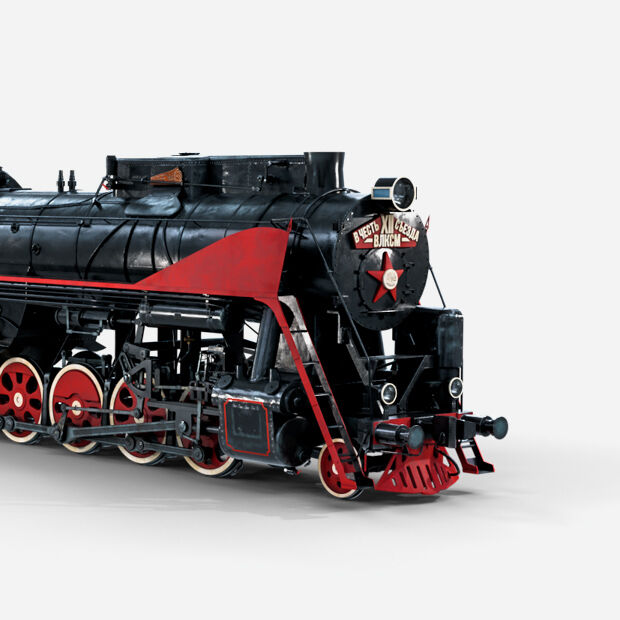
The E L 534 steam locomotive was built by the American Locomotive Company in the USA in 1917, with factory number 57483.


Starting from the 1930s, the steam locomotive was used on the Transbaikal Railway, including at the Mogzon Locomotive Depot. In April 1962, it was transferred to work on the branch lines of the Tom–Usinskaya State District Power Station in the Kemerovo Region, where it operated until the early 1970s. In 1973, the steam locomotive was returned to the Ministry of Railways to be removed from inventory and cut up for scrap metal at the Omsk Locomotive Depot. However, it remained in Omsk until the early 1980s, when it was registered by the Central Museum of Railway Transport of the USSR and subsequently moved to the Zelenogorsk storage base of the Oktyabrskaya Railway for preservation.

Parameters

Technical
specifications

Manufacturer
ALCO
Year
1917
Locomotive weight in working condition without tender, t
85.0
Locomotive coupling weight, t
75.1
Design speed, km/h
55 (70)
Maximum power at the wheel rim, l. s.
1 400
Length of locomotive with tender, mm
21,538
Diameter of driving wheels, mm
1320
Cylinder diameter, mm
635
Piston stroke, mm
711
Steam pressure in the boiler, kg/cm2
12.7
Firebox type
Radial
Grate area, m2
6.0
Full evaporative heating surface of the boiler
240,2 м2
Heating surface of steam superheating tubes, m2
61.3
Tender type
Four-axle
Tender empty weight, t
26
Water supply, m3
28
Coal reserve, t
16
Tender length, mm
9 142
Trolley type, t
Diamond bel

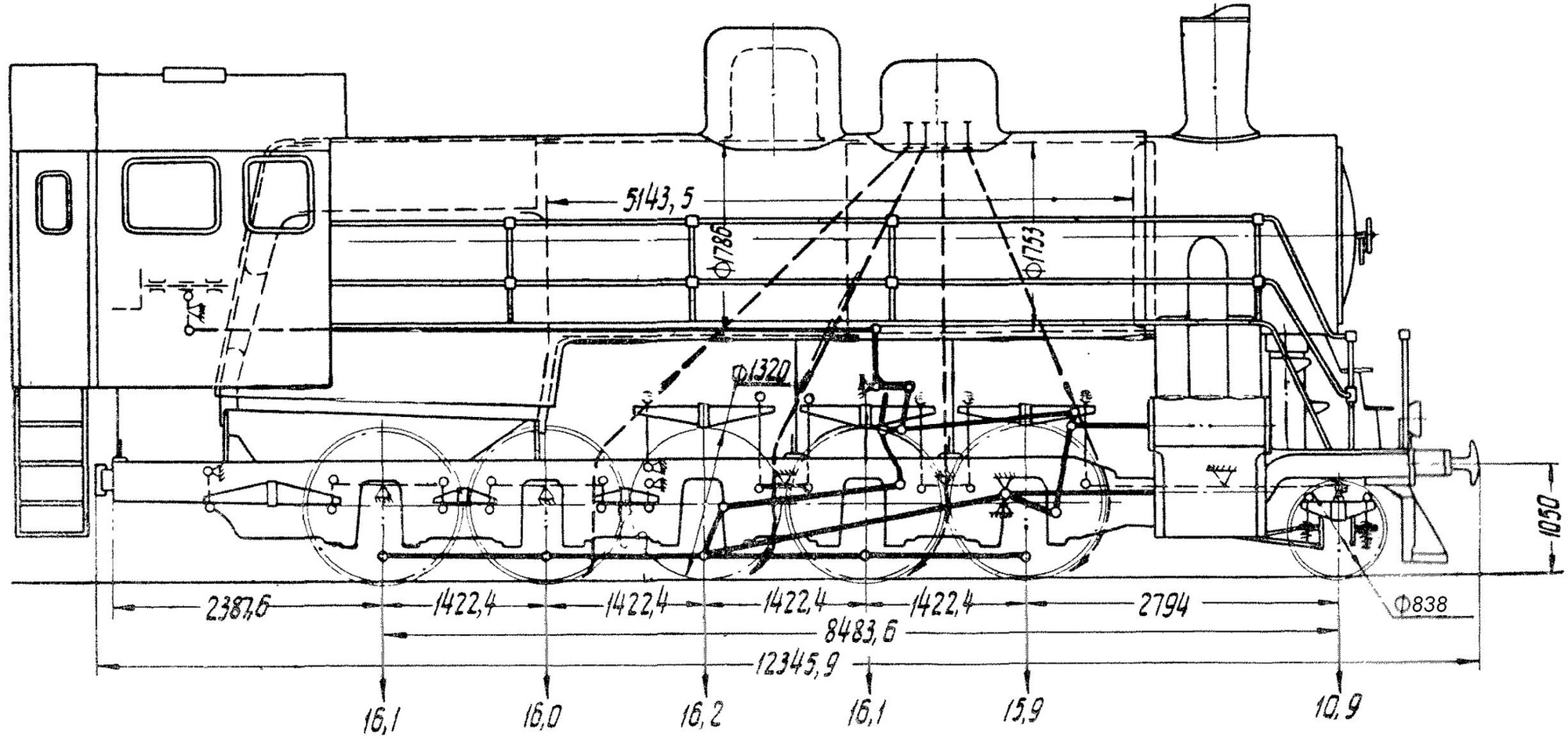
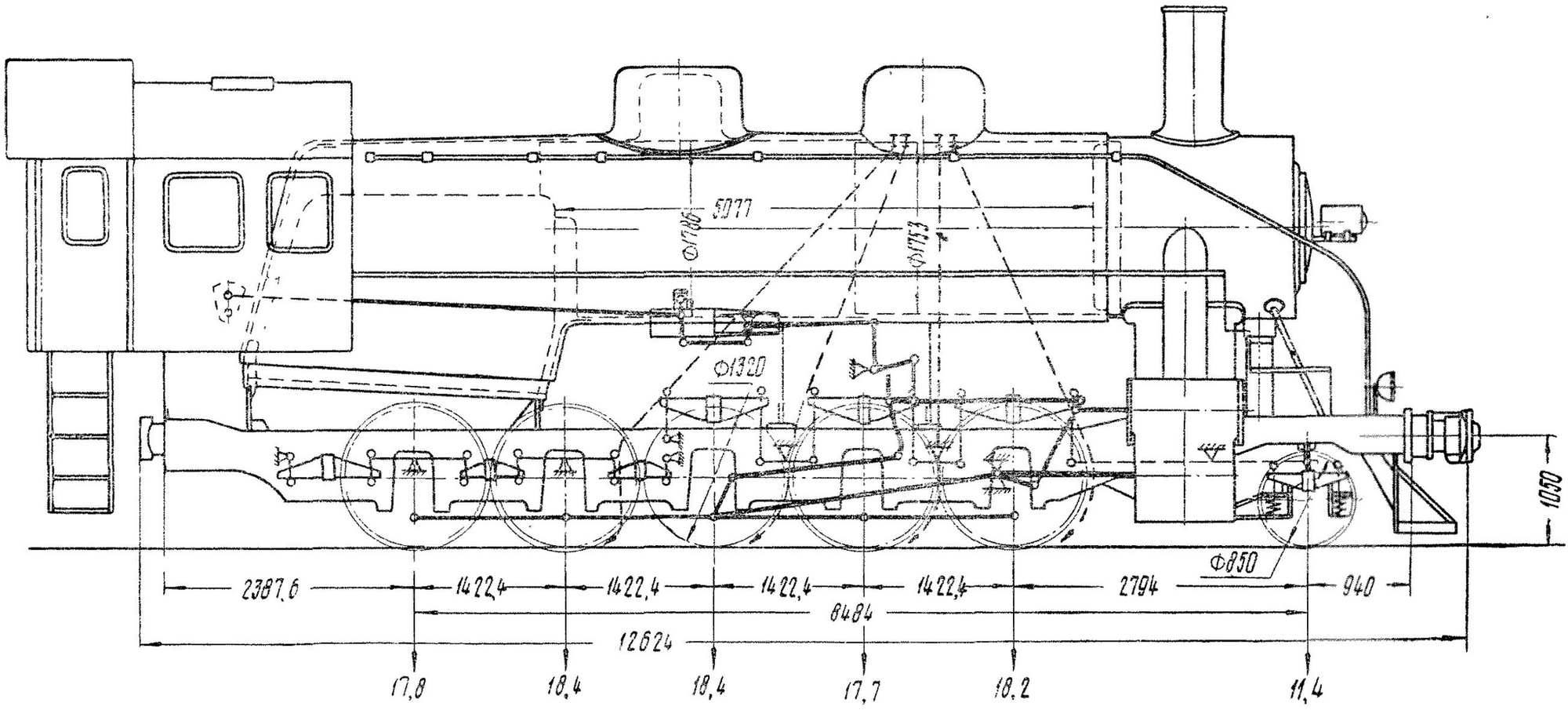
Drawings
and diagrams

History

Chronology

  1. 1915 The Russian Empire ordered the class EL from the USA. The first locomotives arrived in the country at the end of the year.
  2. 1917 The EL 534 steam locomotive was built at a plant in the USA and sent to the Russian Empire.
  3. 1973 The EL 534 steam locomotive was supposed to be sent to the scrap yard, but it miraculously escaped this fate.
  4. 2017 The EL 534 steam locomotive became an exhibit at the Russian Railway Museum.