Today the museum is open from 10:00 to 18:00

Map

Exhibit description

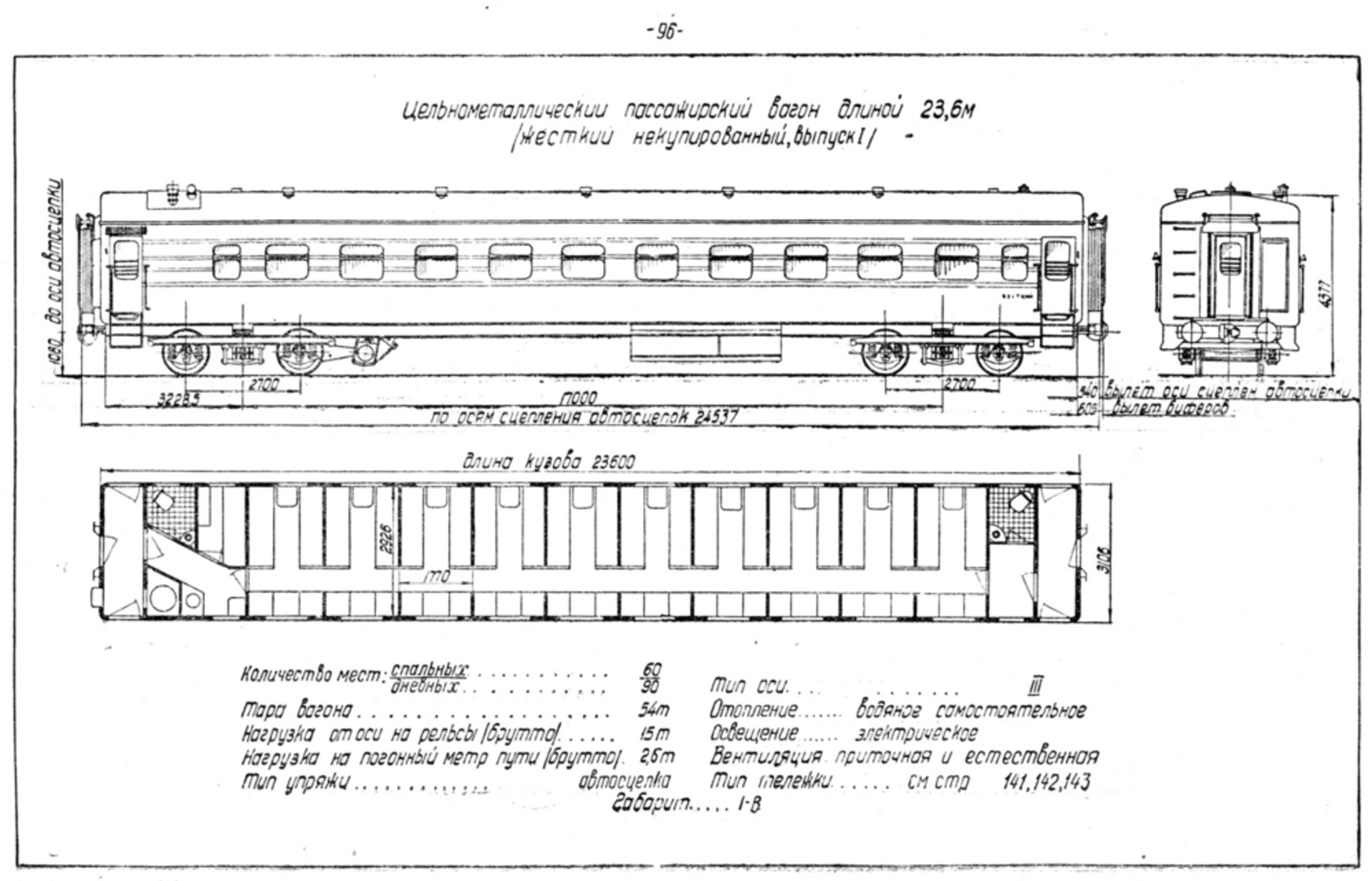
Passenger compartment car No. 083 27090

By the 1930s, countries with the most developed transport engineering had started building passenger cars with all-metal bodies. All passenger cars in the USA had use this design since 1913.

All-metal bodies were much stronger than those built with a wooden frame, and therefore safer. But building them required rolled steel.

In the USSR

During the industrialisation of the USSR, steelworks were built and updated, making rolled and stamped steel more affordable. Electric welding, including automatic welding, developed rapidly in the USSR, and new technologies in car building became possible.

The first series-produced all-metal passenger cars in the USSR were built for the metro.

The Mytishchi Wagon Works began construction of electric multiple units for suburban traffic in 1929. Their cars had metal frames and wall cladding, but the roof cladding was still made of wood, and the roof itself was made of canvas.

The first series-produced all-metal passenger cars in the USSR were built for the metro.

After ceasing construction of two-axle passenger cars in 1930, the Mytishchi Wagon Works stopped building passenger cars with wooden frames. In 1934, the plant began building all-metal cars for the Moscow metro — the first series-produced all-metal cars in the USSR.

The production of all-metal cars for mainline railways was more complicated. In 1934, there were plans to convert the Kalinin Carriage Works for mass production of all-metal cars with a body length of 25.2 m (or, to be precise, 25,198 mm). However, these plans never came to pass. In 1935, the plant built the body and crew sections of a prototype all-metal car, with the internal finish done by the I.E. Egorov Carriage Works in Leningrad. Both plants continued project development and prototype production until 1941, but not a single all-metal car was put into regular passenger service.

From 1945, the I.E. Egorov Carriage Works resumed development of the all-metal car, and the pre-war efforts were deemed a failure. By 1946, the first car of a completely new type and a body length of 23.6 m had been built. This all-metal car entered into series production and set the standards for the further construction of the passenger car fleet of the USSR and Russian Federation to this day. Serial production of all-metal cars began as early as 1947 in three plants: in Leningrad, Tver, and Moscow.

Polish Reserved-Seat Cars

At the same time as the start of series production of all-metal cars in the USSR, orders for all-metal cars were placed in East Germany, Hungary, and Poland.

The Joseph Stalin Metal Works in Poznań (before and now H. Cegielski-Poznań S.A.) began production of cars for the USSR with model 52W hard-seated compartment cars, which had a body length of 21.12 m. These cars left the plant in 1950.

In 1950, the development of cars more in line with the requirements of the Ministry of Railways of the USSR began. These were cars without compartments (reserved-seat cars) with 58 sleeping berths or 87 seats. From 1951 to 1960, 2,746 of these cars, which were given the designation 66W, were built. Numerous changes were being made during production, to the point that later designs with corrugated side walls could be considered a different type of car.

All-metal reserved-seat cars with 58 sleeping berths of 87 seats were built in Poland for the USSR.

Model 66W car was built at the Joseph Stalin Metal Works in Poznań in 1953. Under the 1967 indexing system, the index of this type of car is OP-53-1 (“open, built by a Polish plant, 1953, type 1”). By 1993, car no. 083 27090 was assigned to the Omsk Wagon Depot on the West Siberian Railway.

Parameters

Technical
specifications

Plant
Stalin in Poznan (Cegielski)
Year of construction
1953
Number of axles
4
Length of the car along the axles of the SA-3 automatic couplings, mm
24,540
Body length, mm
23 600
Body width, mm
3 105
Height of the car from UVGR, mm
4 352
Body
All metal
Trolley base, mm
2 700
Trolley base, m
17
Tara, t
54
Generator power, kW
4.5
Number of seats
87
Number of beds
58
Lighting
Electric, incandescent lamps
Type of window frames
Drop-down
Cart type
CMV
Bearings
Rolling

Drawings
and diagrams

History

Chronology

  1. 1949 The Joseph Stalin Metal Works in Poznań begins production of passenger cars for the Ministry of Railways of the USSR, producing model 52W hard-seated compartment cars with a body length of 21.12 m.
  2. 1950 Completion of construction of the first type 52W cars. The Joseph Stalin Metal Works in Poznań begin development of the type 66W, more in line with the requirements of the Ministry of Railways of the USSR. Production of type 66W hard-seated open cars begins.
  3. 1951 Completion of construction of the first batch of type 66W cars.
  4. 1953 The type 66W car now exhibited at the Russian Railway Museum is built.
  5. 1960 Production of type 66W cars at the Joseph Stalin Metal Works in Poznań ends with 2,746 units built.
  6. 1994 Type  66W car 083 27090 enters the collection of the Oktyabrskaya Railway Museum.