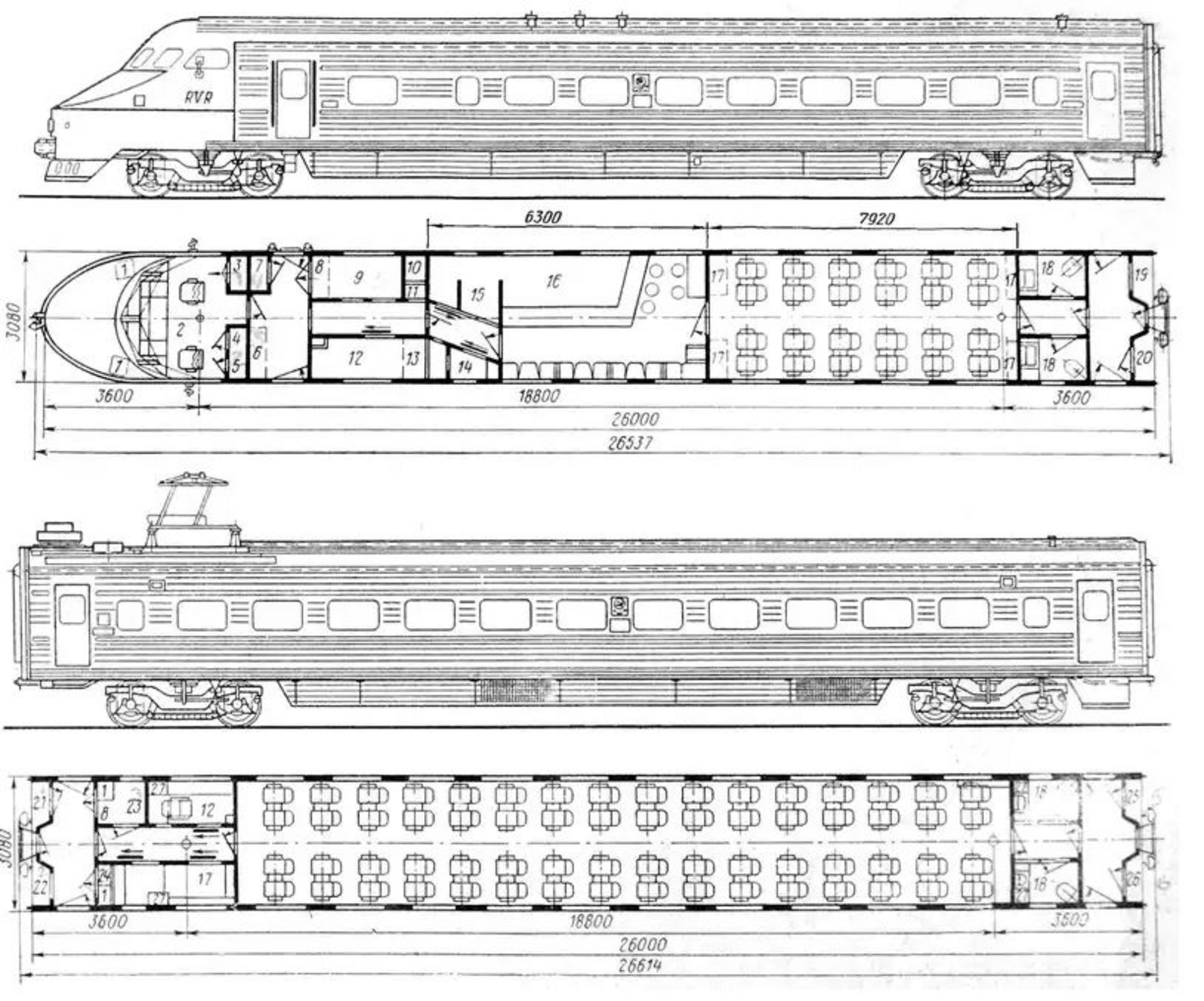
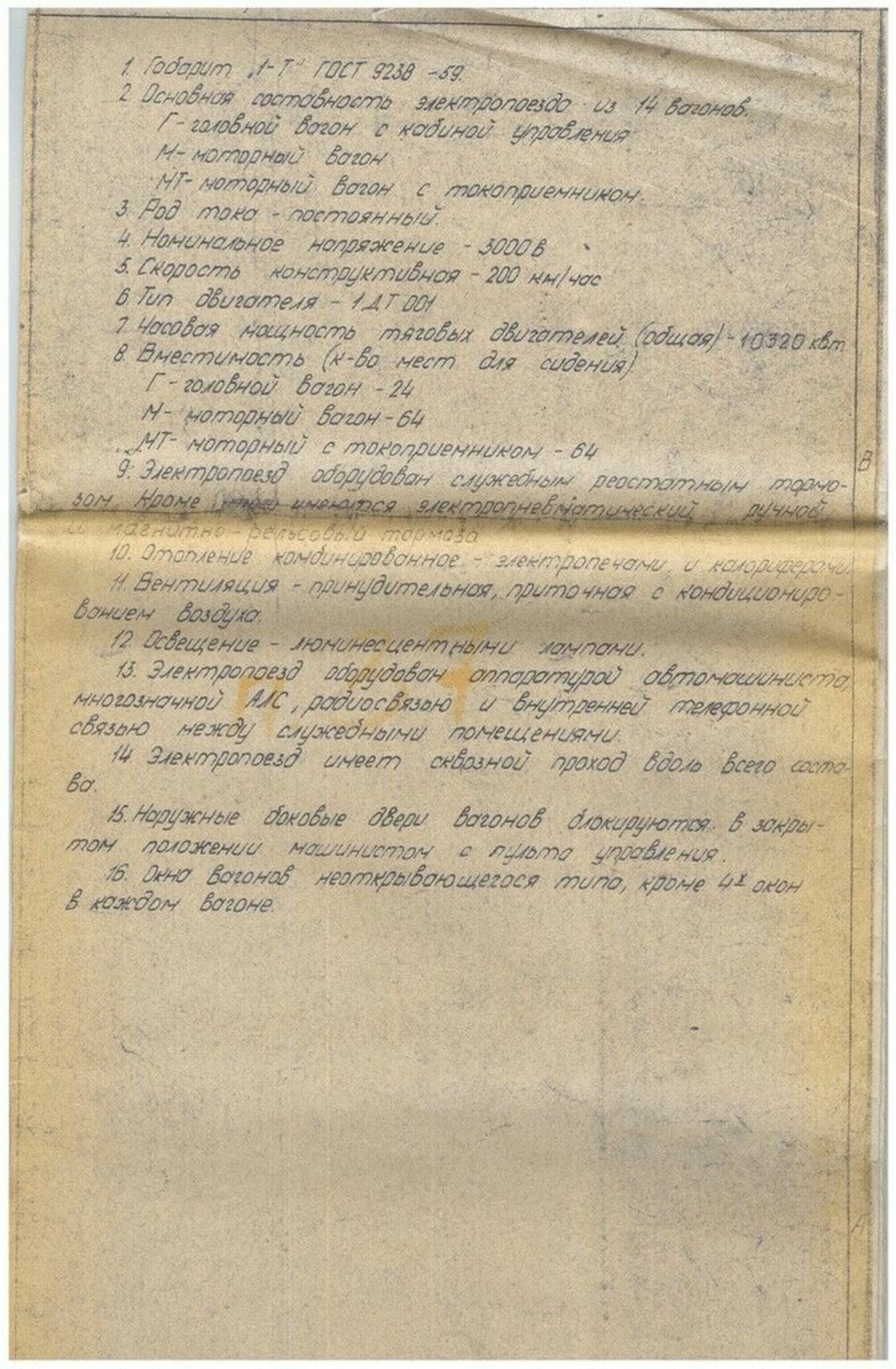
In 1969 the Riga Carriage Works completed the design of a fourteen-car electric train. The head cars were made without a motor to better fit the train into curves, as well as to install speedometer sensors on them. Construction was completed in 1973–1974. The new electric train was designated ER-200.
The bodies of the train cars are made of aluminum alloys — pressed sections and corrugated sheets. The shape of the head part was chosen based on the minimum aerodynamic drag and the plant's capabilities when working with aluminum.
The undercarriage equipment is equipped with bulwarks for better aerodynamics and to protect the undercarriage equipment from damage by objects raised by air currents when the train moves along the track. Exit from the cars is provided only on high platforms. Passengers are provided with aircraft-type seats that can be rotated by 180 degrees, and therefore passengers always sit in the direction of the train's movement.
The length of the car bodies was 26,000 mm, the width was 3,130 mm. The head cars are equipped with an automatic СА-3 coupling, and the inter-car couplings are of the Scharfenberg type. The traction electric motors are mounted on the bogie frames and, via a rubber-cord clutch and a single-stage gearbox, drive the wheel pairs with a diameter of 950 mm.
The wheelbase of the bogie is 2,500 mm, the total wheelbase of the car is 21,300 mm. The electric train had a rheostatic electric brake, a disc brake (except for the first bogie of the lead car) with electric and electropneumatic control, and magnetic rail brakes for emergency braking.
The motor cars of the electric train had 64 seats, and the head cars had 24 seats. The actual weight of the head car is 48.5 t, the motor car without pantograph is 56.3 t, the motor car with pantograph is 58.5 t.