Today the museum is open from 10:00 to 18:00

Map

Exhibit description

Freight two-section diesel locomotive TE3 1001

The mid-1950s marked a major initiative in the USSR’s railway network to replace steam locomotives with “progressive types of traction” — diesel and electric. For train operations on sections and entire railway lines being converted to diesel traction, a large number of new, powerful diesel locomotives were needed to replace steam locomotives. The TE1- and TE2-class vehicles produced in the USSR in the second half of the 1940s no longer met these requirements — more powerful locomotives were needed.

The TE1- and TE2-class diesel locomotives produced in the USSR in the second half of the 1940s no longer met these requirements — more powerful locomotives were needed.

New Class

In 1952–1953, a new model of mainline diesel locomotive was designed at the Kharkiv Locomotive Works and were given the class designation TE3. This was a two-unit locomotive consisting of two identical six-axle units. Each unit was equipped with a ten-cylinder 2D100 two-stroke 2,000 hp diesel engine of a highly original design (with two crankshafts and opposed pistons), based on a diesel engine by American company Fairbanks-Morse thatwas installed on watercraft.

The TE3 was equipped with a ten-cylinder two-stroke diesel engine with two crankshafts and opposed pistons, based on an American engine for watercraft.

The diesel locomotive’s power transmission was electric (direct current). The MPT-99/47 traction generator had continuous power of 1,350 kW. The EDT-200 200 kW continuous-power traction engines each had support-axle suspension. The power transmission was automatically controlled by a special electromagnet system for regulating the traction generator excitation. All the main electrical equipment was designed and manufactured at the Electrotyazhmash Plant in Kharkiv.

The first TE3-model diesel locomotive was built at KhPZ in early 1954. The positive results seen from this locomotive, even before testing was officially finished, meant that it was put into series production in 1955. From the following year, the class TE3 diesel locomotive was put into production at three plants simultaneously. As well as at KhPZ (where diesel locomotives no. 001 and above were built), the same locomotive was built at the Kolomna Locomotive Works (no. 1001 and above) and the Luhansk (Voroshilovgrad, no. 2001 and above) Locomotive Works.

Numerous changes and improvements were made to the locomotive’s design throughout series production. From 1957, there was a new control cab design (the same as the TE7 diesel locomotive); from 1959, buffer gears were no longer installed on the front of the body and from 1962, there was a new truck design, etc.

Mass Production

Class TE3 diesel locomotives were produced for 20 years, and the total number produced at each plant was: the Kharkiv Locomotive Works (the Malyshev Factory) — 598 units (no. 001–598 from 1954 to 1962); the Kolomna Locomotive Works — 406 units (no. 1001–1406 from 1956 to 1963); the Luhansk (Voroshilovgrad) Locomotive Works — 5805 units (no. 2001–7805 from 1956 to 1973).

As indicated above, from 1963, class TE3 diesel locomotives were produced at the Luhansk Locomotive Works only. The total number of vehicles built over two decades at three plants came to 6,809. Variants based on the TE3 were also series produced: the class 3TE3 diesel locomotive (three-unit variant) and the class TE7 (passenger transport variant).

The three plants built 6,809 locomotives over 20 years, making it the most commonly produced mainline diesel locomotive in the USSR.

As a result, class TE3 locomotive became the most common mainline diesel locomotive on Soviet railways. They were in operation on practically every rail network of the Ministry of Railways — from Brest to the Far East and from Arkhangelsk to the South Caucasus and Central Asia. TE3 diesel locomotives were gradually removed from the inventory beginning in the 1980s and ending in the 1990s.

In the 1970s-80s, TE3 diesel locomotives were the main class of diesel locomotive driving freight traffic on the Oktyabrskaya Railway. The last vehicles of this class were decommissioned here in the early 1990s.

The TE3 1001 diesel locomotive displayed in the museum was built in 1956 and was the first locomotive of this class built at the Kolomna Locomotive Works (and the first diesel locomotive built by this plant after the war). After construction, it was delivered to the Moscow-Kursk-Donbas Railway. In 1957, it was transferred to the South-Eastern Railway, then in 1958, to the Privolzhskaya Railway, and in 1960, to the North Caucasus Railway.

Parameters

Technical
specifications

General data
Year of issue
1956
Number of locomotive sections
2
Axial formula
2 (3о-3о)
Length, mm
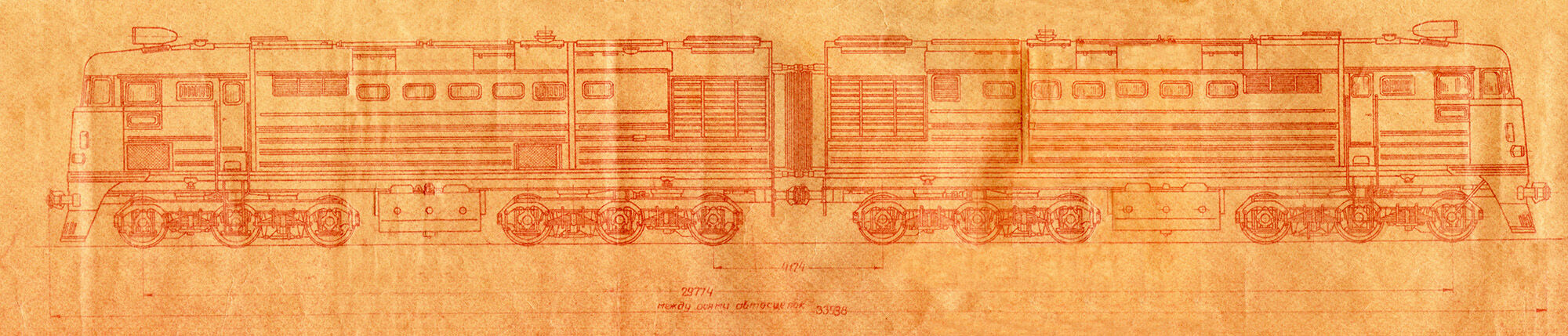
33,948
Full wheelbase, mm
29,774
Service weight of two sections, t
252
Load from moving axle on rails, t
21
Fuel reserve, kg
2 x 5 440
Diameter of moving wheels, mm
1,050
Design speed, km/h
100
Main diesel
Diesel type
2D100
Number of cycles
2
Nominal power, hp
2,000
Nominal speed per minute
850
Cylinders
Location
In-line
Working speed per minute
1700
Diameter, mm
207
Piston stroke, mm
2 x 254
Quantity of cylinders
10
Quantity of pistons in cylinders
2
Main generator
Type
MPT99/47
Nominal power, kW
1,350
Maximum voltage, V
820
Current is long lasting, A
2 455
Short-term current, A
4,000
Traction electric motor
Type
EDT200b
Quantity
2 х 6
Nominal power, kW
206
Current, A
800
Maximum voltage
410 В
Maximum rpm
2 200

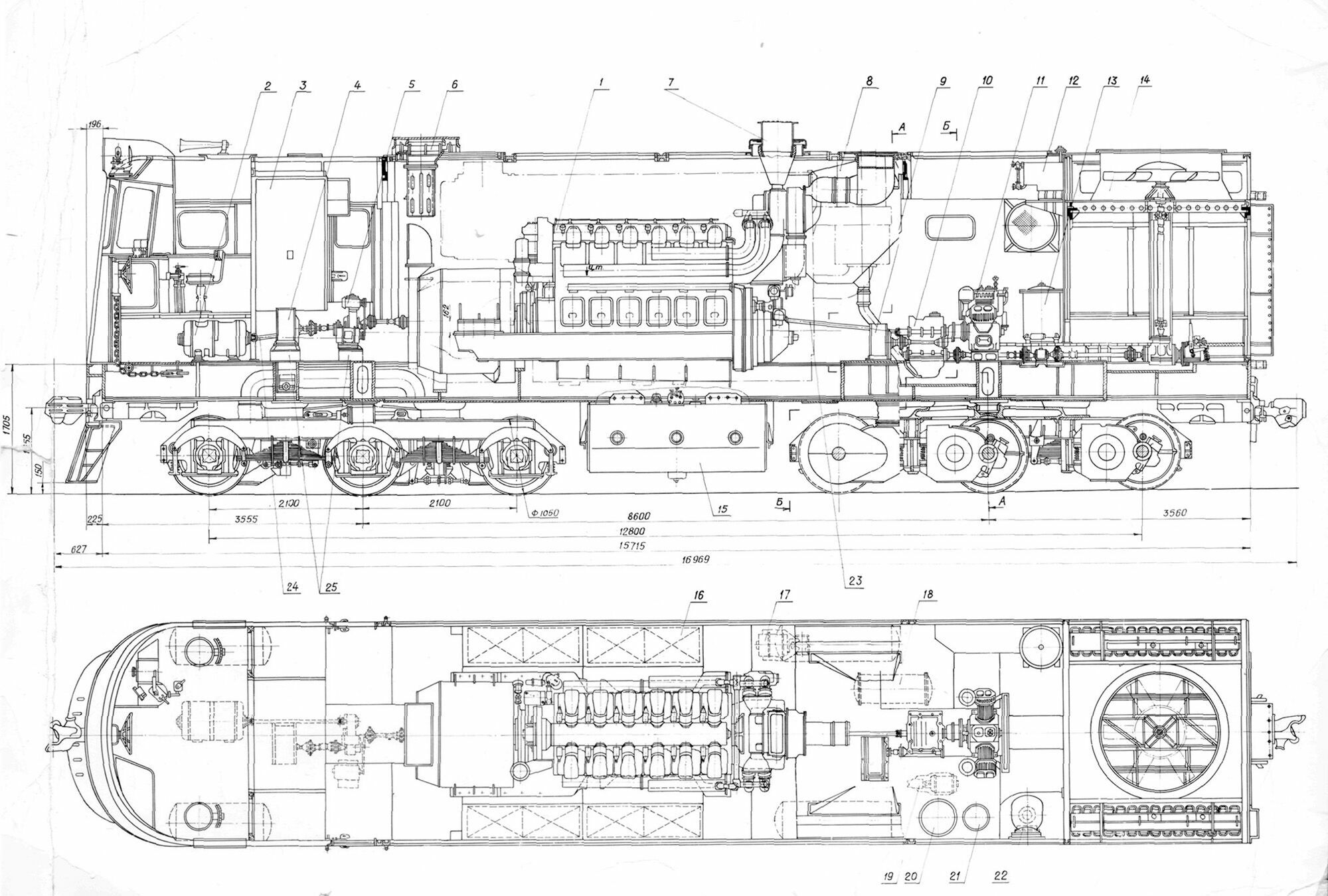
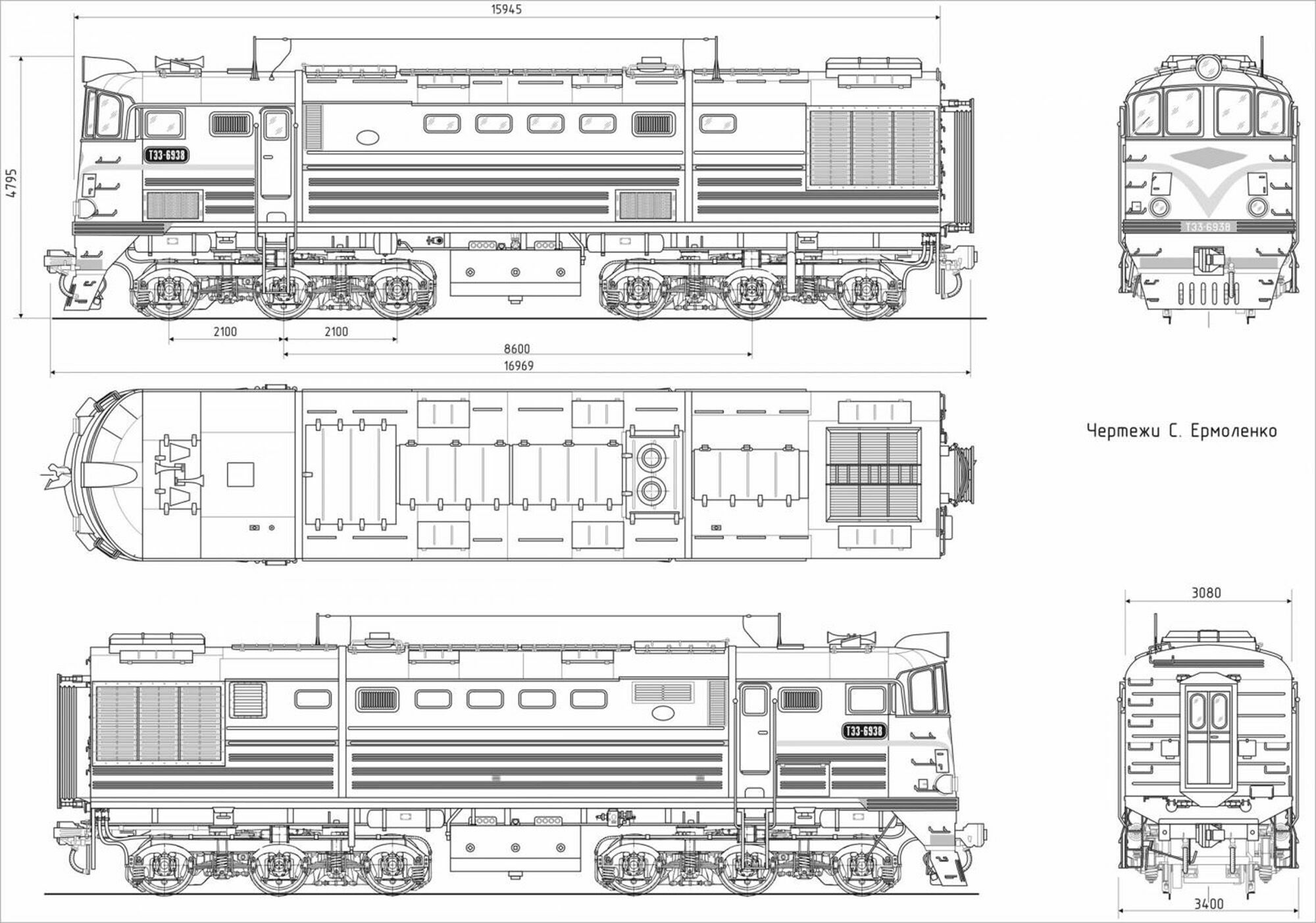
Drawings
and diagrams

History

Chronology

  1. Early 1950s The Kharkiv Locomotive Works and the Kharkiv Diesel Locomotive Electrical Equipment Plant start designing a new model mainline diesel locomotive — the class TE3.
  2. 1952–1953 The new model of mainline diesel locomotive is built at the Kharkiv Locomotive Works and given the class designation TE3.
  3. 1955 TE3 locomotives are put into series production at the Kharkiv Locomotive Works.
  4. 1956 The Kolomna Locomotive Works and the Luhansk (Voroshilovgrad) Locomotive Works begin production of the class TE3. TE3 1001 is the first diesel locomotive produced at the Kolomna Locomotive Works after the war.
  5. 1957 The new control cab design (the same as the TE7 diesel locomotive) is launched.
  6. 1959 Buffer gears are no longer installed on the front of the body of the TE3.
  7. 1962 The TE3 receives a new truck design. The Kharkiv Locomotive Works, renamed into the Malyshev Factory by that time, concludes production of class TE3 diesel locomotives. In total, 598 locomotives were built, no. 001–598.
  8. 1963 Production at the Kolomna Locomotive Works concludes. In total, 406 locomotives were built, no. 1001–1406.
  9. 1973 The Luhansk (Voroshilovgrad) Locomotive Works builds the last class TE3 diesel locomotive. In total, 5,805 locomotives were built, no. 2001–7805.
  10. 1980-е Decommissioning of class TE3 diesel locomotives begins.
  11. 1990-е Decommissioning of class TE3 diesel locomotives is completed.
  12. 1996 Diesel locomotive TE3 1001 arrives at the museum from the Krasnodar Depot of the North Caucasus Railway.