Today the museum is open from 10:00 to 18:00

Map

Exhibit description

Freight electric locomotive VL82M-065

Two systems are needed

At first, the electrification of railways in the USSR followed the path of using direct current with a voltage of 1,500 and 3,000 V due to the simplicity of regulating the speed and traction of the locomotive. However, this requires a very high current, up to 2,500 A, a reinforced copper contact wire and powerful power substations. The development of rail transportation required the use of alternating current, which made it possible to increase the voltage to 25 kV and use it without conversion at an industrial frequency of 50 Hz.

With the advent of two current systems, it was necessary to solve the issue of organizing the movement of trains through junction points. There are two ways to solve this issue. In the first, tracks are arranged at the junction station on which it is possible to switch the type of current, but this requires a change of locomotive. The second uses a locomotive capable of operating on both current systems and passing the joint along a dielectric insert.

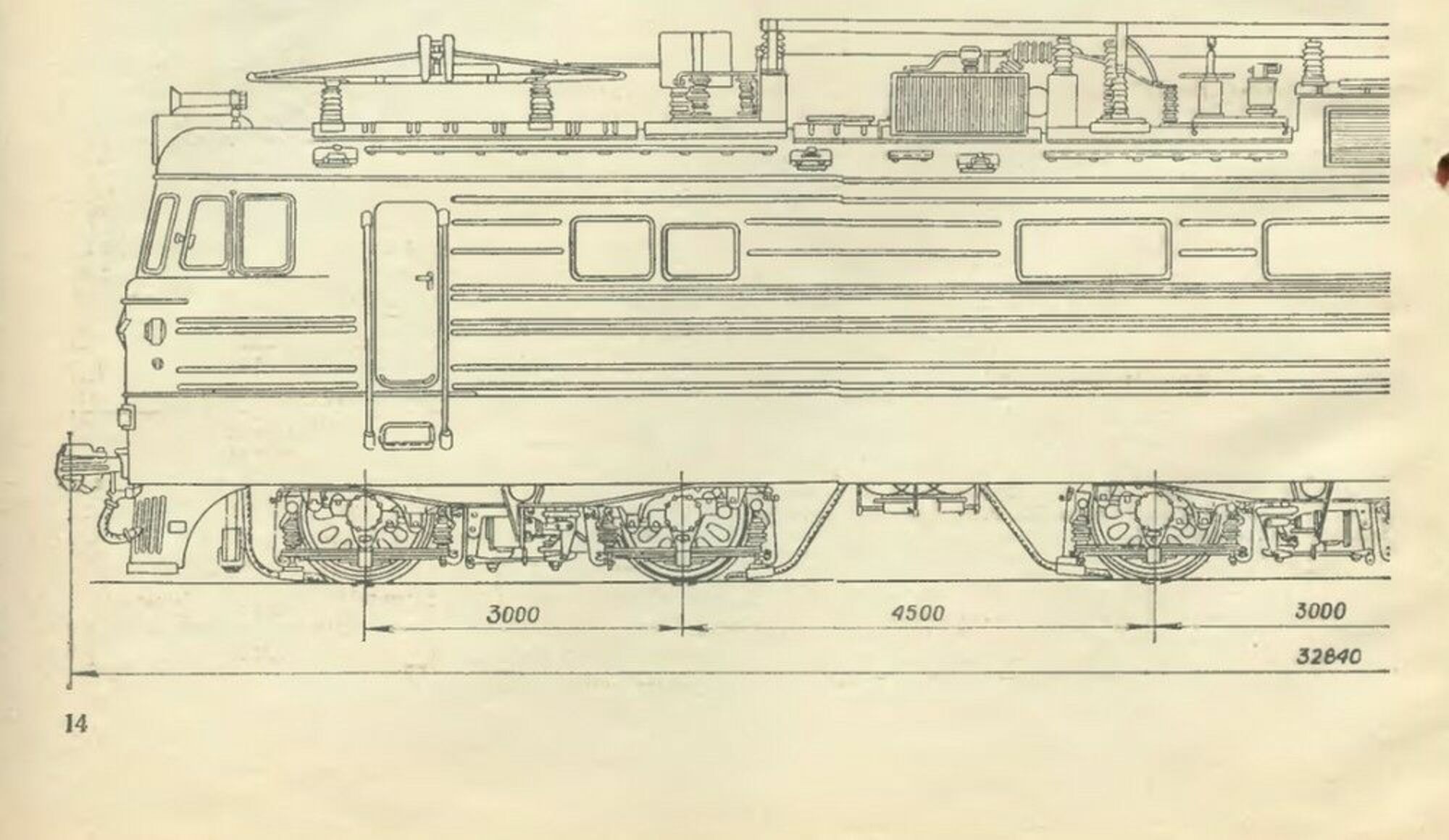
The VL82M electric locomotives had the same body, control cabins, and bogies as the VL80K AC locomotives. These are DC electric locomotives with transformer-rectifier devices for operation under alternating current, for which a step-down transformer is installed on each section. Each axle was driven by six-pole traction electric motors (TEM). For their cooling, two motor-fans were installed on each section.

Both sections of the electric locomotive had identical electrical circuits and could operate on a multiple-unit system. When working on alternating current, the voltage was supplied to the traction motor through a step-down transformer and a rectifier unit. On direct current, the voltage was supplied directly to the traction motor circuits. In both cases, the voltage at the motor terminals was regulated by rheostats. The locomotive's electrical circuit allowed the use of rheostat braking.

The VL82M series electric locomotives were used at the Kupyansk depot (Southern Railway), Krasnoufimsk depot (Gorky), Mineralnye Vody depot (North Caucasian) and Volkhovstroy depot (Oktyabrskaya). On the October Railway, these locomotives hauled trains from Vyborg to the border with Finland.

As the VL82M series electric locomotives entered service, the VL82 locomotives were transferred to work with passenger trains due to their tendency to skid (due to insufficient adhesion mass).

Parameters

Technical
specifications

Current type
Alternating/Direct
Supply voltage, kV/Hz/V
25/50/3000
Number of sections
2
Traction transformer
ODCE-4000/25
Traction electric motor
NB-407B
Electric motor voltage, V (traction motor)
1,500
Electric motor power, hourly, kW
720
Rated current, hourly, A
510
Anchor speed, rpm
890
Electric motor weight, kg
4,500
Number of electric motors (traction motor)
4+4
Rectifier unit
VUK-6 700
Number of rectifier valves (traction motor)
240
Traction force of hourly mode, kgf
42,400
Traction force of long-term mode, kgf
40,000
Speed ​​of hourly mode, km/h
51.0
Speed ​​of long-term mode, km/h
51.6
Maximum speed, km/h
110
Length, mm
20,800
Height, mm
5,100
Width, mm
3,160
Wheel diameter, mm (traction motor)
1,250
Minimum radius of passable curves, m
125
Weight of electric locomotive, t
200

Drawings
and diagrams

History

Chronology

  1. 1957 The draft design of the first dual-system locomotive was created in 1957 by the Design Bureau of the Central Train Station of the Ministry of Railways (Design Bureau of the Main Directorate of Locomotive Facilities of the Ministry of Railways). To create a new type of locomotive, the VL61 AC electric locomotive was selected for conversion. At the end of 1963, the Design Bureau of the Central Train Station of the Ministry of Railways, under the supervision of Chief Engineer Zbrodin, converted the first VL61-004 electric locomotive. The converted locomotive received the VL61D series (Vladimir Lenin, type 61, dual-system). After testing this locomotive, all the remaining 11 electric locomotives of this series were converted to dual-system at the Zaporozhye Electric Locomotive Repair Plant in 1964 and 1965. Subsequently, these electric locomotives served the Mineralnye Vody - Kislovodsk section.
  2. 1964 The successful implementation of this project and the need for such locomotives prompted the resumption of the design and manufacture of such electric locomotives at VElNII (All-Union Scientific Research and Design Institute for Electric Locomotive Construction) and the Novocherkassk Electric Locomotive Plant (NEVZ). In 1964, the special design bureau of VElNII developed a technical design for an eight-axle, two-section, dual-power freight electric locomotive. In July 1966, NEVZ built the first two electric locomotives, VL82-001 and -002, which were designed to operate on 25 kV alternating current with a frequency of 50 Hz and 3 kV direct current.
  3. 1968 Based on the results of tests conducted on the North Caucasian Railway, NEVZ built another 22 VL82 series electric locomotives by 1968.
  4. 1972 Since 1972, the Novocherkassk Electric Locomotive Plant produced an improved version of the electric locomotive, which received the designation VL82M (modernized). A total of 67 such locomotives were built by 1979.
  5. 1977–1980 Initially, the VL82 electric locomotives were used on the Svecha - Buy - Yaroslavl section of the Northern Railway, and after the construction of the docking station, they were transferred to the Kupyansk depot of the Southern Railway. In 1977-1980, most of the locomotives were transferred to the Mineralnye Vody depot of the North Caucasian Railway.
  6. 1977 The VL82M-065 electric locomotive was built by the Novocherkassk Electric Locomotive Plant in 1977. He worked on the October Railway at the Vyborg depot, where he serviced the international crossing between the USSR and Finland. He came to the museum from the Volkhovstroy depot of the October Railway.