Today the museum is open from 10:00 to 18:00

Map

Exhibit description

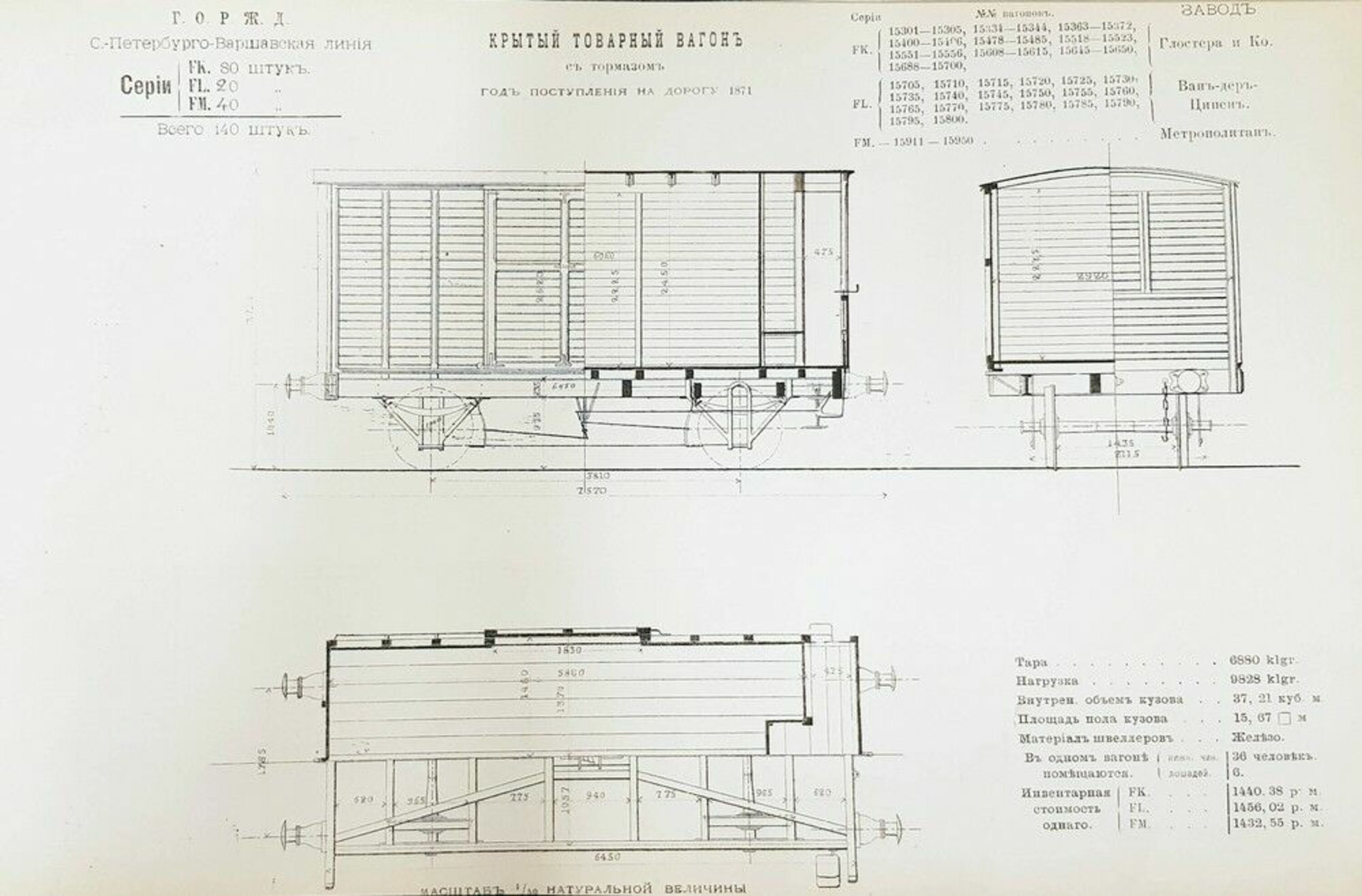
Pre-Standard Covered Goods Wagon No. 584 032

By the 1860s, the rail industry in Russia had entered a period of rapid growth. In the 19th century, most railways in Russia were privately owned and could order their own rolling stock as needed. During this period, the Russian government encouraged the purchase of cars and steam locomotive from within Russia rather than abroad. In this context, many engineering plants focused on building cars, as the goods wagons of the time were small, had a minimal number of metal parts and were simple to manufacture.

During the development of rail communication in the 19thcentury, the need for covered goods wagons for the safer transport of goods became apparent.

At the same time, in the 1860s, the desirability of the ability to transport freight between different railways without the need for unloading and reloading was clear. In 1869, the First General Congress of Railway Representatives was held. Eighteen railways sent representatives. The congress laid the foundations of the transport of freight between railways with different owners without unloading, and also established the minimum common standards for rolling stock required to make this possible.

The Introduction of Standards

To facilitate the transport of troops, in 1875, the Ministry of Railways stipulated “standard dimensions” for any new orders of railway cars. Later, adherence to the uniform dimensions (the standard) became stricter, and the variety of wheelsets, axleboxes and buffers gradually reduced. This made it possible to introduce unloading-free connections on all railways with a gauge of 1,524 mm in 1889.

The Ministry of Railways introduced the  “standard dimensions” in 1875 to facilitate the transport of troops.

The earlier car designs were displaced by the mass delivery of cars conforming to the unified norms, known as “normal”, or standard cars. According to various sources, by 1906, the fleet of standard-type cars made up 90–98 % of the goods wagon fleet, and the majority of the remainder were 1873 state-type cars. The “withdrawal of dilapidated and poorly designed old-type cars” began in July 1936, including those with wooden dead-wood.

The frame of the car on display was designed for operation on a 1,435-mm-gauge track and converted to a 1,524-mm gauge. Initially, its frame had metal channels and transverse I-section equipment bars, and the other bars (buffer, longitudinal equipment, diagonal and intermediate transverse) were made of wood. The wooden dead-wood was reinforced with metal box beam.

Parameters

Technical
specifications

Base, m
3,645
Год постройки
Unknown
Number of axes
2
Frame length, m
6,170
Load capacity, t
16,5
Body
Wooden
Frame
Wood, metal

Drawings
and diagrams

History

Chronology

  1. 1892 The Russian Empire codifies railway norms and standards.
  2. 1915 The Russian army occupies parts of Austrian Galicia and local railways.
  3. 1936 Modernisation of the freight railway fleet begins.
  4. 1987 Car no. 584 032 arrives at the Russian Railway Museum from the Oktyabrskaya Railway.