Today the museum is open from 10:00 to 18:00

Map

Exhibit description

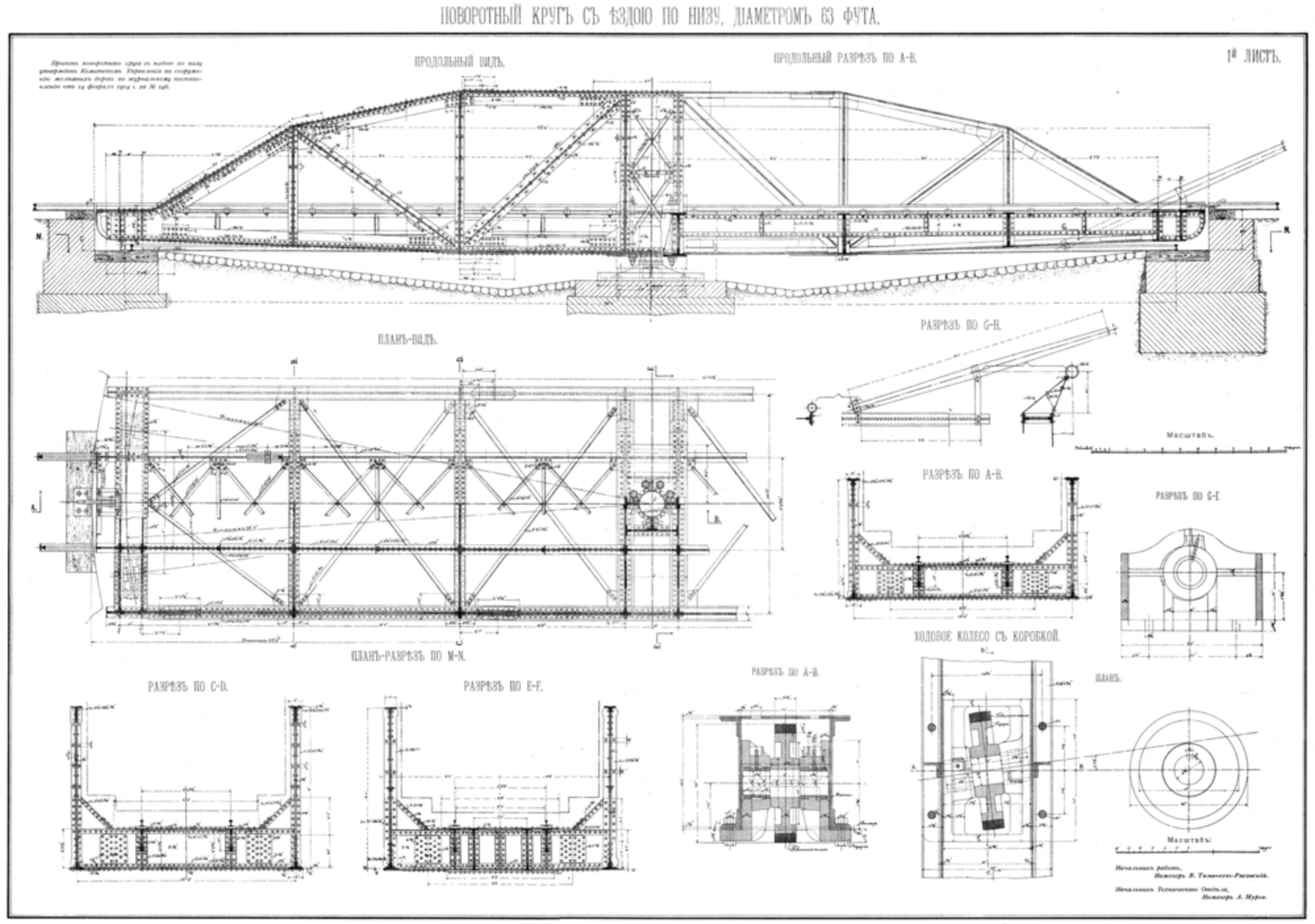
Railway turntable Balanced pony-truss turntable

Facing forward

When driving a train, locomotives must be at the head of the train and turned as provided for by their design. Steam locomotives turned forward with a smokestack, diesel locomotives — a radiator. Electric locomotives and some types of diesel locomotives, equipped already in Soviet times with two control posts, did not need turnaround points.

In most cases, a turntable was built near fan depots and served to drive locomotives into stalls. In addition to circles, if space allowed (territories for the construction of railways were bought from owners), turning triangles, loops and even in rare cases pentagons were arranged.

By design, there were two types of circles: balanced and unbalanced. In the first type, the locomotive was balanced by moving it along the track, as if on a swinging beam, and then turned around with the help of a team of loaders. For this purpose, hoists were installed at the ends of the turning truss. How this happened can be seen in the feature film "Mikolka the Steam Engine" (Belarusfilm, 1956). The unbalanced turning circle rested on wheels located at the ends of the truss — a separate track was laid for these wheels.

The turning circle trusses were also of two types: with a ride below and with a ride above. A circle with a ride on top required a deep pit to install a parabolic truss. Sometimes, excavation work was impossible due to shallow groundwater.

Therefore, with a further increase in the length of the circle, they switched to trusses of a different design, close to a bridge span: the bending moments in the beams under the rails were taken by the side diagonal trusses. A truss with a design of a ride on the bottom did not require a deep pit.

As the weight of the circle and the locomotives themselves increased, they began to use different types of turntables. Much later, they began to use an electric drive, although the first experiments on its use were conducted as early as 1907 on a circle with a diameter of 19.5 m at the Zhmerinka depot of the Southwestern Railway.

By design, there were two types of trusses: with a bottom ride and with a top ride.

The circle truss consisted of two solid walls of riveted construction, spaced apart by the width of the track. Rails were laid on top of them. The walls had a parabolic profile at the bottom and were connected to each other with cross ties. In the middle, they were riveted together with an iron box with a support plate, which transferred the entire weight of the locomotive located on it to a single spherical support.

The use of a parabolic section truss required a deep pit for its installation. And as the length of the truss increased, so did the depth of the pit. With a circle length of 19.5 m, the depth of the pit reached 2.5 m. With a high groundwater level, this caused great difficulties with the construction of a foundation for the central support. Therefore, with a further increase in the length of the circle, they switched to trusses of a different design, close to the bridge span. With this design, the bending moments in the beams under the rails were taken on by the side diagonal trusses.

A truss with a bottom-riding design did not require a deep pit. The supports on which the circles rotated were of different designs, including hydraulic ones. But in any case, the main support was spherical.

Parameters

Technical
specifications

Drawings
and diagrams

History

Chronology

  1. 1900s A typical top-riding circle was the Sellers turntable. The length of the first circles did not exceed 13 m. As the power and size of steam locomotives increased, circles of larger diameters began to be installed. Since the early 1900s, circles of 64 feet, or 19.5 m, in length have already begun to be used.
  2. 1907 As the weight of the circle and the locomotives themselves increased, various types of circular turners began to be used. With the expansion of electrification, they began to use an electric drive. The first experiments on its use were conducted back in 1907 on a circle with a diameter of 19.5 m in the Zhmerinka depot of the South-Western Railway. Externally, the presence of an electric drive was manifested in the installation of a U-shaped truss above the axis of rotation of the circle, carrying a drum with sliding contacts inside to transmit electricity to the engine. A control post in the form of a booth also appeared on the circle.
  3. 2016 A replica of a turntable with a bottom ride and a diameter of 22 m (21,950 mm) is installed in the museum. The object was received from LSS-Varshaskaya LLC on September 30, 2016.