Today the museum is open from 10:00 to 18:00

Map

Exhibit description

Passenger railcar AVAАММОТ 758

AVАММОТ Passenger Railcar

The AVАММОТ 758 railcar is a self-propelled car for transporting passengers, equipped with a diesel engine. It was built at the Malaxa plant in Romania in 1939 and made its way to the USSR during the Great Patriotic War as spoils of war. For a long time, it was operated on the Oktyabrskaya Railway as the official car of the head of the railway. Property of the Central Museum of Railway Transport of Russia.

The railcar is a self-propelled car for transporting passengers, equipped with a diesel engine.

Development History

Serious improvements made to diesel engines let the 1920s and 1930s become a time of mass introduction of diesel engines on railways around the world.

As a result, many countries began to design rail motor cars (railcars) and diesel trains, equipped with high-speed and light-weight diesel engines, which were more economical, had a better engine life, and were more efficient than petrol carburettor engines.

The new rail motor cars were founded on the same concept. They were high-speed (120–160 km/h), all-metal diesel cars with sleek, aerodynamic shapes, designed to carry wealthy first and second class passengers. Passengers were offered an unprecedented level of comfort — soft sofas, an air-conditioning system, and buffets in a dedicated car. Specially designed trucks were developed for high-speed rail motor cars, providing quiet and smooth travel at speeds over 100 km/h, which was quite a feat for engineers of the time.

Rail motor cars reached speeds
of 120–160 km/h. Passengers were offered an unprecedented level of comfort — soft sofas, an air-conditioning system and buffets in a dedicated car.

Unsurprisingly, high-speed railcars became of the symbols of technological progress on the railways of the time. Among the most emblematic of this kind of rolling stock are the Zephyr (USA) and Fliegender Hamburger (Germany) diesel trains and the MAN (Lithuania), Luxtorpeda (Poland), Littorina (Italy), Michelin and Renault (France) railcars.

In the early 1930s, Budapest-based Hungarian engineering plant Ganz developed its own type of high-speed railcar, which was named after Hungarian national hero Árpád. From 1933 to 1940, the plant built 40 Árpád high-speed railcars for the railways of Hungary, Belgium, and Egypt. In 1934, Ganz sold a licence for the manufacture of diesel engines and mechanical transmission to Romanian engineering plant Malaxa in Bucharest.

In 1939, Malaxa began manufacturing its own high-speed railcars, which were almost exact copies of the Hungarian licenced versions. Between 1939 and 1954, 43 of these railcars were produced, numbered from 751 to 793. On Romania’s Căile Ferate Române railways, they were designated as Class 78. Most of them were operated on the Bucharest–Brașov and Bucharest–Constanța lines. Class 78 underwent repeated modernisation throughout its years of service, and its operation in Romania ended in 2010.

43 copies of Hungarian railcars were built in Romania. At least five ended up in Germany and Austria during the war, and two or three were taken to the USSR as spoils of war.

At least five of these railcars ended up in Germany and Austria during World War II. After the end of the war, two (or, according to some sources, three) were taken to the USSR as spoils of war. Their exact fate and whereabouts in 1945–1947 are not yet known.

Museum Exhibit

Railcar AVAАММОТ 758 was built in 1939 at the Malaxa plant in Bucharest, Romania, under the designation 78 759. In the USSR, it was renamed to AVAАММОТ 758 (“avtomotrisa, motornaya” (railcar, motorised), number 758). In 1948, after examination in the rolling stock repair workshops at the Unecha Station on the Belarusian Railway, it was delivered to the Oktyabrskaya Railway, where it was used as the official car of the head of the railway and was known as Ok 1. It operated in this capacity until 1989.

The museum exhibit was used on the Oktyabrskaya Railway as the official car of the head of the railway.

In the 1970s, the railcar underwent major repairs at the Oktyabrsky Electric Car Repair Plant, during which the interior trim was changed. The body was also repaired, which resulted in some changes to its appearance. Due to wear of its mechanical parts and power plant, at the end of its service life, the railcar was being used as a non-propelled car. Since at least 1970, it was based at the Leningrad-Varshavsky Depot, from where it was handed over to the Central Museum of Railway Transport of the USSR at the end of its service life in 1989.

Parameters

Technical
specifications

Plant
Malaxa (Romania)
License of the plant
Ganz (Hungary)
Year of release
1939
Diesel power, l. With.
220
Power transmission type
Mechanical
Axial formula
2 0 – 2
Design speed, km/h
110
Service mass, t
41,4
Diesel type
Malax-Gantz MG-200
Diesel characteristics
Six-cylinder
Number of drive trolleys
1
Transmission
Five-speed
Generator type
DC
Axial gear ratio
1,78
Length between couplers, mm
23 995
Maximum width, mm
2 985
Height from UVGR, mm
3 780
Number of soft seats
24
Number of hard seats
28
Length between couplers, mm
23 995
Voltage, V
24–26
Power, kW
4.5
Location of the diesel engine
Vertical
Kind of diesel engine
Uncompressed
Fuel combustion cycle
Four-stroke
Transmission
Ganz system
Transmission from gearbox to axial gearboxes
Cardan on each axle

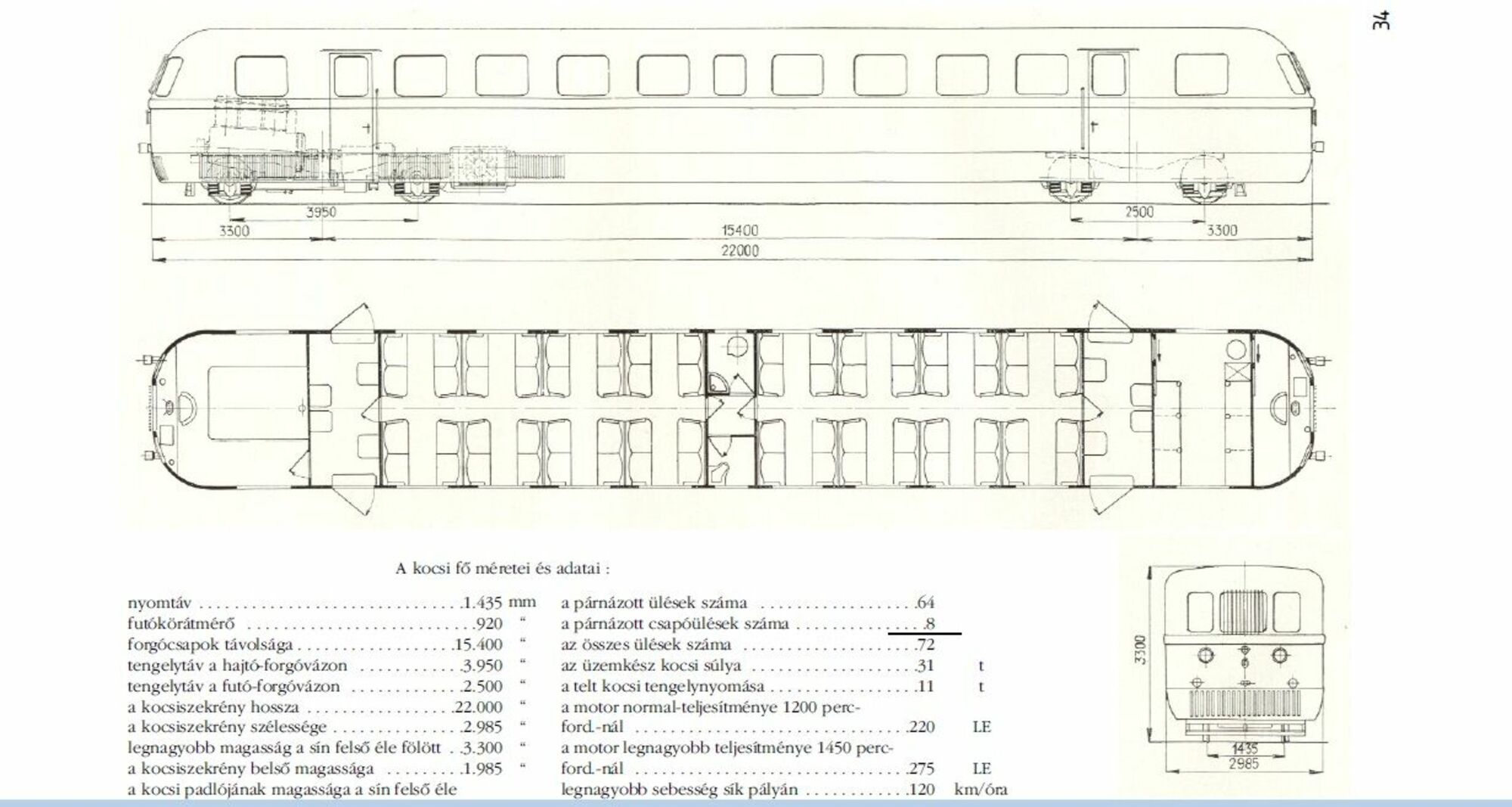
Drawings
and diagrams

History

Chronology

  1. 1930 Hungarian plant Ganz develops the Árpád high-speed railcar.
  2. 1934 Ganz sells a licence for the manufacture of diesel engines and mechanical transmission to Romanian plant Malaxa.
  3. 1939 Production of Class 78 railcars begins in Romania.
  4. 1941–1945 During the Great Patriotic War, a Romanian passenger railcar ends up in the USSR.
  5. 1948 The railcar is named Ok 1 and becomes the official car of the head of the Oktyabrskaya Railway.
  6. 1970s Ok 1 undergoes major repairs, and its appearance changes slightly.
  7. 1989 The railcar gains a second lease on life as a museum exhibit.