Today the museum is closed

Map

Exhibit description

Museum display Evolution of rail tracks

Wheel invention

The problem of moving loads has been with people since ancient times. In the primitive era, muscle power and natural waterways were used to transport heavy loads. The invention of the wheel was a revolution in the field of transport. Over time, there was a need for structures that would facilitate the movement of vehicles.

The development of mining in the 15th–17th centuries required the development of new technologies for transporting ore. In order to increase productivity, miners began to use structures made of scaffolds, sleepers, and carts that had guide rods.

On railways in mines, wooden bases were usually used to secure the rails. The most practical was the transverse base, which was later called a "sleeper" (from the Dutch "support").

The First Road

Over time, the shape of the rail changed: round, angle, mushroom-shaped and wide-bottomed rails were used. An important stage in the history of rail transport in Russia was the creation of the Tsarskoye Selo Railway. By the beginning of its construction, engineers had not yet come to a consensus on the most convenient shape of the rails.

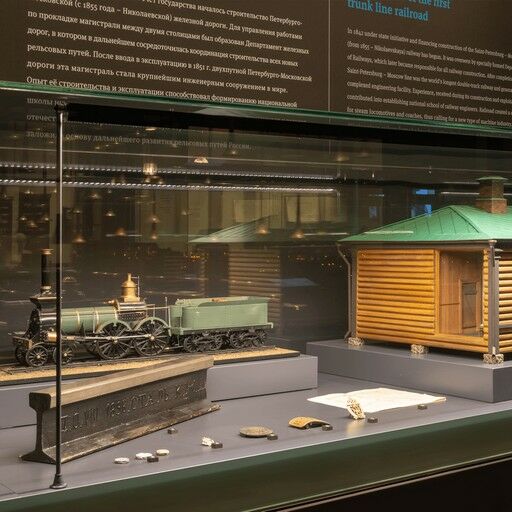
Initially, double-headed rails of a symmetrical cross-section were laid between St. Petersburg and Pavlovsk, so that when the upper head of the rail wore out, it could simply be turned over. In 1869, when laying the second track, they were replaced with modern wide-bottomed ones.

In the 19th–20th centuries engineers actively experimented with the material and design of sleepers. In Germany, metal sleepers became widespread, and in Japan, since the end of the 20th century, plastic sleepers have appeared on some railways.

The creation of modern railways became possible thanks to the experience of many generations, who gradually improved the usual methods of moving heavy loads — from primitive rollers to the first prototypes of wheel guides.

The emergence of railways led to a revolution in the system of transporting people and goods, and it is no longer possible to imagine the modern world without them.

The first semblance of a rail track — a diolk — appeared in Ancient Greece. It was a stone track and made it possible to drag even heavy ships.

Over time, people began to use other materials for building such a track, and later wheels. For example, cast iron or iron were used. The evolution of the track and the railway wheel is clearly presented in the history hall of the museum.

History

Chronology

  1. 16th century But one of the closest prototypes of the modern railway track were wooden rails that appeared in the mines of Germany and neighboring regions in the 16th century. At that time, loaded trolleys were moved along wooden rails. Their wheels, as in our time, were made using peculiar ridges (flanges). These ridges prevented the trolleys from frequently derailing.