Today the museum is open from 10:00 to 18:00

Map

Exhibit description

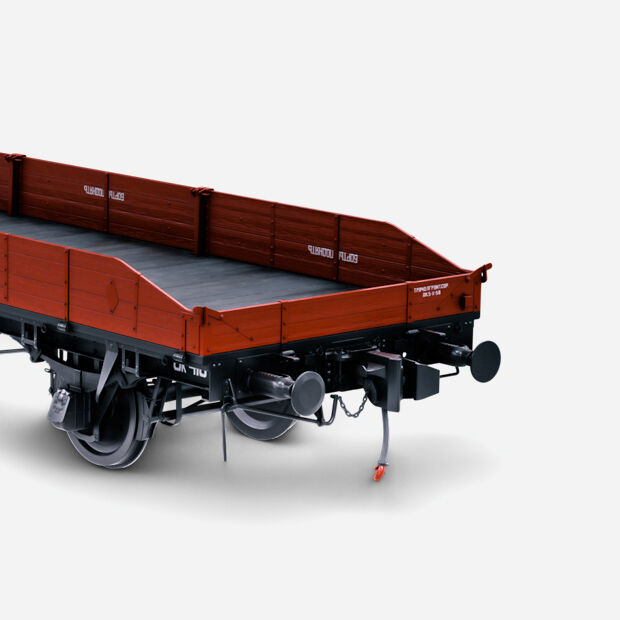
Railway car № 682-3287

One Hundred-Ton Gondola

In 1937 Uralvagonzavod received the task of reworking the design of a one hundred-ton gondola of a solid type — this is what gondola cars were called before the war.

The need to rework the design was explained by the cancellation of deliveries of improved metal, which was originally planned to be used, as well as a change in manufacturer. At the same time, the named after the newspaper "Pravda" had everything necessary for electric welding of car parts.

The six-axle gondola was ready by the beginning of 1938 It received a steel body to withstand the fall of boulders weighing up to 2 tons from a height of 2 m, as well as unloading on wagon dumpers.

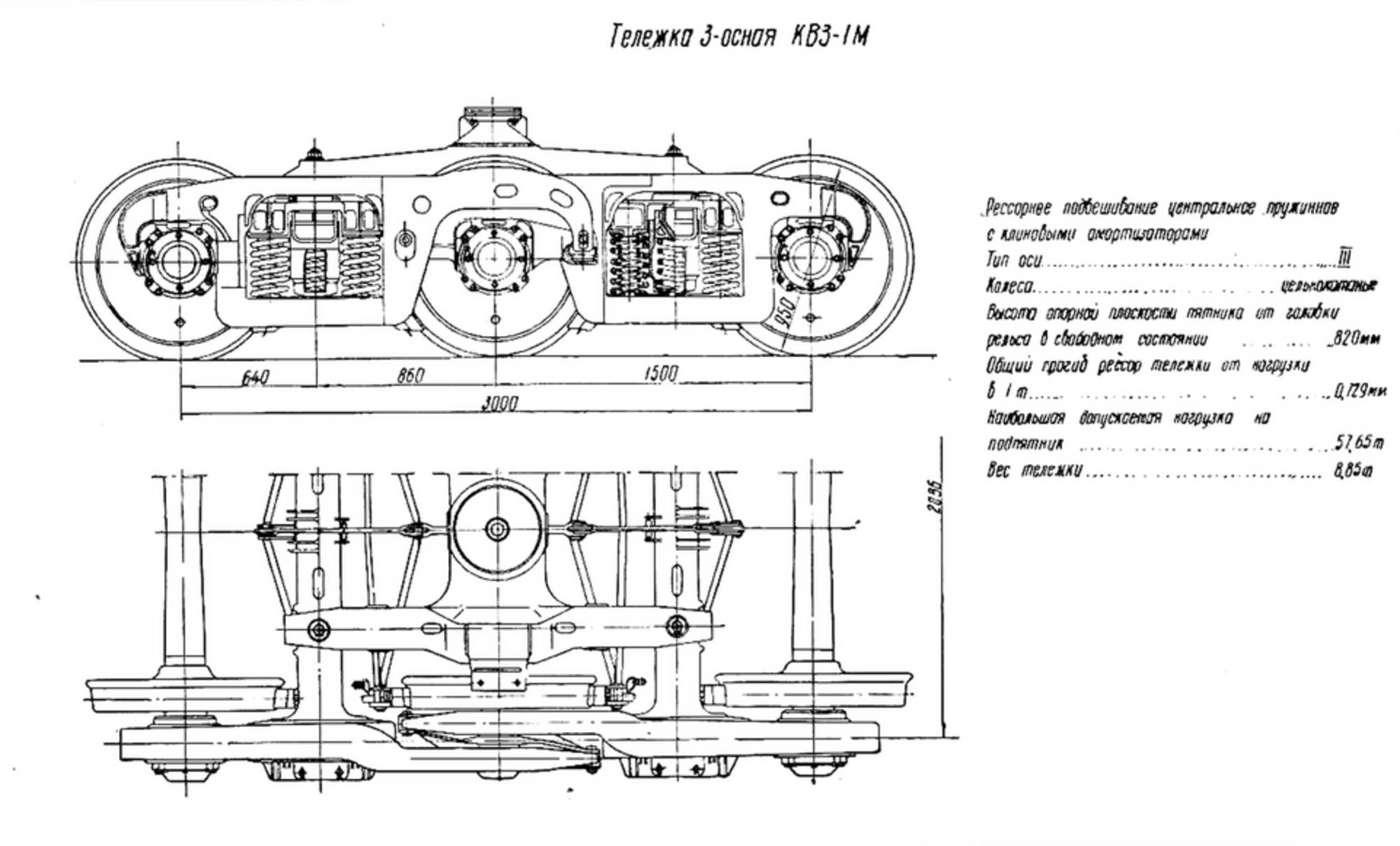
The three-axle bogies were taken from the tender of a steam locomotive of the FD series. Due to the large axle load of 24.2 tons the gondola could not go on mainline railways, where the load was limited to 18–20 tons. The gondola was intended only for special tracks.

The project was accepted, and the Pravda newspaper plant was engaged in the experimental samples. By the summer of 1938, the first gondola cars had undergone a full cycle of tests, including on the car dumper of the Kuznetsk Metallurgical Plant.

Tagil designer Anatoly Aksyonov took part in the experimental work. The Pravda newspaper plant received permission for serial production of six-axle hundred-ton gondolas. 40 units were assembled by the end of 1938, another as many — in the first half of 1941.

After the war, it was decided to build six-axle cars for use on the general railway network of the USSR. In order to specifically increase the load capacity with a limited load from the wheelset, the Kryukov Plant developed in 1954 projects for six-axle and eight-axle gondola cars. They had a carrying capacity of 90 and 115–120 tons, respectively. The plant began to build six-axle gondola cars in 1955.

Museum exhibit

In 1967 the production of six-axle gondola cars was stopped due to the transition to the production of eight-axle cars. Today, six-axle gondola cars are considered an important link in the development of freight transportation in Russia.

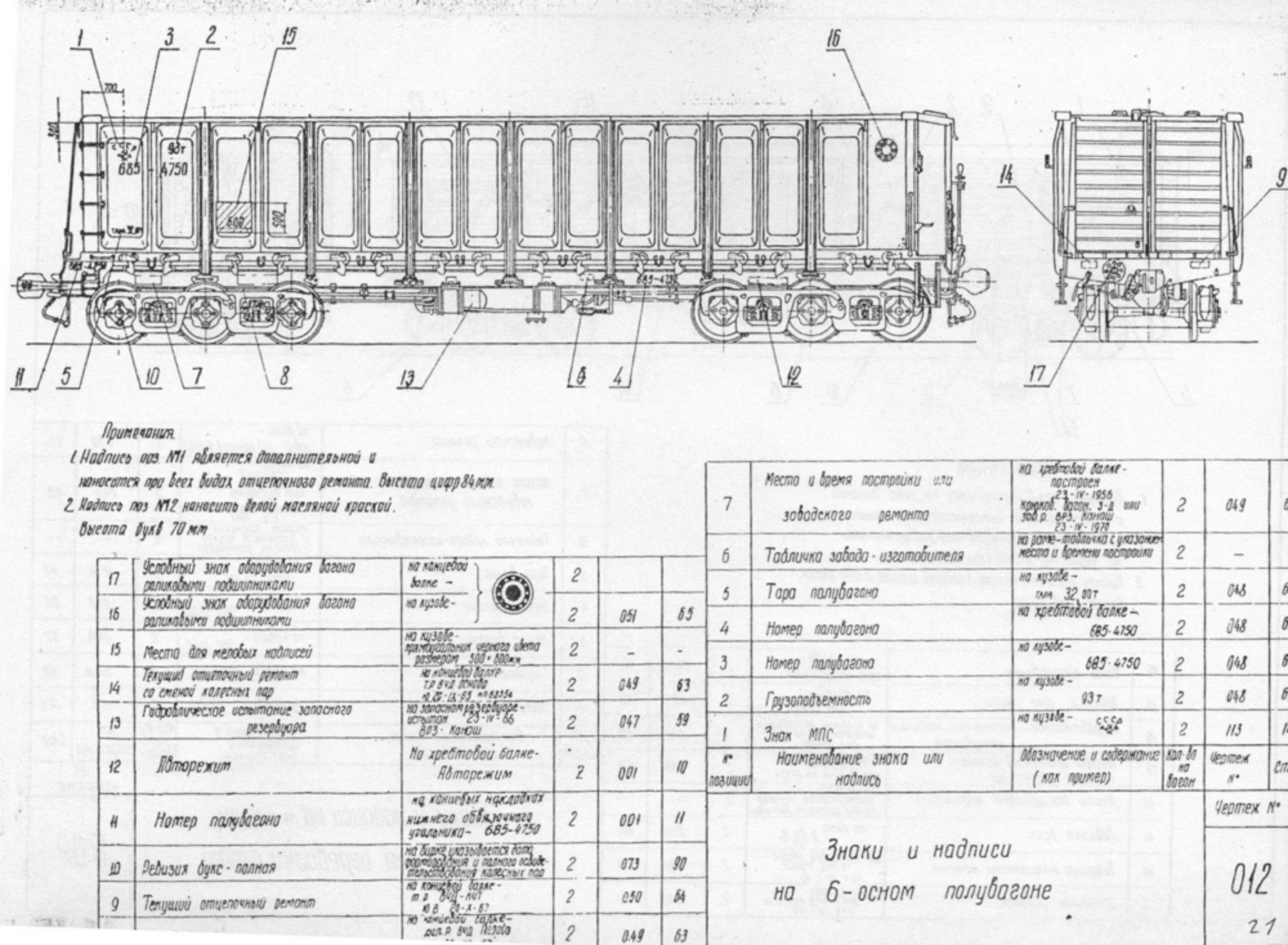
The gondola car No. 682-3287 presented in the museum was built by the Kryukov Plant in 1961. Since the 1970s it was located in the St. Petersburg-Baltic motor car depot. Transferred to the museum in 1997

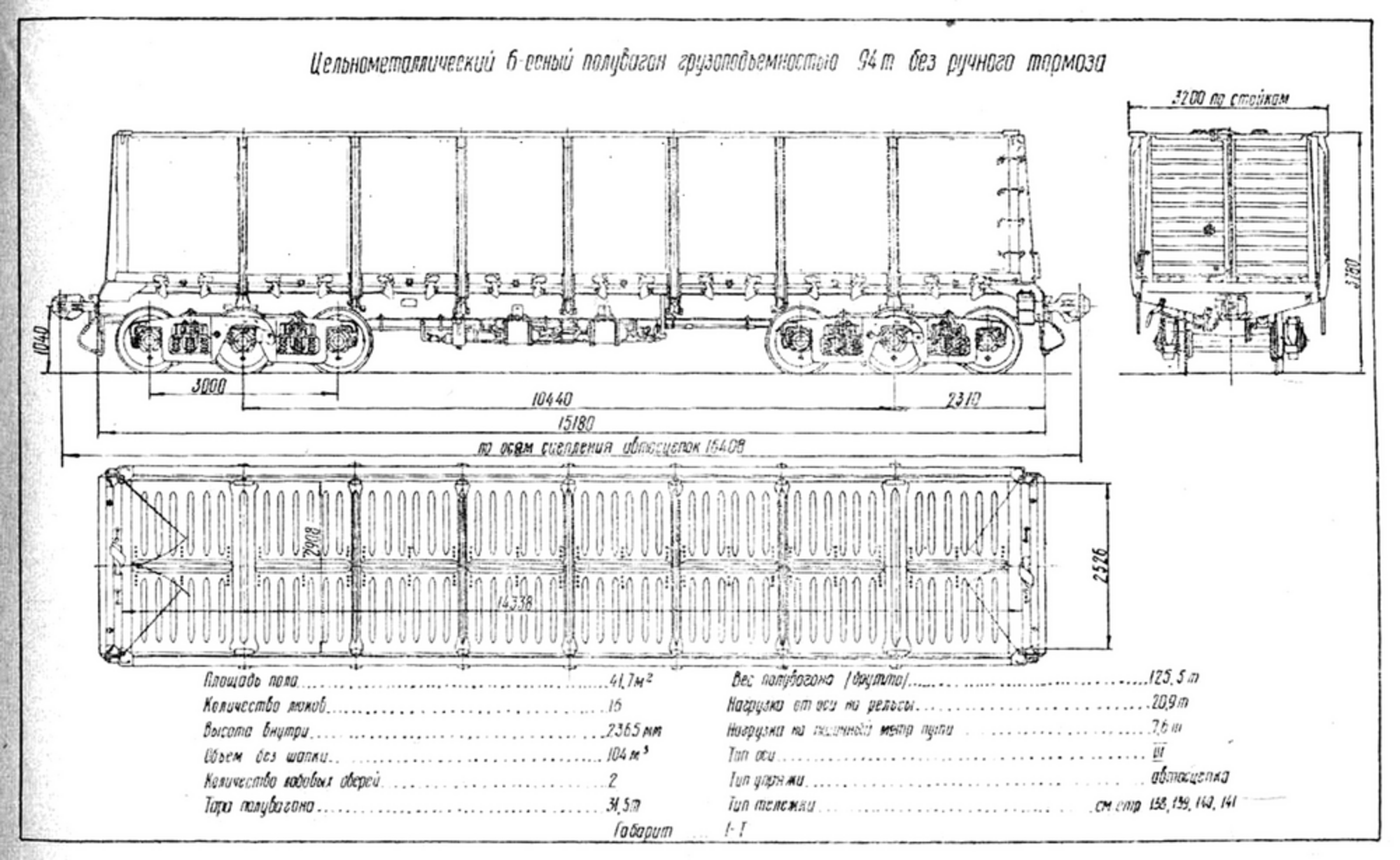
All-metal six-axle self-unloading gondola cars are designed to transport bulk cargo, as well as timber, rolled metal and other long cargo.

Parameters

Technical
specifications

Load capacity, t
93
Tara, t
31.6
Body volume, m³
107
Floor area, m³
40.9
Length along coupling axes of automatic couplings, mm
16,400
Base, mm
10,440
Pressure from axle to rail, t
21.1
Pressure per linear meter of track, t
7.72
Tare coefficient
0.33
Specific volume, m³/t
1,126
Number of unloading hatches
16
Overall dimensions
1-B

Drawings
and diagrams

History

Chronology

  1. 1930s Experience in designing and assembling all-metal cars has been accumulated in Nizhny Tagil since the 1930s. The first task of this kind was received by the Uralvagonzavod Design Bureau back in October 1937. It was necessary to rework the design of a 100-ton solid-type gondola - this is what gondola cars were called before the war. It was intended for industrial use at the Pribalkhash Mining Plant. At that time, the design created by the Central Design Bureau provided for the use of low-alloy steel. The design was riveted, since the production of gondola cars was planned at the Ust-Katav plant, where there was a very weak power plant. But the design had to be redone. There were two reasons: refusal to supply improved metal and a change in the manufacturer. And at the plant im. the newspaper "Pravda" had everything necessary for electric welding of wagon parts.
  2. 1938 By the beginning of 1938, the task was completed. The six-axle gondola received a high-strength steel body to withstand loading with the help of excavators (falling of blocks weighing up to 2 tons from a height of 2 m) and unloading on wagon dumpers. Three-axle bogies were borrowed from the tender of the FD steam locomotive, they were supplied in finished form by the Lugansk plant. The gondola car had a high axle load - 24.2 tons. Because of this, it was intended only for special tracks and could not go on main railways, where the load was limited to 18-20 tons. The project was accepted, and the plant named after the newspaper "Pravda" was engaged in prototypes.
  3. 1938 By the summer of 1938, the first gondola cars had undergone a full cycle of tests, including on the car dumper of the Kuznetsk Metallurgical Plant. The Pravda newspaper plant received permission for serial production of six-axle hundred-ton gondolas. 40 units were assembled by the end of 1938, and the same number in the first half of 1941.
  4. 1954 In the post-war period, it was decided to build six-axle cars that would be able to circulate on the general railway network of the USSR. Six-axle gondola cars made it possible to increase the efficiency of cars by increasing their load capacity and, importantly, the linear load. The load from the wheelset on the rails was limited. In order to increase the carrying capacity, the Kryukov Plant developed in 1954 projects for six-axle and eight-axle gondola cars with a carrying capacity of 90 and 115–120 tons, respectively. The Kryukov Plant began building six-axle gondola cars in 1955.
  5. 1961 The gondola car presented in the museum was built by the Kryukov Plant in 1961. It was transferred to the museum from the St. Petersburg-Baltic motorcar depot in 1997. It had been at the St. Petersburg-Baltic motorcar depot since the 1970s, where it was used for technological purposes.
  6. 1967 In 1967, the production of six-axle gondola cars was discontinued due to the transition to the production of eight-axle gondola cars.