Today the museum is open from 10:00 to 18:00

Map

Exhibit description

Freight steam locomotive SOМ 17 1137

Unlike conventional steam locomotives, where steam is released into the atmosphere after performing useful work in the engine, designs with steam condensation featured special devices that cooled the exhaust steam and converted it into water, which could be reused in the boiler.

In conventional steam locomotives, the exhaust steam is released into the atmosphere, whereas in condensation designs, it is cooled, converted back into water, and reused in the boiler.

The first steam locomotives equipped with steam condensation devices appeared at the end of the 19th century. These were fairly primitive systems, where the steam was cooled by atmospheric air as it passed through special tubes located on the locomotive’s roof or a dedicated frame. These tank locomotives were mainly used for tram and light commuter trains. Such locomotives were built in the USA, England, Germany, and Russia (the Kolomna Locomotive Works’s tank locomotives of types 44, 45, and 96).


The next step in the development of locomotives with steam condensation was the construction in the 1920s of steam turbine locomotives—locomotives equipped with steam turbines. Most of them used steam condensation to improve the efficiency of the steam turbine. The construction of steam turbine locomotives was limited mainly to experimental models.

Henschel & Son

The development of conventional steam locomotives with steam condensation was continued by the German company Henschelz & Son after the construction of several steam turbine locomotives. The company successfully developed a steam condensation system that allowed for the recovery of up to 95% of the boiler water. The first such 1,000 mm gauge steam locomotive was built for Argentine railways in 1930.

In the design of the German company Henschel & Son, up to 95% of the boiler water was recovered.

In 1933, to conduct comparative tests of diesel and steam locomotives, the People’s Commissariat of Communication Routes commissioned the German company Henschel & Son to equip the EG-5224 steam locomotive, which had been built by the same firm in 1921 under a Soviet order, with steam condensation devices.

The new locomotive underwent extensive testing under various climatic conditions for a considerable period: in winter on the Moscow–Kursk Railway, and in summer on the Central Asian Railway. The tests were conducted at different outside temperatures, using both oil and coal heating, and with trains of varying weights. Based on the results, expert opinions were divided: some saw great potential in the new locomotives, while others, particularly specialists from the Research Institute of Traction, considered them to be unpromising.

Opponents of the new project pointed to the high construction costs, the extensive repairs needed, oil contamination of the boiler, and problems at low temperatures.

Opponents of steam locomotives with steam condensation cited the following arguments: high construction costs, more extensive repairs compared to conventional steam locomotives, increased backpressure on the pistons of the steam engine, inevitable oil contamination of the boiler, and problems with operation at low temperatures.


The proponents of the new type of steam locomotives believed that the technical challenges could be overcome and that the higher construction and operating costs would be offset by the improved performance of steam locomotives with steam condensation. In theory, condensing locomotives could make significantly longer trips without needing to take on water, unlike conventional steam locomotives, which required water every 60–100 km. The repeated reuse of boiler water helped reduce scale buildup. Using hot water to feed the boiler offered potential fuel savings of up to 10%.


Ultimately, the supporters of steam locomotives with steam condensation prevailed. In 1935, the Kolomna Locomotive Works began designing a Soviet tender-condenser, closely resembling the model developed by Henschel & Son. The new type 1-5-0 SO17 steam locomotive was chosen as the carrier for the condensation equipment.

Work Begins

At the December Plenum of the Central Committee of the All-Union Communist Party (Bolsheviks) in 1935, People’s Commissar of Communication Routes L. M. Kaganovich declared: “In 1936, a new type of steam locomotive will be introduced to railway transport for the first time—one equipped with steam condensation. This locomotive will revolutionize the locomotive industry”. This announcement profoundly influenced the direction of domestic locomotive construction in the pre-war period.


At the beginning of 1936, two new SO17 locomotives—SO17-84 and SO17-85—built by the Kharkiv Locomotive Works, were delivered to the Kolomna Locomotive Works for conversion into condensation locomotives.

On 28th February 1936, the first domestically produced steam locomotive with steam condensation, SO17-85, undertook its trial run on the Golutvin–Ramenskoye section. On 8th March, the steam locomotive was presented at the Kiyv Station in Moscow to People’s Commissars L. M. Kaganovich and S. Ordzhonikidze, along with N. S. Khrushchev, Secretary of the Moscow Committee of the All-Union Communist Party (Bolsheviks). The steam locomotive’s innovative design was explained by Lebedyansky, the Kolomna Locomotive Works’s Designer, and Tomlenov, the Chief Engineer of the Central Steam Locomotive Directorate of the People’s Commissariat of Communication Routes. The condition of the steam locomotive, its initial tests, and meticulous exterior finishing earned the complete approval of the party leadership. In March, the conversion of the second locomotive was finalised.


Later in 1936, the Kharkiv and Bryansk Locomotive Works commenced mass production of SO19 steam locomotives—condensing steam locomotives of the SO class with an axial load from the driving wheelsets of approximately 19 t—concluding the production of SO17 steam locomotives. The primary supplier of P11 tender-condensers for the new locomotives was the Kolomna Machine-Building Plant.

The equipment of steam locomotives with steam condensation consisted of the following elements.

The condensing unit on the tender included a condenser, an exhaust-steam turbine, air fans, piping, and condensate tanks. The condenser itself consisted of a series of thin brass tubes fitted with external fins. As the exhaust steam travelled through these tubes, it transferred its heat to the air flowing over the tubes, cooling down and condensing into the water with a temperature of 80–90°C. To cool all the steam passing through the condenser within an hour, up to 650,000 m³ of air was required. This quantity was supplied by three fans driven by a special exhaust steam turbine with a capacity of 170 hp.


The smoke exhaust system (centrifugal fan) replaced the blast pipe of an ordinary steam locomotive and was driven by an exhaust steam turbine with a capacity of about 70 hp.


Feed pumps and filters were used to deliver hot condensate to the boiler and to remove oil carried over with the steam from the steam locomotive engine.


The operation of the steam locomotive followed this sequence: steam that had completed its work in the steam engine entered an exhaust steam turbine, which powered the smoke exhauster. From there, the steam was directed via a special pipeline to the tender’s air fan turbine. After working there, the steam was routed to the condenser. Here the steam was converted back into water, which was collected in a dedicated condensation tank. From this tank, the water was pumped through filters, where it was purified, and then fed back into the boiler. The boiler heated the condensate, turning it back into steam, which worked in the steam engine once again.

Operation

The process of establishing serial production of condensing steam locomotives at steam locomotive manufacturing plants proved challenging. Delays in component deliveries, subpar assembly quality, and issues with low-quality smoke exhaust turbines frequently disrupted production schedules. The situation was further complicated by the plants having to independently develop and produce tender condensers.

The new steam locomotives did not fit into the bays and turntables. The steam locomotive and repair crews were not familiar with their design.

The introduction of the new steam locomotives initially caused significant challenges. Their length exceeded that of the EM by 5 m, making them incompatible with existing bays and older turntables. Additionally, steam locomotive and repair crews were unfamiliar with their design. These difficulties arose as a result of the “revolutionary” approach to deploying the new locomotives.


The People’s Commissariat of Communication Routes took active measures to address these issues. Technical specialists were sent to the depots receiving the new steam locomotives. In Moscow, courses on the new steam locomotives were set up at the Ilyich Depot and the Kolomna Locomotive Works. A dedicated group for condensing steam locomotives was also formed within the People’s Commissariat of Communication Routes.

To demonstrate the capabilities of the new locomotives to steam locomotive crews, a test run of the condensing steam locomotive SO17-635 (the first SO steam locomotives with steam condensation, built in Bryansk, had the old designation SO17) was conducted along the Moscow–Vladivostok–Moscow route from 9th December 1936 to 15th February 1937. Valentin Makarov, who delivered the Skovorodino–Moscow relay train hauled by the steam locomotive EL-689 in 1936 in 13 days without changing the steam locomotive or entering any depots, was appointed as Senior Steam Locomotive Driver.

The new steam locomotive completed the journey from Moscow to Vladivostok and back in 69 days.

The run, conducted under winter conditions, demonstrated the effectiveness of the condensing locomotives in even the most challenging environments. Railway publications described the journey as a “deep reconnaissance” for the introduction of new locomotive types.


Gradually, despite operational challenges, the SO19 steam locomotives became widespread across the Soviet Union’s railways. They operated on the roads of Siberia, the Far East, Ukraine, Central Asia, the Caucasus, and Kazakhstan.

As operational experience with the SO19 steam locomotives grew, design flaws in the tender-condenser began to surface. The tender, with an axial load of over 19 t, was initially equipped with wheelsets having a 900 mm diameter. This led to rapid wear and chipping of the binding bands. The issue was addressed by installing wheelsets with a diameter of 1,050 mm during repairs.


Another shortcoming of the tender was its limited fuel capacity of 14.5 t, which proved inadequate given the increased operational range of the condensing steam locomotives. An experimental four-axle condenser tender with an increased fuel capacity showed an unacceptable rise in axial loads. The only potential solution was the construction of five-axle or six-axle tenders, but this plan was never realised.

Wrong Decision

According to the transport development plan for the Third Five-Year Plan, approved in 1938 at the 18th Congress of the All-Union Communist Party (Bolsheviks), the fleet of SO condensing steam locomotives was to be expanded by 4,200 units by 1942. However, the reality turned out to be different: between 1936 and 1942, the Kharkiv, Bryansk, Voroshilovgrad, and Ulan-Ude plants built approximately 1,450 SO19 steam locomotives.


It’s important to note that the construction of such a large number of condensing steam locomotives was a case of technical voluntarism. While the use of condensing steam locomotives in the arid regions of Central Asia and in areas with water unsuitable for feeding steam locomotive boilers was justified, their widespread deployment proved to be an obvious mistake.

In Central Asia, where water quality was unsuitable for steam locomotives, the new project made sense. However, its widespread deployment proved to be a mistake.

The production of the SO19 steam locomotive was more expensive for the state than that of the much more powerful FD steam locomotive, and its repairs were also costlier. The constant shortage of spare parts led to the “stripping” of steam locomotives, which were put into reserve and awaiting repairs, to maintain the working fleet. In 1947, only 45% of the entire fleet of SO19 steam locomotives were in active service, and even fewer were used for freight transport.


However, one of the most freight-intensive sections of the Trans-Siberian Railway, from Chulymskaya to Petropavlovsk, was serviced by condensing steam locomotives from 1938 until the early 1950s (when the section was electrified). The People’s Commissariat of Communication Routes did not consider replacing them with locomotives from other classes, even during the Great Patriotic War, primarily due to the poor quality of water. Replacing the condensing steam locomotives would have resulted in a sudden increase in washing repairs, for which the existing capacity of steam locomotive depots was insufficient.

With the construction of a significant number of electric and diesel locomotives and the reduction of sections served by steam locomotives, the Ministry of Railways deemed the maintenance of a fleet of condensing steam locomotives impractical. Starting in the second half of the 1950s, the Orenburg, Zaporizhzhia, and Poltava steam locomotive repair plants began dismantling the condensation equipment from SO19 steam locomotives during medium or major repairs.

Starting in the second half of the 1950s, condensation equipment began to be dismantled during repairs.

The fan-driven exhaust system was replaced with a blast pipe exhaust system, and instead of feed pumps, V-250 injectors were installed. The tender’s frame was shortened, and a newly manufactured water tank was installed. The axial load of the steam locomotive was reduced to 17 t. Most locomotives that had their condensation equipment removed were fitted with a mechanical stoker.


After these modifications, the steam locomotives were designated SOМ17. A small number of locomotives were either immediately equipped with oil heating or departed from the repair plants with manual heating. By the early 1960s, the conversion of condensing steam locomotives was complete. On average, the SO19 locomotives served on the railways for about 20 years.


The SOM17 steam locomotives were sent from the locomotive repair plants to the railways of the European part of the country, where they were successfully used in train service until the mid-1960s. On some sections, they remained in service into the early 1970s. The only external difference between them and the regular SO17 steam locomotives was their distinctive “tall” tender.


Today, ten SO steam locomotives, which once had steam condensation equipment, are preserved in museums and on pedestals across the post-Soviet space.

Museum Exhibit

The SOM17-1137 locomotive was originally built as a condensing steam locomotive, SO19-1137, by the Kharkiv Locomotive Works in 1938. Factory number: 5237.


After its construction, the locomotive was delivered to the Vyazma Depot of the Western Railway, where it served on the Vyazma–Mozhaysk, Vyazma–Smolensk, and Vyazma–Rzhev routes. In late 1940, it was transferred to the Kartaly Depot of the South Ural Railway. Then it operated at the Kazakhstan Depot of the Ryazan-Ural Railway, followed by a transfer to the Petropavlovsk Depot of the Omsk Railway.

Starting from December 1955, the steam locomotive operated at the Salsk Depot of the North Caucasus Railway. During a medium repair at the Poltava Locomotive Repair Plant in March 1958, the steam condensation equipment was removed, and a mechanical stoker was installed. The steam locomotive received the designation SOМ17-1137. After the repair, it was sent to the Kalinin Railway, where it operated at the Rzhev and Novosokolniki Depots.

In May 1963, the steam locomotive was placed in reserve at the Bologoye II reserve base. The total operational mileage was 1,011,734 km. On 29th September 1989, by order of TsTL-36, SOM17-1137 was officially removed from the USSR Ministry of Railways’ inventory.


In 1990, it was transferred from the Bologoye II reserve base to the Leningrad-Finlyandsky Locomotive Depot for scrapping. While awaiting dismantling, it was placed at the Zelenogorsk reserve base. Shortly before that, the staff of the Central Museum of the Oktyabrskaya Railway successfully arranged the locomotive’s transfer to the museum.

Parameters

Technical
specifications

Year
1938
Locomotive empty weight, t
85
Locomotive coupling weight, t
87,5
Tender type
Four-axle
Full wheelbase steam locomotive with tender, mm
19 500
Length of the locomotive with tender along the axes of the automatic coupler, mm
23 200
Diameter of driving wheels, mm
1 320
Smallest radius of a traversable curve, m
85
Steam pressure, kg/cm2
14
Firebox type
Radial
Grate area, m2
6.0
Full evaporative heating surface of the boiler (water), m2
229,67
Heating surface of steam superheating tubes (gas), m2
93,6
Number of smoke pipes, pcs.
147
Diameter of smoke pipes (outer), mm
51
Number of flame tubes, pcs.
52
Diameter of flame tubes (outer), mm
133
Diameter of steam superheating pipes (outer), mm
35
Weight of the locomotive in working condition, t
97,8
Estimated weight of locomotive with tender, t
165
Design speed, km/h
70
Maximum power at the wheel rim, l. s.
2 200
Superheater type
Double turn

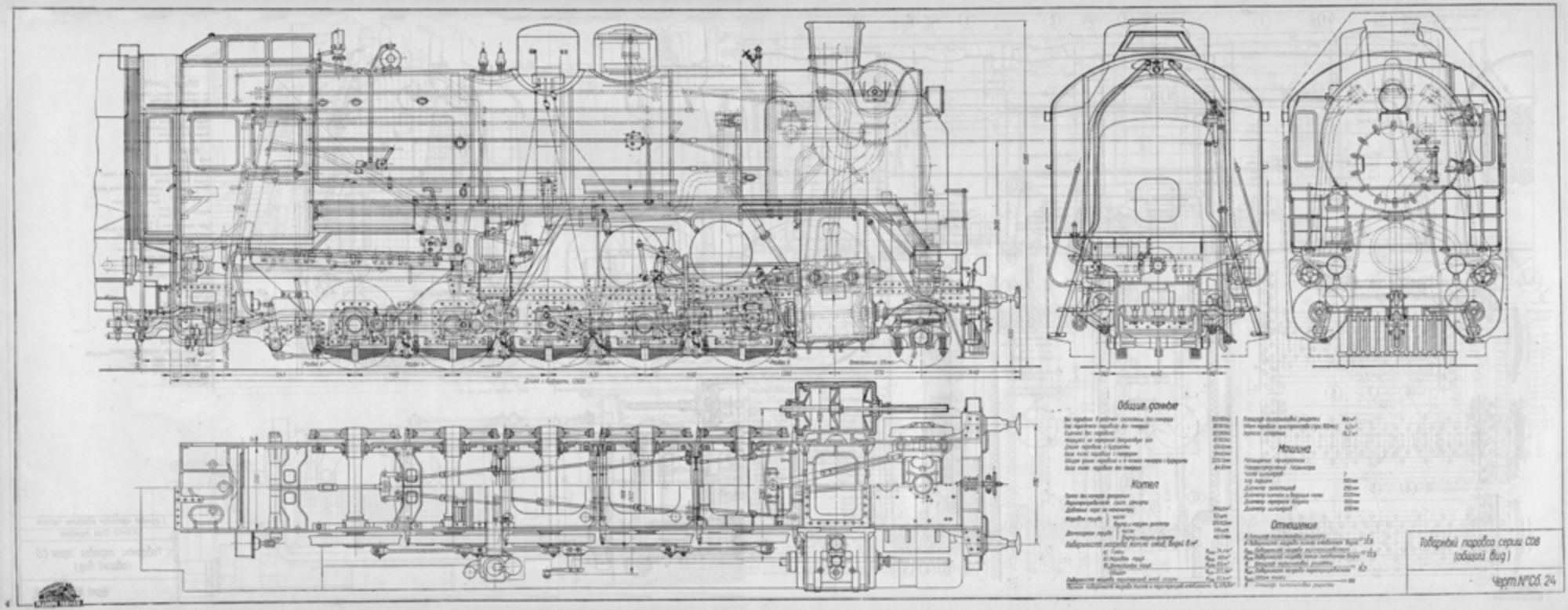
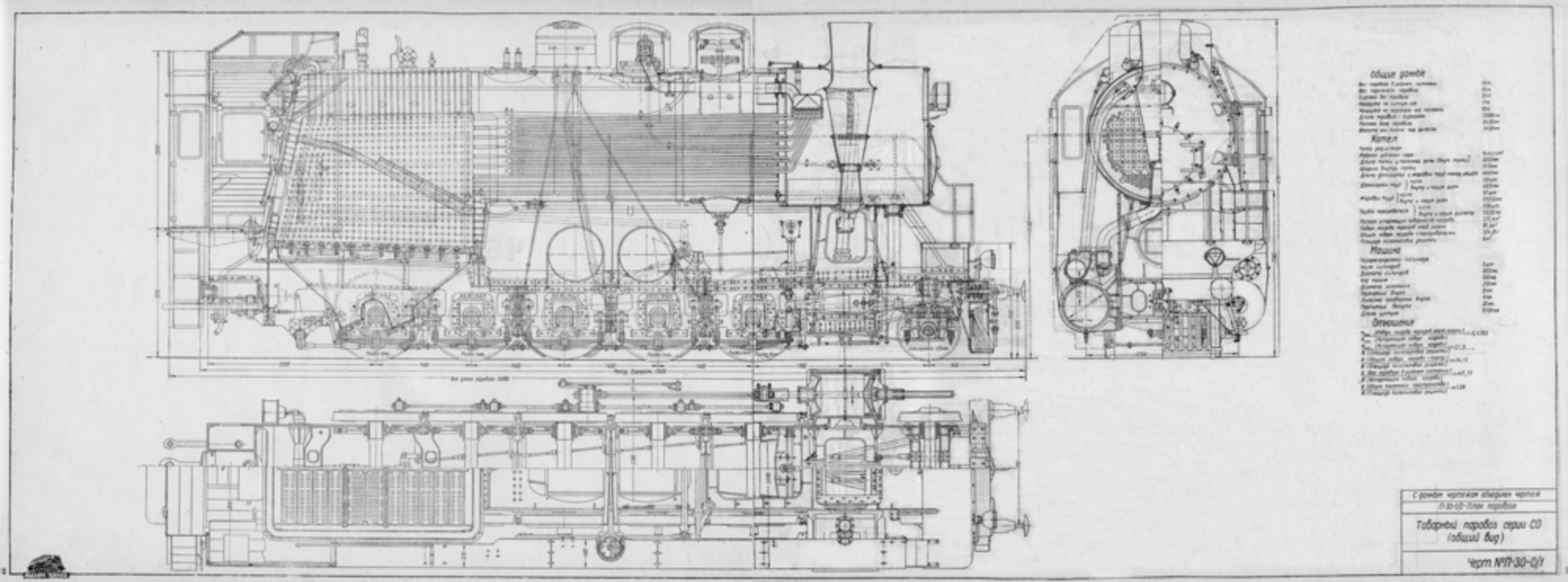
Drawings
and diagrams

History

Chronology

  1. 1936 Kharkiv and Bryansk plants began mass production of new SO19 steam locomotives.
  2. 1938 The SOМ17-1137 steam locomotive was built by the Kharkiv Locomotive Works with a steam condensation device under the designation SO19-1137.
  3. 1940 The SOМ17-1137 steam locomotive was transferred to the Kartaly Depot of the South Ural Railway, then to the Kazakhstan Depot, from where it was transferred to the Omsk Railway.
  4. 1955 The SOМ17-1137 steam locomotive was operated at the Salsk Depot of the North Caucasus Railway.
  5. 1958 The steam condensation devices were dismantled from the steam locomotive, and a mechanical stoker was installed. It was designated as SOM17-1137 class and was sent to the Kalinin Railway, where it operated at the Rzhev and Novosokolniki Depots.
  6. 1963 The SOМ17-1137 was placed in reserve and stationed at the Bologoye II base.
  7. 1989 The SOМ17-1137 was excluded from the Ministry of Railways inventory.
  8. 1991 The SOM17-1137 was delivered to the Leningrad-Finlyandsky Locomotive Depot for scrapping. The staff of the Central Museum of the Oktyabrskaya Railway successfully arranged the locomotive’s transfer to the museum.
  9. Till 2001 The steam locomotive was relocated to the museum site of the Shushary station.
  10. 2001–2016 The SOM17-1137 was on display at the museum at the former Varshavsky Station in Saint Petersburg.