Today the museum is open from 10:00 to 18:00

Map

Exhibit description

Diesel locomotive TGE-016

First MPS

With the transfer of maintenance and repair of railway tracks to the jurisdiction of track machine stations (MPS), their equipping with the appropriate equipment began. The first MPS was organized on the Moscow-Kursk Railway in 1934 and became an experimental base for the mechanization of track work on railways.

The transition to the widespread implementation of MPS began with the issuance of the order of the People's Commissar of Railways of the USSR dated April 1 1936 "On the organization of machine-track stations". In accordance with it, 50 machine-track stations were created on the railways. From two weeks to two months were allocated for the formation and inclusion of new enterprises and the creation of all 50 MPS.

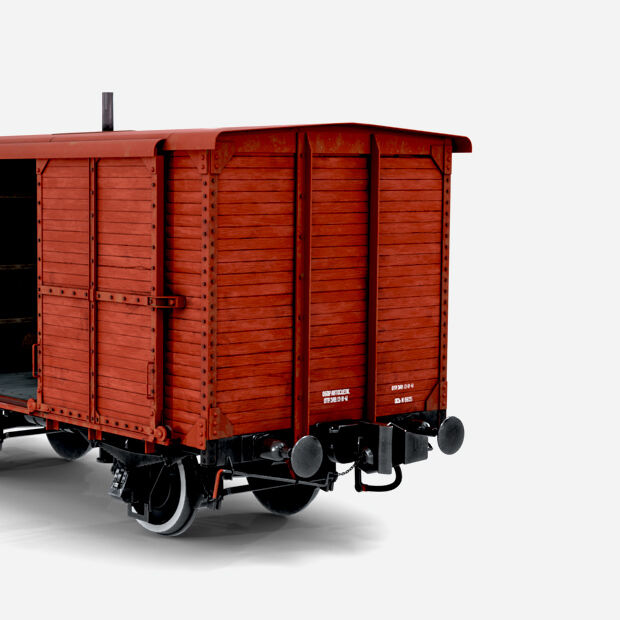
Each MPS was allocated wagons for the placement of equipment, workshops, materials and fuel, as well as 30-50 boxcars for the workers' accommodation. In addition, each MPS received the first track machines with a pneumatic drive (ballasters and planers), six to eight compressors, 60 sleeper tampers, motor jacks, Dolgov track-measuring trolleys, Matveyev's acceleration devices and other equipment. All MPS were provided with motor locomotives, tractors, mobile power plants and diesel units.

Process mechanisation

In 1946 the USSR completely restored the railways destroyed during the war. Technical documentation was developed in a short time, and production of new track layers began. The widespread use of track layers predetermined the flow method of work with a clear allocation of individual technological operations, accelerated the saturation of the track facilities with machines for the mechanization of specific production processes.

The new machines mostly already had electric drives and needed special locomotives for movement at "creeping" speeds of about 1–3 km/h and the ability to generate electricity to drive the mechanisms. In order to speed up the production of such locomotives as samples for a special assignment of the Ministry of Railways for shunting service and work with track and construction machines, three-axle diesel locomotives of the TGэ series were purchased from the Austrian company Ienbacher Werke in 1958–1959.

This is a special machine with three axles in a rigid frame and a cabin that is moved above the hoods for better visibility. Under the hood, on one side, they had a diesel engine, a cooling system and a compressor, on the other — an alternating current generator.

27 diesel locomotives were built, but this number may not be final. It is based on the highest known number of a diesel locomotive that worked at the Orenburg sleeper impregnation plant (the photograph is preserved in the archives). Diesel locomotive TGэ 016, presented in the museum, was purchased from the Omsk reinforced concrete plant.

The new machines mostly already had electric drives. They needed special locomotives for movement at "creeping" speeds of about 1-3 km / h and the ability to generate electricity to drive the mechanisms.

27 diesel locomotives were built. The number may be inaccurate: it was determined from a photograph of a locomotive with the highest known number. It worked at the Orenburg sleeper impregnation plant. The museum acquired the locomotive TGE-016 from the Omsk reinforced concrete plant.

Parameters

Technical
specifications

Wheel diameter, mm
950
Design speed, km/h
60
Diesel characteristic
V-shape, 12-cylinder, 2-stroke, no compressor
Service weight, t
48
Continuous mode tractive effort, kgf
22 000
Axle load on rail, t
16
Creeping mode speed, km/h
1-3
Shunting mode speed, km/h
10-30
Train mode speed, km/h
20-60
Transport speed, km/h
80
Creeping mode tractive effort, kgf
11 750-7 000
Shunting mode tractive effort, kgf
10 000-3 100
Train mode tractive effort, kgf
4 800-1 480
Min. curve radius, m
80
Product type
IW-600
Diesel characteristic
V-shape, 12-cylinder, 2-stroke, no compressor
Hydraulic transmission type
L24UKG
Reverse reduction gear type
SWV24
Reverse reduction gear ratio
3 078 train; 5,51 shunting
Generator type, power
FL326/23-4, 3-phase 300 kW
Axial gearbox drive ratio
5,25
Diesel power, hp
600
Transmission type
Hydraulic
Axial formula
3-axle

History

Chronology

  1. 1936 The transition to the widespread implementation of MPS (machine-track stations) began with the issuance of the order of April 1, 1936 "On the organization of machine-track stations". In accordance with it, 50 machine-track stations were created on the railways. Moreover, from two weeks to two months were allocated for the creation of all 50 MPS, the formation and inclusion of new enterprises. The order provided for the allocation of the required number of cars to each MPS to accommodate equipment, workshops, materials and fuel, as well as 30-50 boxcars for workers to live in. All MPS were provided with motor locomotives, motor transport, tractors, mobile power plants and diesel power plants.
  2. 1946 In 1946, the USSR completely restored the railways destroyed during the war. In a short time, technical documentation was developed and production of new track layers began. The widespread use of track layers predetermined the flow method of work with a clear allocation of individual technological operations. This also accelerated the saturation of the track facilities with machines for the mechanization of specific production processes.
  3. 1958–1959 In order to accelerate the independent production of such locomotives, three-axle diesel locomotives of the TGE series (a diesel locomotive with a hydraulic transmission and an electric generator) were purchased from the Austrian company "Jenbacher Werke" as samples in 1958-1959. This was done on a special assignment from the Ministry of Railways for the shunting service, as well as for work with track and construction machines.