Today the museum is closed

Map

Exhibit description

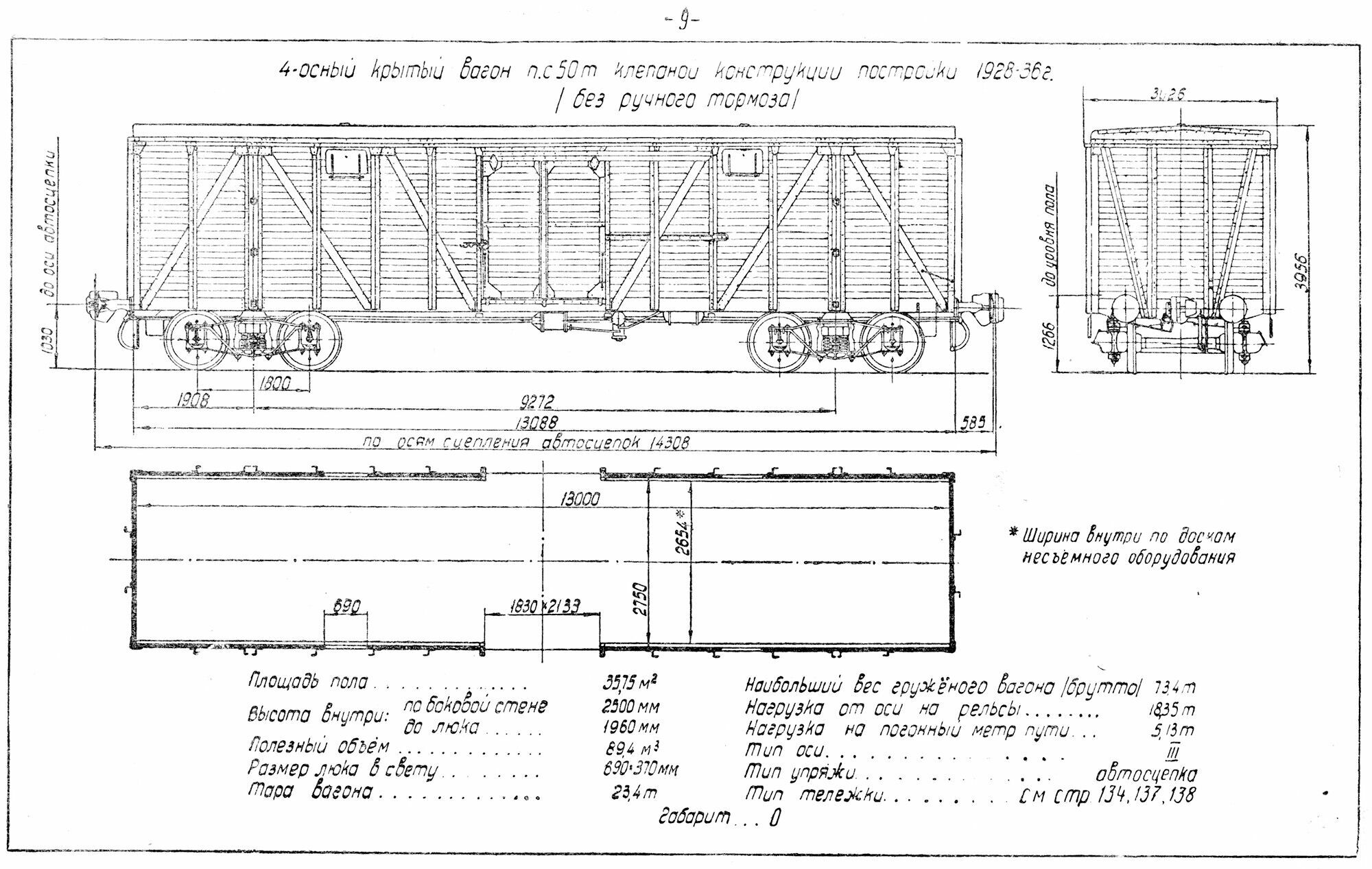
Covered freight car No. 704 349

During the period of the New Economic Policy (1921–1928) and the beginning of industrialisation, freight traffic in the USSR increased significantly. The need for the industry to adopt and mass produce high-capacity freight cars, which had already shown their advantages over two-axle cars, was clear. While the carrying capacity of two-axle covered wagons can be estimated at 16.5–20 t, four-axle covered wagons can carry 40–50  t.

The economic development and industrialisation of the USSR led to growth of freight traffic, and this necessitated the development of high-capacity cars.

Museum Exhibit

The Krasnoye Sormovo Plant as well as plants in Bryansk and Tver began experimental production of four-axle covered wagons of various designs in 1925. These experiments led to the start of mass production of covered wagons with a carrying capacity of 50 t based on drawings from the Bryansk Locomotive Works in 1928.

Parameters

Technical
specifications

Number of axes
4
Trolley type, mm
1800–1905
Floor area, m2
35,75
Height inside the wall from the floor, mm
2 600
Car base, mm
9 272
Frame length, mm
13 088
Tara, t
22,5
Load capacity, t
50
Maximum gross weight, t
62,5
Rail load, t
15,6
Installation of automatic coupler
Possible
Length by buffers, mm
14 278
Capacity, m3
89,375
External width, mm
3 026
Internal width, mm
2 750
Height to rail level, mm
3 956
Type of harness
United, strengthened

Drawings
and diagrams

History

Chronology

  1. 1925 The Krasnoye Sormovo Plant as well as plants in Bryansk and Tver begin experimental production of four-axle covered wagons of various designs.
  2. 1927 The Tver Carriage Works builds high-capacity covered wagon No. 704 349.
  3. 1928 Mass production of covered wagons with a carrying capacity of 50 t based on drawings from the Bryansk Locomotive Works begins.
  4. 1998 The car comes to the museum from the Vyborg Depot on the Oktyabrskaya Railway.